Pinetree Capital will undergo a change of control

A company that I used to write about in the past, Pinetree Capital (TSX: PNP), will finally be undergoing a change of control.

I own a small portion of their senior secured debentures (TSX: PNP.DB). This holding was much larger earlier in 2015, but they were mostly liquidated through redemptions throughout 2015. By virtue of the last redemption (which was partially paid out in equity) I also own a small amount of equity in Pinetree Capital that I have not bothered to selling yet as they were trading below my opinion of fair value.

I anticipated that the final liquidation of the public entity would be in the form of a constructive sale of its sizable ($500 million+) capital losses. Instead, it comes in the form of a rights offering. I’m not sure what the formal terminology of this is, but I would call it a passive takeover.

Pinetree will issue rights that are exercisable at 2.5 cents per share (which is about a penny, or nearly 1/3rd, below their existing market price). If no more than 40% of these rights are exercised, then a numbered corporation entity controlled by Peter Tolnai will exercise the remaining unexercised rights and take control of approximately 30-49.9% of the company. Tolnai also receives $250,000 for his efforts (probably paying for a lot of legal and advisory fees to structure the rights offering) (Update: Only $250k received if there was a superior offer, see the comments below).

Considering only 22 million shares (of approximately-then 200 million shares outstanding) were voted in their last annual general meeting, it would be a reasonable bet that investor appetite to purchase further shares in Pinetree will be most certainly less than 40% of the existing shareholders. A 30% stake in the company is akin to effective control. I have some fairly good guesses why Tolnai would not want more than 50% ownership of the company.

The rights will be traded on the TSX, but my analysis would determine the price would trade at bid/ask $0.005/$0.01 assuming the common shares are trading at bid/ask $0.03/$0.035. As a result, the rights would not be easy to liquidate after transaction charges and would probably remain relatively illiquid.

Peter Tolnai, judging by his website, feels like somebody I could relate to personally. My guess is that he is taking a strong minority stake in the company for the purposes of obtaining a functional, inexpensive, and public entity to raise capital and utilizing the rich reserves of capital losses to grow capital tax-free. I would deeply suspect he has a team in mind and will be raising capital after the April 22, 2016 special meeting that will authorize a (much needed) 100:1 reverse split.

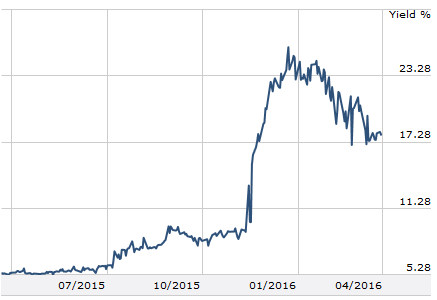
The net proceeds of the rights offering is to pay off the senior secured debentures, which mature on May 31, 2016. The amount outstanding on the debentures is not huge – $6.7 million principal plus six months’ interest (another $335,000). However, Pinetree has disclosed in its filings that if it is unable to raise money with these rights, they would have to liquidate its remaining privately held investments, implying it does not have anything liquid anymore.

Considering Pinetree Capital has not released any financial information since the end of their September 30, 2015 quarter, it remains to be seen what their current balance sheet situation looks like on the asset column. I’m guessing they sold off all of their liquid publicly traded securities in 2015 (the largest of which was PTK Technologies). Pinetree must release their audited financial statements for the year ended December 31, 2015 by the end of March.

Shareholders as of March 23, 2016 will receive the rights to buy at 2.5 cents per share (which means March 18, 2016 is the last day to purchase common shares if you wish to receive rights), but somehow I don’t think the market will be bidding up Pinetree common shares.

This leaves the last question of the valuation of the final entity, assuming the rights are exercised in full. With the senior secured debentures paid off, there is likely a non-zero value in the company, but a better snapshot can be obtained after the release of the year-end 2015 statements. Another question will be how Peter Tolnai’s team will plan on making capital gains and utilizing the huge tax assets left in Pinetree, but considering he will likely have a 30-49.9% stake in the company, his incentives are well geared towards the passive shareholder base.

Utilizing Pinetree’s capital losses is actually a problem that I would like to help him solve, to quote a line from his “Giving Back” section on his biography, if I was so privileged!

Re-examination of Yellow Media

I’ve written about Yellow Media (TSX: Y) extensively in the past on this site before their recapitalization.

I’ve been generally surprised at their financial performance – from 2014 to 2015, revenues dropped only 5% and while EBITDA margins have compressed (to around 31% from 36% before special items), the negative trajectory is flattening out rather than an accelerated drop. Notably they’ve been generating a ton of cash relative to their market capitalization – $73 million in 2014 and $122 million in 2015.

Balance sheet-wise, they are still leveraged. After their recapitalization, their senior secured debt holders receive a mandatory redemption payment of 75% of free cash flow. In 2015 they repaid about $100 million of debt and since the recapitalization (December 2012) the total has been $393 million, or nearly half the balance outstanding. It is probable that they will be able to redeem another $100 million in 2016 and by that point it should be evident they will be home free (in addition to paying less onerous financing charges).

They reserve the right to redeem more debt prior to May 31, 2017 for 105%, and afterwards at par value. Thus, it would make sense that the company would be aiming for June 1st for a refinancing of existing debt and a removal of the pesky covenants that have been restricting management’s ability to perform other functions with their capital.

The only other debt outstanding are unsecured debentures (TSX: YPG.DB) of which $107 million remain outstanding. These debentures have a coupon of 8% and mature on November 30, 2022 – quite a long-dated debenture. Only after the senior secured debentures are matured, these debentures can be called by the company at 110% of par anytime, or 100% after May 2021. The company can also choose to defer cash interest payments and accrue a 12% payment-in-kind provision but so far they have not exercised this route.

Another feature of these debentures is that they can be converted to Yellow common shares at $19.04 – which is barely above the existing market price of $18.95 on Friday’s close.

This creates an interesting valuation puzzle. Investors have functionally sold a call at 110% of par to the company contingent on the redemption of the senior secured debt, while they have an embedded call linked to the common share price.

In terms of business valuation, if Yellow Media’s revenue/EBITDA margin trajectory remains roughly what management projects (which amazingly to date has been generally the outcome), Yellow Media should be earning somewhere around $70 million in net income. This would work out to $2.50 per basic share outstanding (not accounting for dilution if the debentures convert). If there is a modest growth valuation assigned to the company, one can make a case that Yellow should be trading around $30/share and not the $19/share it is trading at presently.

This would place a valuation of about 150-160 cents on the dollar for the debentures, with relatively little downside from current market prices (the bid of 109 would go down to somewhere around par if the underlying business eroded faster than the current trajectory).

This also does not account for the time value of the at-the-money call option within the debentures – currently their warrants with a strike of $28.16 (nearly 50% above current market value) and an expiry of December 2022 trades at $4.13, so there is clearly time value in the call option.

The warrants are unattractive because break-even would be a common share price of $36/share (i.e. if you bought warrants at $4.13 vs. common shares at $18.96, you would do equally well with an investment if the common went up to $36/share at expiration – note your warrants would do significantly better if $36/share was reached prior to expiry).

While I am not interested in the common shares or warrants, I did buy a small amount of debentures near par in January with the expectation of holding onto them until they are likely redeemed (or if the common shares trade above $20.94, converted). They are a low risk, medium reward type investment. I will caution anybody wanting to trade them that you should be prepared for a very slow market and part of the reason why I have such a small holding is because of the relative market illiquidity.

What to do with profitable option positions

If you are in a fortunate situation where you bought out-of-the-money options and then the market moved favourably in your direction to the point where the value of the underlying is at your estimate of where it should be, what do you do with your existing option position? You would have made a small fortune and there are a few options:

1. Sell the option – you will probably pay a higher spread since it is in-the-money and will be receiving less time value;
2. Sell the common, and wait for the exercise – doing this will expose you to the downside below the strike price and also give up the time value of the option;
3. Sell the common, and exercise – doing this will give up the time value.

In most cases, the best option is #4: Sell an at-the-money option.

This maximizes the time value remaining in the option. There is still downside risk, but your in-the-money option’s time value will increase at it approaches the strike price, which acts as a weak hedge.

I generally do not play with options because they are incredibly inexpensive instruments to play with (mainly spreads, but they are also commission-heavy). The few times it makes sense is always when you are receiving good value for money – in the most recent case it was something trading at a far lower volatility than it should have combined with an obviously retail order on the ask that I just had to hit. The other instance was selling high-volatility puts in instances where things couldn’t get any lower. Sometimes those automated models do offer some free money when they do so without regard of the fundamentals of the underlying stock.

Genworth MI

It is quite obvious by trading action over the past month that some institution is accumulating shares of Genworth MI (TSX: MIC) and is sweeping up the supply that is being applied at existing prices. I loaded up in shares during the second half of January and bought a very small position in some out-of-the-money options (the Canadian options market is illiquid, high-spread, expensive to trade in and generally junky, but there was somebody on the ask that was not the market maker and at a reasonable price, I hit his ask). Genworth MI is once again the largest component in my portfolio.

It is difficult to understand how something trading at a greater than 1/3rd discount to tangible book value and giving a greater than 7% cash yield, and trading at a P/E of 8 can continue to trade so low unless if it can be explained by general paranoia (which exists on Canadian housing).

Insiders (as of February 22) have reported purchases of common shares of Genworth MI. They are not huge but it is something.

The reports of the Canadian housing market’s demise is clearly over-blown except in very narrow sectors that have traditionally had resource commodity concentration (looking at Fort McMurray as the prime example).

The underlying entity is incredibly profitable. The only real risk is whether the parent entity (NYSE: GNW) will sell Genworth MI out, which is a real possibility.

Such a sale, if done presently, would likely be done under book (CAD$36.82 presently). A sale at 10% under book ($33.14/share) would still be a 25-30% premium over current trading prices. The company’s P/E would still be 8 at this point and an acquisition would be instantly accretive to some other financial company.

This take-out price does not reflect my true value that the company should be trading at, which I would judge at least at book value. The Canadian economy, and thus residential mortgages servicing abilities, is not the most robust so the premium to book would be modest before I started to sell shares again. I also apply a general discount to majority-controlled entities, but suffice to say my target price is north of CAD$36.28.

Genworth Financial’s issues I do not want to get into in depth, but they have a pending May 22, 2018 debt maturity (bonds are trading at 87 cents on the dollar at the moment) and a series of maturities 2 years later (June 15, 2020, trading at 68 cents) that the market is getting panicky about. This may cause them to sell out their equity holdings in the mortgage insurance firms they have taken public (Canada and Australia), but it is a decision I do not think they would want to make lightly.

Financial crisis #2

The perverted effects of having a negative yield curve is finally hitting the financial markets. In particular, this is hitting the banking sector in Europe, but there is also spill-over effect in the USA as well – I had previously written about Bank of America, but this is also affecting other financial institutions.

However, I do have a general rule and that is whenever it hits the headlines of mainstream publications, it is likely closer to the 9th inning of the ballgame rather than the beginning.

I observe on the Drudge Report, which is usually ahead on things:

drudge

Once news like this starts getting on the covers of the various US magazines and such, then it is likely over.

Canadian publications are also picking up on the fact that the government bond yield curve is flat-to-inverting:

Target overnight rate: 0.5%
1 month: 0.43%
1 year: 0.42%
2 years: 0.35%
3 years: 0.35%
5 years: 0.48%
7 years: 0.79%
10 years: 1.01%

The half-point spread is a very pessimistic for the Canadian economy – people are willing to pay dearly for safety at the moment.

With government bond yields so low, investors must look elsewhere to obtain yield. This leads institutions into the wonderful world of corporate debt, and you can ask how the big 5 Canadian Banks (Royal, Scotia, CIBC, TD and BMO) are doing with all of their secured credit lines they’ve given to a lot of the oil and gas industry, in addition to their mortgage portfolios.

The Bank of Canada must be watching the sector like a hawk right now because if there is a cascade of confidence loss, things will get very ugly and very quickly. Conversely if this crisis starts to fade away, investors will be handsomely rewarded for taking the risk right now.

In the meantime, enjoy the volatility. The environment right now is once again reminding me of something like mid-2008 when everything is all panicky. Bargains that have good potential for double-digit appreciation are hitting the radar in huge frequency.