Relative debt pricing – Yield and Quality

Noticed that AON Corporation (NYSE: AON), which is a financially stable and large insurance broker, issued some debt to fund a $1.5 billion dollar takeover of another corporation:

Of these notes, $600 million will mature on September 30, 2015 and bear interest at a fixed annual rate of 3.50 percent; $600 million will mature on September 30, 2020 and bear interest at a fixed annual rate of 5.00 percent; and $300 million will mature on September 30, 2040 and bear interest at a fixed annual rate of 6.25 percent. The offering is expected to close on September 10, 2010.

They have a convenient 5-year, 10-year and 30-year maturity, which compared to the US treasury bond is a spread of 2.05%, 2.35% and 2.52%, respectively compared to the closing quotes in September 8, 2010. AON is receiving very cheap debt financing, and the bonds were rated BBB+, although one can see by a quick look at AON’s financial statements that despite the takeover (which is roughly a $5 billion purchase, half cash, half stock that dilutes shareholders by about 20%) they should still be generating sufficient cash to pay off the debt.

So let’s pretend you are owning some 30-year corporate debt in a less solvent entity (e.g. QWest) and have a yield to maturity of 7.5% on a similar bond. Do you trade 1.25% of yield in exchange for higher credit quality? Or do you think the macro environment (e.g. the risk-free rate) will turn hostile to long bond yields and both assets will depreciate? Very difficult to say.

Bonds are trading high

When markets move in a direction, the trend typically goes longer than most people otherwise anticipate. The Vancouver Real Estate market is a great example, or I could just be completely wrong and not realize there is some fundamental underpinnings that I am unaware of.

I believe this lasting momentum is the case for the bond market – today, I continue to unload at a pace of a trickle some of my slightly-better-than-junk debt (long-dated maturities) because the quotations just keep going higher.

Fortunately, some of it is sheltered in a registered account so I can defer the tax hit for a future time, but some of it is in the non-registered account. There is a tax timing problem in that I ideally would want to carry forward gains into the 2011 tax year, but it is better to take the bird in hand, rather than waiting 4 months. The taxes have to be paid eventually, but I’d rather want to pay them in April 2012 than April 2011.

Chances are in four months the bond party will still be going strong (especially when people dump their annual RSP contributions into the hottest bond fund they can find), but as a bond investor, I am getting very concerned as to the macro movement toward fixed income products and accordingly am continuing to leak my positions to the market as quotations go higher.

My cash balance continues to rise in the portfolio. It is at a higher level (in absolute but not percent terms) than at the end of 2008!

Clearwater Seafoods facing debt crunch

Clearwater Seafoods Income Fund (TSX: CLR-UN.TO) is a financially distressed entity. The fund has an equity interest in a limited partnership. The limited partnership is the operating business that sells seafood. The units are trading at around 80 cents, with a market capitalization of about $23 million. The trust has stopped paying distributions since 2007 and is not likely to pay distributions for a long, long time.

Whenever investing in an income trust, they typically have more complicated ownership structures than corporations. You can usually get a summary of the structure in the first few pages of the annual information form. I have extracted a diagram which illustrates the relationship between the fund and the operating entity:

Whenever I see something like this, I think negatively since usually such structures exist to give certain (usually founding) entities control over the operating assets, but to distribute the economic interests to other parties that is not in proportion to voting interests. In this case, the unitholders of Clearwater Seafoods Income Fund are simply there for the ride by virtue of having a 54% voting interest in a very indirect say as to what goes on at the operating level. As a result, an investor would need extra compensation (i.e. higher reward) for the extra risk that they are taking (the risk that their interests are not going to be in alignment with the people holding the puppet strings).

Clearwater also has a debt problem – as of June 30, 2010 the operating entity has about $218 million in debt outstanding, and of this debt, the trust has lent the operating entity $45 million in exchange for partnership units (they have also done this in other instances with different terms and maturity dates). This loan matures in December 31, 2010. The operating entity also does not generate enough cash, nor are there other assets readily available to pay off the debt. As a result, the company will have to find external financing or find some method to recapitalize the debt.

There is also another $11.3 million loan that is due in September 2010.

In the management discussion and analysis, we have the following paragraph:

In December 2010 Clearwater Seafoods Income Fund has $45 million of convertible debentures that come due. These funds were invested by the Fund in Class C Units issued by Clearwater with similar terms and conditions, including maturity in December 2010. Clearwater also has approximately 1.3 billion in ISK denominated bonds, including CPI and accrued interest that come due in September 2010 (approximately Canadian $11.3 million at July 3, 2010). Clearwater is currently investigating refinancing alternatives and plans to refinance both before the respective maturity dates.

When we look at the market for the $45 million debenture, we see it is trading at 88.5 cents on the dollar. So the market is heavily betting that the debt will be refinanced at relatively favourable terms to debt investors. Recapitalization, however, appears to be out of the question since it would require relinquishing control to the debtholders and the current market value of the units is far too low to make a direct conversion worthwhile. Going into bankruptcy protection might occur if the debtholders and trustees cannot come to a mutually equitable arrangement.

Given the lackluster cash flow from operations, the complexity of the trust and underlying operating entities, and obvious credit risk, I will be watching this one purely from the sidelines to see how this mess gets resolved. My cursory look at the situation would suggest that the debt and equity are both overvalued.

Week ends with some bond selling

The 30-year US treasury bond had a significant sell-off over the past few days.  It will be interesting to see whether this is a start of a larger sell-off in the autumn, or whether this is just a simple profit-taking exercise:

I had another trade execution in an issue, but probably the most frustrating thing on the planet is when you have your order in, the price gets touched, and you get a fill in for 100 shares and then the market backs away from your price. It is more annoying that this happens than if the order was never touched at all. Hopefully the market will be a little more generous next week.

More market silliness in the Trust Preferred marketplace

Looking at the whole exchange-traded bond market, there is nothing ordinary going on – some up, some down, most of them less than a percentage point. It looks like a typical slow end of summer day – and indeed, this week no significant decisions will be made since a lot of decision-makers out there, including the President of the United States, are on holiday.

However, there is one significant blip on my radar, and considering up until today, I held onto them, was a trust preferred issue which is backed by March 2033 senior debt of Limited Brands, trading as NYSE: PZB. Already (at 12:30 Pacific, or 30 minutes to closing), 60,000 units have been traded, the highest volume day since July 8, 2009 (which was an unremarkable day).

Unlike back in July, today there was a clear and pronounced price increase, up 5.9% to 22.5 (90 cents to par value).

Why the price spike? I am not sure, but I suspect the trust preferred made it onto some newsletter or recommendation list.

Unlike the underlying debt which has a 6.95% coupon, PZB has a 6.7% coupon, which means it should trade below the bond price (which is currently 91 cents on TRACE). At 90 cents on the dollar, an investor in PZB would receive a 7.44% current yield, with a 0.47% implied capital gain if held and redeemed at maturity 22.5 years from now. An investor in the 6.95% senior bonds at 91 cents would receive a current yield of 7.64%, and an implied capital gain of 0.42% at maturity.

In my efforts to reduce duration and long-term corporate debt exposure, I have expunged my small position in PZB. It is a difficult decision, knowing that you are trading something with a decent and relatively secure yield for something that is giving you nearly nothing (cash interest), but keeping liquid is the name of the game – you will have ammunition to strike when the real opportunities start arising, whenever it may be. Having the discipline to holding onto substantial portions of cash is a crucial skill to survive in the markets.

Is that it for the rise in long term bonds?

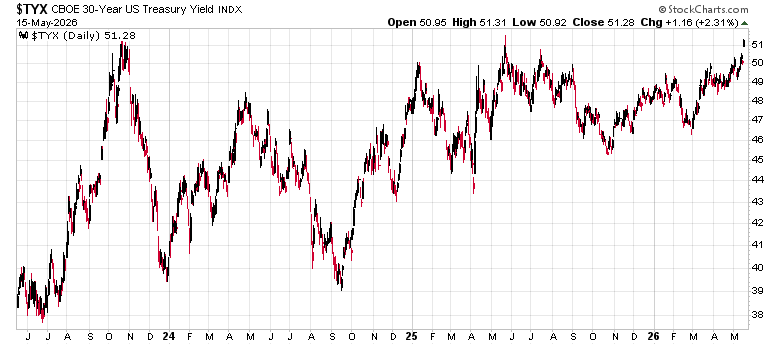
Attached is a chart of the 30-year treasury bond yield, and please observe that lower yields mean higher bond prices:

There are probably a lot of speculators out there with long positions in the bond, wanting to take profits. There are probably a lot of speculators out there with long positions that want to see even greater amounts of profits.

Ben Bernanke’s statements today was obviously a catalyst for the downward price movement in bonds. When reading the speech, I generally do not take the media’s perception that he was saying anything new with respect to inflation or any future use of monetary policy. I am forced to conclude that this was a technical correction of expectations rather than any reaction to pricing in future policy decisions from the Federal Reserve.

Traders that have used increases in bond yields to add to their long positions have profited handsomely over the past 4 months; will it be the case here? Time will tell. Every technical analyst out there will point out the slope implied by the chart, and see that the y-intercept at the right hand side of the chart is around 4.0%. The question is whether the market will take it there or not.

This has always been one of my big beefs about technical analysis – its ability to predict the future is not good, it is always in retrospect you can construct these “trends”, “resistances” and “support” levels. Does four months of downward yields mean the next four months will be the same? What about two months of data? Or six? What would signal a trend reversal? One month of rising yields? Two? Two days of trading? Again, it is always much easier to answer these questions in retrospect, which is why I do not have a lot of respect for technical analysts, although there is some value in the process because other people think there is value in it.

Finally, if long bond yields are truly rising again, it should affect the corporate long term debt market. I am continuing to liquidate my long term corporate debt positions and there are some other issues in my portfolio that are tantalizingly and/or frustratingly close to liquidation prices. Hopefully there will be a flood of retailers that will be bidding up these products for one final push before they collapse again in price.

Looking at the government bond market

Every analyst that is actively tracking the market is acutely aware that the US government bond (and this also applies to Canadian government bond) yields have been dropping dramatically over the past couple months. Here is a chart of the 10-year US Treasury note yield over the past two years (the y-axis is the percent yield times 10):

What do we see?

People that loaded up on government debt four months ago are laughing right now since they have a significant profit. But should they liquidate? What is the market anticipating? (Just as a side note, I don’t apply my “August trading is not to be taken seriously” stance on the government bond market.)

Typically institutions invest in bonds if they anticipate deflation (as having a fixed income yield in a deflationary situation is ideal) or if there is a “flight to safety” or some incident that spooks the market – such as a global economic crisis that occurred in late 2008/early 2009. Bond yields went as low as around 2.0% at that point in time.

But where is the global economic crisis today? It is obvious the market is trying to say something is going to happen, and I believe the bet is on some sort of deflation.

Even though I believe the next “swing” in monetary trends will be an inflation, this will only happen when the vast quantity of money supply out there is unleashed into the economy – right now those reserves are being held by banks that are very resistant to lending them because of credit concerns. They don’t want a repeat of late 2008, so they are buffering themselves. The catalyst to lending will be confidence in the marketplace, and right now is the most business-unfriendly administration the US has ever seen in a long, long time. Until this administration is gone and replaced by a pro-business administration, investors will not have the confidence. However, that will be the catalyst for inflation.

So until then, we might be seeing a deflationary dip as government stimulus slows down and the economy comes grinding to a halt. I don’t think we will be entering into a “new depression” by any means, but economic growth is going to be slow.

What are the implications?

1. Federal funds rates will be kept at zero for a long time. December 2011 futures are trading at 0.45%. In Canada, I would expect one more rate increase of 0.25% to 1.00% in September, and that is it for now.

2. People will struggle to find yield at an acceptable price. You can’t invest in the short-end of the rate curve, since this yields almost nothing (two-year government bonds give you less than 0.5%!). This already has been happening, especially since the last four months. Gold is also popular, which is counter-intuitive since assets decline in deflationary situations – I believe the mentality is that “bond rates are low, Gold will return nothing, but it will retain its value since it is a de facto quasi-currency.” Other commodities, such as oil, copper, etc., should depreciate unless if they also have a quasi-currency perception by the marketplace. Note that America’s economy used to dominate the commodity market, but with emerging markets (e.g. China, India, Brazil in particular) taking a higher proportion of commodities, the linkage might change somewhat.

3. Companies with debt will find financing a little tricky if they are too leveraged – low interest rates are “good” since they will be able to pay less interest on debt, but this is assuming they get extended credit since their cash-generation ability will be compromised by the deflation itself.

4. In a deflationary situation, zero-yield cash also has a positive return at the rate of the deflation itself. Any savings banks that give a positive yield (e.g. Ally at 2%) is “gravy” on top.

How low will the 10-year note yield go? I have no idea. However, at current yields, 2.6% looks very pricey compared to other alternatives that are available. It takes a very brave person to be shorting these products since it is very well believable that you could see even lower yields.

I do know when this paradigm changes to the inflationary cycle that it will be very quick – like a flash forest fire.

Equal Energy – Debentures

Equal Energy – Equity (TSX: EQU) is trading relatively high (roughly a market cap of $160 million) and the balance sheet is strong for a small oil and gas producer by virtue of recently doing some equity fundraising and asset disposals. They still have a net debt position but it is easily buffered by cash flows from operations.

Their CFO did resign today over a compensation dispute – a yellow flag, but the market did not appear to be too concerned about this. I do not believe this will compromise their ability to pay off their debentures.

They have two series of debentures outstanding, including EQU.DB – $80 million outstanding, matures on December 31, 2011, pays an 8% coupon. Perhaps more importantly, they are callable presently at 105 and 102.5 after January 1, 2011 with 30-60 days of notice. Current market price at the ask is about 102, although if you floated a bid at 101.75, you would likely get hit. The following assumes a purchase at 102.

It is a respectably high probability event that they will refinance debt and call out their existing debt on January 1, 2011 for 102.5. If so, this represents an annualized gain of 9.1% – approximately 7.8% of that is a cash yield and a 1.2% premium for being called out between now and January 1, 2011. If not called out, then assuming you hold onto maturity for the final year, the gain would be 6.4% – approximately a 7.8% current yield and -1.4% capital loss.

Putting this into raw numbers, $100 invested today would give you $103.57 on January 1, 2011 assuming a call-out as anticipated. If not, $100 invested today would give you $109.12 on December 31, 2011 assuming maturity at par. None of this includes commissions and assumes a purchase at 102.

Considering that your risk-free yield at 4 months and 16 months is roughly 2% in a cash account, parking your capital in a manner such as this is a relatively low-risk, low-reward alternative that can give you more yield.

Feeling brave? Invest in Greece

The National Bank of Greece has an issue of preferred shares which trades on the NYSE that gives out $2.25/year in quarterly payments. Right now they are trading at an implied yield of 12.8%, assuming they actually pay. They are non-cumulative, and callable @ $25 in 2013, but this seems to be unlikely at the moment.

Yield chasers might note that if the crisis continues to worsen, 12.8% might go significantly higher, so market timing is a critical element in picking it off.

I won’t be touching these securities, I have a strict rule against investing outside my depth, and certainly the internal political situation and the dynamics of the Greek banking sector are far from my field of expertise.

Fixed income and rising interest rates

The public perception is that the value of fixed income securities goes down when interest rates rise.

In a sense, this is true, but how it get reflected in the marketplace is different than what the common “retail” perception is. A better way of phrasing this is that the value of fixed income securities go lower when the there is a perception of interest rates rising.

Even though the whole planet knows that the Bank of Canada overnight rate target is 0.25%, the whole world also knows that this will increase by an amount coming June. This expectation has already been baked into the marketplace, and thus in most circumstances it should be baked into the prices of fixed income securities.

Reading the comments on some Garth Turner articles, where Turner is generally pushing preferred shares over GICs, readers are giving “blowback” stating that the price of those securities will drop when rates rise.

In the eyes of the marketplace, rates are going to rise. You can see this in the 5-year Canadian bond rate.

The question is whether the market prices for preferred securities is going to reflect this or not. In any market, you have to ask yourself about the participants, and a lot of preferred issues are dominated by retail traders. In this event, and assuming retail traders think prices are going to go down because of a flawed notion of a price impact with a rate increase, it would suggest there is a dislocation of information that can be exploited.

Preferred shares require a bit extra research than standard equities or bonds simply because they contain varying provisions which gives the holders and company certain rights that have dramatic effects on their risk profile.

Also, the intent of owning preferred shares is to provide income, rather than capital appreciation and this should always be taken into consideration – it is an alternative to putting money in a savings account, rather than a replacement for an equity (growth) component of a portfolio.