Uranium One now majority controlled

Uranium One’s shareholders voted convincingly in favour of the takeover of a majority stake in the corporation by a Russian “crown” corporation SC Atomredmetzolo (“ARMZ”) with approximately 91.99% of non-ARMZ shareholders in favour of the transaction.

The salient terms of the agreement is that ARMZ will take a 51% majority stake, and pay the rest of the shareholders $1.06/share in a cash dividend. Shareholders, assuming they haven’t already sold at market value, will be in for the ride and will have to make sure that their interests are in alignment with the majority ownership.

This is almost the reverse case of Magna International, where the Stronach family is being paid a considerable sum by the corporation to relinquish its controlling stake.

Investors should always be very cautious in making sure whenever they invest in companies that have majority or near-controlling ownership stakes that their interests are in alignment with the large shareholders. While a majority stake is not necessarily an exclusion criterion to considering a potential investment, it does raise the bar considerably higher. I tend to have a high aversion to majority or near-majority controlled domestic corporations as they can abuse minority shareholders.

The debenture holders, however, should be looking good – Uranium One has a December 31, 2011 issue that has a 4.25% coupon that is a very probability candidate for maturity at par; between the bid and ask, it is trading at 98.5 cents. Once you factor in capital gains, it is a relatively low risk 5% return on investment. Uranium One has another outstanding debenture issue that matures in March 2015 and this one is muddied by the fact that the conversion privilege (at $4/share) is close to the common stock price – this issue is trading at around 105 cents.

It is not likely that the 1.3 years between now and December 31, 2011 will pose much of a credit risk for the initial debenture issue – the corporation is likely to refinance this debt. However, the 2015 debenture has more embedded risk simply due to the time between now and the March 2015 maturity – you never know how much of the company assets will get stripped out. The worst case scenario is that ARMZ will try to to repatriate the assets (mainly agreements to mine and sell Uranium, mostly from Kazakhstan) of Uranium One into some other corporation controlled by ARMZ. You then don’t have to worry about the bankruptcy of a Canadian corporation once the assets have been stripped out of it, and debenture holders and shareholders alike would be left with nothing. It is unlikely this scenario will happen by 2011, but by 2015 it becomes somewhat more likely.

Suffice to say, I won’t be touching the equity or debt of this corporation.

Canadian Interest Rate Projections – August 31

Looking at Banker’s Acceptance Futures, we have the following rates:

Month / Strike Bid Price Ask Price Settl. Price Net Change Vol.
+ 10 SE 98.915 98.930 98.925 0.000 16053
+ 10 OC 0.000 0.000 98.830 0.000 0
+ 10 NO 0.000 0.000 98.820 0.000 0
+ 10 DE 98.890 98.900 98.900 0.000 27314
+ 11 MR 98.820 98.830 98.830 0.000 25451
+ 11 JN 98.740 98.750 98.750 -0.010 8618
+ 11 SE 98.600 98.620 98.610 0.010 1774
+ 11 DE 98.480 98.520 98.490 0.020 1197
+ 12 MR 98.360 98.440 98.370 0.060 386

It looks like that there will be a higher than 50/50 probability that the Bank of Canada will raise their overnight target rate by 0.25% in their September meeting, but after that, future rates in the 2011 calendar year are projected to go up by 0.25% to 0.5%.

The drop in increase expectations has likely contributed to depreciation of the Canadian currency – currently at 94 cents US to a Canadian dollar, while this was high as 98 cents earlier in August, and at parity back in April.  During the depths of the economic crisis, the Canadian dollar reached 78 cents multiple times throughout the October 2008 to March 2009 period.

Deflation before inflation – What to do in a deflationary environment

The bond market is pricing in an upcoming deflation. Canadian 10-year benchmark yields are at around 2.8%, which is quite close to the all-time low of 2.55% reached during the pits of the economic crisis in early 2009. Although I stated previously that the next economic cycle will be inflationary, it will only be after certain conditions have been achieved – mainly the willingness of companies and consumers to spend money. Until then (which could be years away), we will not see inflation.

If this is true, then cash is likely to be a good performing asset class, if not the best asset class.

Cash is also the least “sexiest” of asset classes. It is boring. Just imagine trying to tell your colleagues that your investment portfolio is packed full of Canadian dollars. It provides a very low return (about 2%), and no possibility of appreciation. It is ironic that it might be a good asset class by virtue of other asset classes having negative returns.

Investors of government bonds will also be profiting in a deflationary environment because the government will be guaranteeing the payment of the principal – longer durations will result in larger capital gains as yields go down.

Corporate debt and other fixed income securities will fare less well simply because in deflationary environments it becomes more difficult for companies to generate cash. Debt-issuing companies will have to repay debt in nominal dollars that will have higher real value – hence, credit risk becomes a more predominant concern of the pricing of the corporate debt. For companies that have good solvency ratios (e.g. debt-to-equity and/or debt-to-free cash flows are very good), then this becomes less of a concern and corporate debt will then appreciate. But junk debt issues or corporations that are inflation-sensitive (i.e. can’t charge as much to your customers) will not be a safe haven in such an environment.

Deflation really messes with economic intuition and if market participants cannot adapt to it, there will be inefficient pricing in the markets to take advantage of if it does materialize. It would be a virtual guarantee that the Canadian real estate market would get hit badly in an economic deflation, as the prospect of paying off higher-valued debt in the future would crush prices and trump even the low interest rates that would be offered to credit-worthy customers.

More market silliness in the Trust Preferred marketplace

Looking at the whole exchange-traded bond market, there is nothing ordinary going on – some up, some down, most of them less than a percentage point. It looks like a typical slow end of summer day – and indeed, this week no significant decisions will be made since a lot of decision-makers out there, including the President of the United States, are on holiday.

However, there is one significant blip on my radar, and considering up until today, I held onto them, was a trust preferred issue which is backed by March 2033 senior debt of Limited Brands, trading as NYSE: PZB. Already (at 12:30 Pacific, or 30 minutes to closing), 60,000 units have been traded, the highest volume day since July 8, 2009 (which was an unremarkable day).

Unlike back in July, today there was a clear and pronounced price increase, up 5.9% to 22.5 (90 cents to par value).

Why the price spike? I am not sure, but I suspect the trust preferred made it onto some newsletter or recommendation list.

Unlike the underlying debt which has a 6.95% coupon, PZB has a 6.7% coupon, which means it should trade below the bond price (which is currently 91 cents on TRACE). At 90 cents on the dollar, an investor in PZB would receive a 7.44% current yield, with a 0.47% implied capital gain if held and redeemed at maturity 22.5 years from now. An investor in the 6.95% senior bonds at 91 cents would receive a current yield of 7.64%, and an implied capital gain of 0.42% at maturity.

In my efforts to reduce duration and long-term corporate debt exposure, I have expunged my small position in PZB. It is a difficult decision, knowing that you are trading something with a decent and relatively secure yield for something that is giving you nearly nothing (cash interest), but keeping liquid is the name of the game – you will have ammunition to strike when the real opportunities start arising, whenever it may be. Having the discipline to holding onto substantial portions of cash is a crucial skill to survive in the markets.

Is that it for the rise in long term bonds?

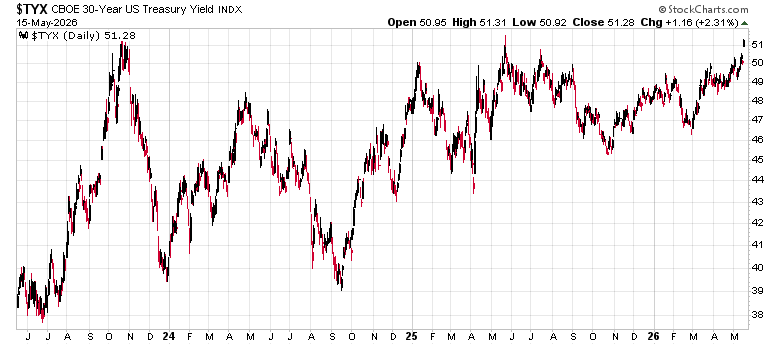
Attached is a chart of the 30-year treasury bond yield, and please observe that lower yields mean higher bond prices:

There are probably a lot of speculators out there with long positions in the bond, wanting to take profits. There are probably a lot of speculators out there with long positions that want to see even greater amounts of profits.

Ben Bernanke’s statements today was obviously a catalyst for the downward price movement in bonds. When reading the speech, I generally do not take the media’s perception that he was saying anything new with respect to inflation or any future use of monetary policy. I am forced to conclude that this was a technical correction of expectations rather than any reaction to pricing in future policy decisions from the Federal Reserve.

Traders that have used increases in bond yields to add to their long positions have profited handsomely over the past 4 months; will it be the case here? Time will tell. Every technical analyst out there will point out the slope implied by the chart, and see that the y-intercept at the right hand side of the chart is around 4.0%. The question is whether the market will take it there or not.

This has always been one of my big beefs about technical analysis – its ability to predict the future is not good, it is always in retrospect you can construct these “trends”, “resistances” and “support” levels. Does four months of downward yields mean the next four months will be the same? What about two months of data? Or six? What would signal a trend reversal? One month of rising yields? Two? Two days of trading? Again, it is always much easier to answer these questions in retrospect, which is why I do not have a lot of respect for technical analysts, although there is some value in the process because other people think there is value in it.

Finally, if long bond yields are truly rising again, it should affect the corporate long term debt market. I am continuing to liquidate my long term corporate debt positions and there are some other issues in my portfolio that are tantalizingly and/or frustratingly close to liquidation prices. Hopefully there will be a flood of retailers that will be bidding up these products for one final push before they collapse again in price.

A basic guide on how to do Canadian equity research

Whenever I hear of a publicly traded company, I follow a fairly standard methodology to do some basic research on the firm.

In a perfect world, you try to do research before looking at the share price of the company. The whole idea of the research methodology is to pin down a valuation for the equity (or in some cases, debt) and seeing a stock price contaminates what should be an unbiased analysis. You want to come up with your own valuation, rather than looking at the market’s valuation and then thinking of ways to rationalize the stock price. Unfortunately 9 times out of 10, the first thing I do is pull up the stock quote. I’ve been trying to train myself to no longer do this, but it is really, really difficult to not see a quote attached to an article.

Once I am ready to research, I pull off these documents from SEDAR in this order:

1. If the “nearest” financial report is an interim statement, I pull down the interim financial statements and MD&A document and read them. Doing analysis on this alone is time-consuming, and you look for tidbits in the statement, get an idea of how the company is capitalized and look at the cash situation. If the “nearest” report is an annual one, I read that and the MD&A.

2. Then I read the management information circular, and look at executive compensation scheme, insider ownership, and executive biographies and get a “feel” for who is running the firm, and who is on the board.

Usually by this point, you can come up with a ballpark number and then it becomes irresistible to look at the share price and hence valuation. Which then leaves:

3. Pulling up the stock chart, and then looking at any significant price moves, and then connecting those price moves to various news releases of the company;

4. Reading every news release of the company over the past X years, chronologically, and then looking at the reaction of the stock to what is significant news;

5. Reading the latest annual report (not the glossy version, the dry financial version) with its MD&A, and/or the Annual Information Form, which is also a good document that has information that is not contained in the interim statements;

6. Insider trading is available on SEDI and can influence a decision. While insider selling is not necessarily a negative signal, whenever you see insider buying it gets your attention much more.

7. The company’s website.

Usually by this point you spent many hours of reading and synthesizing information, and should have a pretty good idea as to what makes the company “tick”. Then the next step is to have a sector-wide comprehension and start investigating competitors, and firms up and down the supply chain to get a feel for the economic variables at stake. This is a never-ending process and eventually at some point you cut it off and then make a buy/sell/leave alone decision.

Learning to prune investment candidates at stage #2 is a very good skill to have – I usually set price triggers on those companies, and when the triggers are hit, I get an email and this triggers me to take a second look at the company to see if anything has changed. In the second half of 2008, so many companies were triggering low price alerts that I had a very, very difficult time keeping up with what was literally an avalanche of securities. I probably could have performed better in 2008 had I had more time to look at all the securities that were flashing at me.

Today, there is hardly anything that triggers my low price alerts, so I am using different screens to put some companies on the research queue.

Cursory scan of mortgage markets

As 5 and 10-year yields plunge, they have had a corresponding impact on mortgage interest rates.

The best variable rates I can find are prime minus 0.75% for a 3-year variable mortgage, or prime minus 0.7% for a 5-year variable mortgage. Prime currently is 2.75%. This is still the dirt-cheap option and is preferential compared to the best available 5-year fixed rate, which is currently 3.75%.

Assuming the Bank of Canada raises rates 0.25% this September (which is not a certainty, but is a likely action) then the break-even proposition, in terms of net interest paid over a 5-year fixed period, is quite unlikely. An example of a breakeven calculation would be, on a 25-year amortization mortgage, a 0.25% rate increase every half-year in order for the 5-year fixed rate to be breakeven with the variable rate. This would correspond with a 2.5% rate increase over 5 years which seems to be unlikely given that the futures currently indicate that rates will go up by about 0.69% over the next 2.75 years.

That said, the current interest rates are historically low, and interest rates are not very predictable – it sometimes feels like one is reading tea leaves in order to get glimpses of the economic future.

As there is a real estate implication to mortgage rates, it should be noted that even though the USA has record low financing rates for mortgages, it is not sparking their real estate market.

General Market Commentary

Very little going on in the day-to-day action in the marketplace, hence very little to write about. If there was a story to write about, it would be at the extremely low yields of the US treasury market and how it continues to induce others to chase yield. Forcing people to invest in assets for income when they do not receive a fair risk-adjusted return of capital (opposed to return on capital) means making such investment decisions is a tricky endeavour.

Spot gold continues to swim at the US$1,200/Oz mark; spot crude continues to wobble between US$70 and US$85/barrel. Natural gas has been wobbling around $4.5/mmBtu, which is still quite divergent with the energy content implied with the crude contract – Natural gas has considerably lagged crude, presumably due to the implementation of cheap shale gas drilling (so-called hydraulic fracturing, or “fracking” in short).

3-month banker’s acceptance futures have also shifted slightly downward, implying less of a chance that the Bank of Canada will raise interest rates on their September 8th meeting. Three-month corporate paper is trading at a 0.91% yield. This change in the future projected rates also had the effect of taking down the Canadian dollar from roughly 97 cents to 95 cents, but this could just be white noise. The currency diversification is an interesting and separate topic, but I am happy with my mix of Canadian and US-based portfolio components.

There’s not a lot to be writing about, which gives me some time to research individual issues on my research queue. Also, since the last two weeks of August are the most heavily booked vacation days before the kids go back to school, the markets should also be relatively quiet in volume, but not necessarily price! However, at least Monday was a calm day.

I have been noticing some of my income trusts creeping up in price; if they go much higher, I might consider a partial liquidation.

Looking at the government bond market

Every analyst that is actively tracking the market is acutely aware that the US government bond (and this also applies to Canadian government bond) yields have been dropping dramatically over the past couple months. Here is a chart of the 10-year US Treasury note yield over the past two years (the y-axis is the percent yield times 10):

What do we see?

People that loaded up on government debt four months ago are laughing right now since they have a significant profit. But should they liquidate? What is the market anticipating? (Just as a side note, I don’t apply my “August trading is not to be taken seriously” stance on the government bond market.)

Typically institutions invest in bonds if they anticipate deflation (as having a fixed income yield in a deflationary situation is ideal) or if there is a “flight to safety” or some incident that spooks the market – such as a global economic crisis that occurred in late 2008/early 2009. Bond yields went as low as around 2.0% at that point in time.

But where is the global economic crisis today? It is obvious the market is trying to say something is going to happen, and I believe the bet is on some sort of deflation.

Even though I believe the next “swing” in monetary trends will be an inflation, this will only happen when the vast quantity of money supply out there is unleashed into the economy – right now those reserves are being held by banks that are very resistant to lending them because of credit concerns. They don’t want a repeat of late 2008, so they are buffering themselves. The catalyst to lending will be confidence in the marketplace, and right now is the most business-unfriendly administration the US has ever seen in a long, long time. Until this administration is gone and replaced by a pro-business administration, investors will not have the confidence. However, that will be the catalyst for inflation.

So until then, we might be seeing a deflationary dip as government stimulus slows down and the economy comes grinding to a halt. I don’t think we will be entering into a “new depression” by any means, but economic growth is going to be slow.

What are the implications?

1. Federal funds rates will be kept at zero for a long time. December 2011 futures are trading at 0.45%. In Canada, I would expect one more rate increase of 0.25% to 1.00% in September, and that is it for now.

2. People will struggle to find yield at an acceptable price. You can’t invest in the short-end of the rate curve, since this yields almost nothing (two-year government bonds give you less than 0.5%!). This already has been happening, especially since the last four months. Gold is also popular, which is counter-intuitive since assets decline in deflationary situations – I believe the mentality is that “bond rates are low, Gold will return nothing, but it will retain its value since it is a de facto quasi-currency.” Other commodities, such as oil, copper, etc., should depreciate unless if they also have a quasi-currency perception by the marketplace. Note that America’s economy used to dominate the commodity market, but with emerging markets (e.g. China, India, Brazil in particular) taking a higher proportion of commodities, the linkage might change somewhat.

3. Companies with debt will find financing a little tricky if they are too leveraged – low interest rates are “good” since they will be able to pay less interest on debt, but this is assuming they get extended credit since their cash-generation ability will be compromised by the deflation itself.

4. In a deflationary situation, zero-yield cash also has a positive return at the rate of the deflation itself. Any savings banks that give a positive yield (e.g. Ally at 2%) is “gravy” on top.

How low will the 10-year note yield go? I have no idea. However, at current yields, 2.6% looks very pricey compared to other alternatives that are available. It takes a very brave person to be shorting these products since it is very well believable that you could see even lower yields.

I do know when this paradigm changes to the inflationary cycle that it will be very quick – like a flash forest fire.

ING Direct gets into the chequing market

In an interesting corporate strategy shift, ING Direct is now getting into the chequing and bill payment market. The salient details are similar to the local credit union that I deal with, mainly no transaction charges and a nominal fee for other basic services (ordering cheques, writing bank drafts, etc.).

ING Direct used to start off as a basic business model where you can save your money at a high rate of return – ING Direct would then use this as collateral to write mortgages, and then make the money off the spread between the mortgage rates and the savings interest paid. As their deposit base grew, they eventually morphed from giving their clients the best rates available to just giving slightly above average rates for savings. They are now out-competed by Ally and other providers.

As there is nothing preventing competition for funds, the only barrier for customers to switch banks is simply to fill in an application form. Since the interest spread between ING Direct and Ally is 0.5% on short-term savings at present, it is a $50 difference on a $10,000 deposit for a year. While this is not a gigantic amount of money, it is likely worth it for those that can spend the 20 minutes applying and getting an account.

As for the chequing account, I was assuming that the funds you leave on deposit would be earning ING Direct’s typical interest rate on savings, but it is not – apparently the first $50,000 will earn 0.25%, and the remainder will be earning more. This is far below the 1.5% that ING Direct offers.

So what is the point of opening an account? Typically the convenience of opening such a chequing account would be that it works completely in synergy with your main ING Direct account, and offering the high rate while you keep your cash idle in the account. Instead, you still have to go through the same procedure to transfer over your money from the high rate account to the lower rate chequing account, and then make the cheque or bill payment.

I don’t think this is going to attract the type of clients that ING Direct wants, mainly those that keep large amounts of deposits in the account.

It is also interesting how most banks probably take a loss processing these accounts – the big money maker on the retail end are for mortgages, loans and credit card interest debt.