Embarrassing investments

Sometimes there are stocks out there of companies that have such bad financial statements, poor execution and operations, and just simply make one wonder “what the heck am I doing investing in this entity?”.

However, in the world of the public marketplace, if you pay a price that assumes a terrible operation and instead the actual performance is simply mediocre, you will make money.

I’ve taken a 3% position in one such company. It is traded in the USA, definitely in the microcap category (although historically it has been well in the triple digit millions category in terms of market capitalization), negative tangible equity, negative gross margin, etc, etc. They are on the threshold of not being able to maintain their NYSE listing, and will likely have to cure that one whenever they release their 2014 audited financial statements.

I’m surprised they haven’t issued a going concern statement yet, although in their 10-Q for September 30, 2014 they did state they have sufficient liquidity for the next 12 months of operations. We’ll see if that changes in the 10-K.

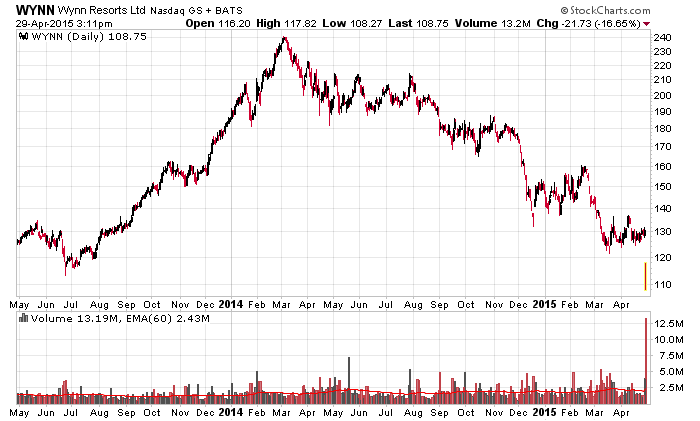
If you look at the stock chart, it looks like the elevation profile of a long dammed river.

Anybody investing in this company is clearly nuts and the stock trades that way.

However, they do have a strategic asset which is not listed on their balance sheet that would cost several billion if somebody else were to do it from scratch. Right now that asset is not profitable, but it is plausible that in the medium term future that it could be (and hence worth a fortune since it would be the low cost producer of this particular item that I do not want to mention otherwise I would give away the story).

Again, the stock trades like it is going to bankruptcy. Financially, it looks like that they are on life support. However, if they spend enough time treading water, it is conceivable that the valuation could be 50 times higher than what it is presently.

A small position is warranted. But I’m too embarrassed to admit what it is I’m investing in.

Genworth MI Q4-2014, Canadian housing market

Genworth MI (TSX: MIC) reported their Q4 results a couple days ago. This report was a little more interesting than previous ones simply because there has been a relatively large shift in sentiment concerning the Canadian housing market due to the collapse in crude oil pricing (and its impact on Alberta and Saskatchewan).

The actual result was less relevant than the future guidance of the company.

Specifically, the guidance was that the loss ratio anticipated in 2015 would be between the 20-30% range, while the long-range guidance was for a loss ratio of 30-35%.

As I have pointed out on multiple occasions, the loss metrics for Genworth MI over the past couple years has been extraordinarily favourable, with the pinnacle of loss ratios in Q2-2014 of 12%. Q4-2014 was moderate, with 26%.

Cited was the economic slowdown in Alberta, but they appear to have a fairly solid grip on the upcoming cataclysm that will be occurring to employment in Alberta and Sasketchewan. Approximately 27% of the insurance written in 2014 was in Alberta, although 17% of the insurance in force is from the province.

By virtue of the fact that zero-down loans are no longer done, direct comparisons to 2008 would appear to be less muted, although there will obviously be an increase in losses coming in 2015 from Alberta and Saskatchewan for the company. The question is how bad they will be.

That said, the company still has an incredible amount of room to maneuver with. Their loss ratio for fiscal 2014 was 20% and expense ratio of 19%.

Realize accounting-wise that all of their cash is collected up-front and then revenues are recognized according to a financial model that allocates premiums written (deferred revenues on cash received) to actual revenues (removal of deferred revenues). The revenue recognized is not cash. Instead, the company must earn cash on future premiums collected (somewhat pyramid-schemish!) but also the receipt of investment income.

Investment income is obtained through a portfolio that is 41% corporate debt, 49% government debt, 3% equity and 2% asset-backed bonds, and the remainder 5% is cash and short-term cash equivalents. The total value of this portfolio is $5.4 billion earning an investment yield of approximately 3.5% and a duration of 3.7 years. As interest rates continue to plummet, this investment yield will likely decrease (although they do have a good chunk of unrealized gains due to the rate drop). Reinvestment will become continually a higher challenge for this insurer and many others.

Investment income for the year was $195 million.

In terms of book value, they ended the year approximately at $35.12/share according to my calculations.

Valuation-wise, they are somewhat below my fair value estimate, but not at the point where I would buy more shares. Market sentiment may take them further down and if it does so, I may consider adding to my position. The company itself may decide to repurchase shares (at a much better price than its previously botched buyback of 1.87 million shares at CAD$40/share) which I would approve of simply because repurchases would cause book value to increase. The company holds a minimum capital buffer of 220% over the regulatory requirements (currently at 225%) and they have indicated that they will hold a modest amount of capital above this percentage. I suspect the majority of excess will go towards a share buyback later in the year.

If the company streamed off its entire net income to dividends, they would be giving a 12% yield at present.

I generally do not believe that there will be a precipitous collapse in the Canadian housing market unless if there is an overall recession that affects more than a single commodity industry. In addition, most equities that I see that have significant exposure to Alberta’s economy are trading significantly lower than they were half a year ago. I do have a name in mind (below book value as well) when I write this, but my inability to predict when Alberta will get “hot” again is not assisting with an investment decision.

Government bond yields indicative of a very ill market

If we are in the Japan-like scenario of what happened after 1989, it would suggest that we will be seeing very choppy equity markets over the next decade (this includes up and down swings of 40% or so over multi-year periods, just look at the Nikkei index) and one should wrap their heads around the ability to make money in the marketplace when the overall indicies are not moving in the long run. Some basic financial theory would suggest that if the market gives equities a modest 2-3% risk premium, the most we will be seeing out of the S&P 500 on an annualized basis is around 4-5% nominal returns. The ultra-low bond yields we are seeing internationally are also a symptom of huge problems.

As a small factoid, Canadian 10-year debt is at 1.3%. Looks relatively attractive when comparing it to Japan’s 0.38%, Germany’s 0.37%, or the wonderfully fantastic -0.1% yield you’ll get by buying Swiss Government 10-year debt.

Smarter people than myself have already figured out that one of the primary arguments against gold is that it has no yield. But gold looks very attractive when viewed in relation to either sitting on a pile of Swiss paper (literally Swiss Francs underneath the bed mattress) as you wouldn’t want to be investing your money in negative-yield debt. At least when your house catches on fire, the gold is reclaimable.

Once all the gyrations in the fossil fuel market work their way through, having a swimming pool of crude oil in the backyard isn’t going to hurt either.

The new norm is going to be increased volatility

There are a lot of gyrations going on right now with central banks jockeying for position and a certain amount of dysfunctionality out there. The new normal is increased volatility than the relatively calm times in the middle of 2014:

vix

Other than the direct purchase of VIX futures (or the VIX ETF, the most liquid of which is VXX), one must think about companies out there that can take advantage of volatility.

Connacher recapitalization

Connacher Oil and Gas (TSX: CLL) announced late last week a recapitalization plan. In exchange for CAD$350 and USD$550 million of second-lien notes (behind $144 million in first-lien notes and an operating facility), Connacher will give 98% of the equity to the second-lien noteholders. 70% of the noteholders are apparently on board with the proposal.

The noteholders will also have the right to subscribe to another $35 million of second-lien notes.

The company also announced its 2015 projections at WTIC US$49.75/barrel, and it is not pretty: $76 million in losses projected.

Assuming the recapitalization succeeds, shareholders are looking at a 50x dilution of their holdings. The alternative would simply be a zero so there is some value left in the equity.

Clearly the company is uneconomical with existing oil prices and if existing prices continue for the next few years, the company will likely get into financial trouble once again. Not for the faint of heart.

Connacher has a soft spot in my financial heart as their convertible debentures were something I invested in the middle of the financial crisis. They were at around 30 cents on the dollar and I got out in the 90’s a year or two later. They eventually did get redeemed at par on maturity. I have no positions presently.