Interesting article posted by David Desjardins on Seeking Alpha – he has purchased deep out-of-the-money put options (January 2018 puts with a strike of 18) and is clearly anticipating a drop further in the stock price.
His arguments can be summed up as follows:
1. Vancouver housing prices are ridiculously high, inventories are climbing, and prices are dropping;
2. Alberta unemployment is at relative highs and their delinquency rates should spike to 2010 levels;
3. Ontario housing prices have ascended and when they taper, delinquency rates should rise to averages;
4. Higher delinquencies will result in higher claims, and these claims will have a serious negative impact on the corporation;
5. Increased capital requirements, both as a result of claims but government regulatory changes, will require MIC to issue shares.
My comments:
1. My own overall thesis is that we will see a tapering of pricing demand in the urban real estate markets, but not a crash. The housing targeted to foreign interests will depreciate considerably (my own on-the-ground research has shown this has had a 10-15% impact on asking prices in BC), but these markets have not been eligible for mortgage insurance since July 7, 2012. The spill-over is what happens to the townhouses and condominiums in the Vancouver marketplace – there will be undoubtedly be price compression due to decreased demand as a result of decreased credit availability.
I do agree, however, that BC’s delinquency ratio (currently 0.07%) is abnormally low. Ontario’s (0.04%) is also abnormally low, but the company’s loss ratio guidance has always been above the expectations of what delinquency numbers would imply – original 2016 guidance was 25%-40%, but it is fairly obvious that it is going to be well under 40%, and they decreased the upper band for loss guidance to 35%.
2. If we see the delinquency rates as he suggests in his article (1% in BC, 0.7% in Ontario), then Genworth MI and CMHC will be in very rough shape. You would see a significantly lower stock price and you will be seeing huge political ripples about the whole Canadian housing market going from boom to bust in short order. Genworth MI’s peak delinquency rate was 0.3% in June 30, 2009 during the 2008/2009 global economic meltdown, and their loss ratio was 46%. It is not a stretch that a delinquency ratio larger than that would be the result of another meltdown in equal size, something I do not believe in the offering.
If the author’s worst case scenario of 1.5% delinquency rates occur in the insured mortgage space then you will be seeing crisis headlines that would ripple well beyond the financial state of the mortgage insurance industry.
It is also important to note that lending practices in the USA during 2008-2009 had significant differences than lending practices in Canada today.
3. Genworth MI, in general, has a healthier mortgage insurance portfolio than CMHC (I will leave speculation why out of this discussion). In Q2-2016, Genworth MI’s delinquency rate was 0.1%, CMHC was 0.32%. Any changes in regulatory burdens will impact CMHC’s profitability more so than Genworth MI; while this doesn’t directly impact whether there will be a spike in delinquencies, the federal government clearly does not want to knee-cap its own crown corporation in the process (one that generated about $550 million in net income to the Crown in the first half of this year).
4. Housing prices are the primary driver of claim severity, while unemployment is the primary driver of claims. Insured mortgages in Canada are full-recourse, which means the metric to watch for is unemployment and not housing prices. An unemployment rate of 7% nationally is not concerning for housing.
5. In Alberta, unemployment is anti-correlated with increases in energy prices and has probably peaked around 9%. Housing prices have decreased by 5-10% in the province, and delinquencies have climbed from 0.09% (Q2-2015) to 0.17% (Q2-2016), but this has been well-anticipated by management. Delinquencies peaked in Alberta at 0.62% for Genworth MI in Q4-2010 (the primary after-effect of oil going down to US$33 at the beginning of 2009). My estimate for delinquencies in Alberta should taper off around 0.25-0.3%.
6. The author appears to be misunderstanding the minimum capital test. The new regulations by OSFI introduce a new regime for minimum capital required to retain insured mortgages. While the statutory minimum is 100%, the supervisory target is 150%, and the company typically keeps an internal buffer higher than the supervisory target to ensure that month-to-month operations do not bring the ratio under 150% – the pro-forma at Q2-2016 was 153-156% of the new MCT, while I suspect the internal target will be somewhat higher. Genworth MI will book another $100 million of after-tax income for the second half of the year (after dividends) and this will push it to the 160% level. They do not need to raise capital – they just need to slow down issuing insurance and continue amortize their current book.
In addition, there are transitional arrangements to the new capital levels that will only “kick-in” after they are lower than the old capital test levels. That said, the old and the new capital test levels include a 20% buffer for “operational risk”, and since the new capital test levels are higher, this will also increase the capital required for operational risk (which in the new rules, is the operating capital minus the supplementary capital required for insuring mortgages in “hot” markets). This increase in required capital is transitioned in over a 3 year period.
The effect of these changes, however, will definitely increase capital required for mortgages, especially for lower ratio mortgages:
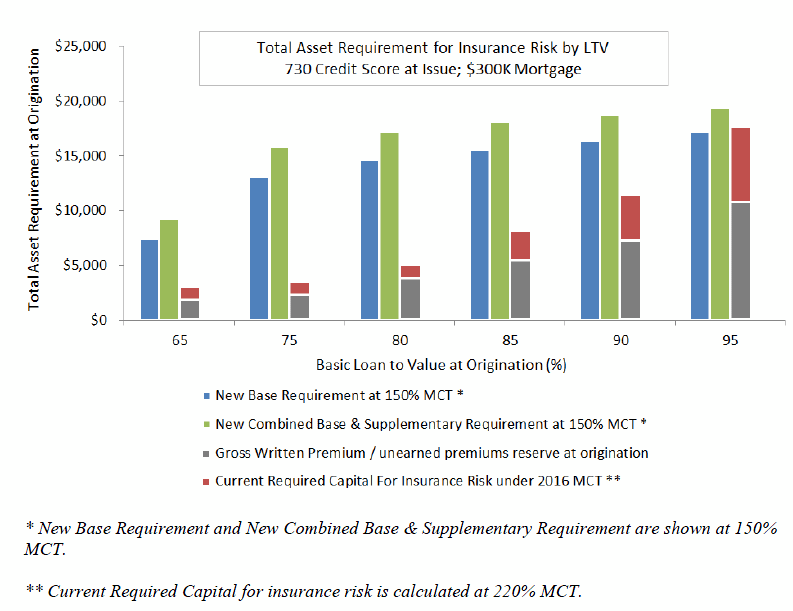
These changes affect MIC and also CMHC. CMHC is relatively less affected as in Q2-2016, its MCT level was 366%.
As a result of these changes, I expect transactional mortgage insurance origination to decrease significantly (guessing around 20%). As I said before, if Genworth MI stopped writing insurance, their share price would still increase as their liability book would shrink and capital is released for asset distribution.
7. 92% of MIC’s mortgage business is written on loans under $550,000. 8% would be between $550k to $1M. In relation to income capacity of borrowers, this does appear to be reasonable (especially considering the average gross debt service ratio of borrowers is a reasonable-sounding 24% on Q2-2016).
8. Even if home values drop below mortgage values, the option to strategically default in Canada is much, much more expensive due to full recourse rules on insured mortgages. As long as people are employed, they will continue paying their mortgages (albeit be a bit bitter about paying down a debt on a property that is valued less than the debt).
While the author’s “what-if” estimates in the event of a spike in delinquencies is an excellent stress test, they appear to stem from a scenario that is the result of something worse than what happened in 2008-2009. If the 2008-2009 scenario happened, there are far better short sales out there than Genworth MI (candidates that come to mind include HCG, EQB, FN, etc.).
Recall that Genworth MI went public in 2009 at CAD$19/share (the first window of opportunity after the financial crisis) and this was a forced IPO because Genworth Financial desperately needed to raise capital. CAD$19 back then was a fire-sale price and the entity today is larger and more profitable than it was back then (and also noting that they had 117.1 million shares outstanding after IPO, compared to 91.9 million today) – and they IPOed at 10% under book value, compared to 25% under book today!