Barring any investment discoveries in the next month, the cash balance I will be reporting in June is going to be a considerably high fraction of the portfolio.
While cash is great, it also earns zero yield.
Compounding this problem is the majority of it is in US currency.
Unfortunately I have done some exhaustive scans of the marketplace and there is little in the way of Canadian fixed income opportunities (specifically in the debenture space) that I have seen that warrants anything than a small single-digit allocation. I would consider these to be medium reward to low-medium risk type opportunities. Things that won’t be home runs, but reasonable base hit opportunities.
Rate-reset preferred shares have also piqued my interest strictly on the basis of discounts to par value and some embedded features of interest rate hike protection, but my radar on future interest rates is quite fuzzy at the moment (my suspicion is that Canadian yields will trade as a function of US treasuries and the US Fed is going to take a bit longer than most people expect to raise rates since they do not want to crash their stock market while Obama is still in the President’s seat).
I have yet to fully delve into the US bond space, but right now the most “yield-y” securities in the fixed income sector are revolving around oil and gas companies.
There are plenty of oil and gas companies in Canada that have insolvent entities with outstanding debt issues, so I am not too interested in the US oil and gas sector since the dynamics are mostly the same, just different geographies.
I’m expecting Albertan producers to feel the pain when the royalty regimes are altered once again by their new NDP government. There will be a point of maximum pessimism and chances are that will present a better opportunity than present.
Even a driller like Transocean (NYSE: RIG) that is basically tearing down its own rigs in storage have debt that matures in 2022 yielding about 7.9%. If I was an institutional fund manager I’d consider the debt as being a reasonable opportunity, but I think it would be an even bigger opportunity once the corporation has lost its investment grade credit rating.
Canadian REIT equity give off good yields relative to almost everything else, but my deep suspicion is that these generally present low reward and low-medium risk type opportunities. Residential REITs (e.g. TSX: CAR.UN) I believe have the most fundamental momentum, but the market is pricing them like it is a done deal which is not appealing to myself from a market opportunity.
The conclusion of this post is that a focus on zero-yield securities is likely to bear more fruit. While I am not going to be sticking 100% of the portfolio in Twitter and LinkedIn, the only space where there will probably be outsized risk-reward opportunities left is in stocks that do not give out dividends. It will also be likely that a lot of these cases will involve some sort of special or distressed situations that cannot easily be picked up on a robotic (computerized) screening.
I would not be saddened to see the stock markets crash this summer, albeit I do not think this will be occurring.
Pinetree Capital (TSX: PNP) announced it will be redeeming another $10 million in its debentures on June 5, 2015. This is on top of the $10 million that was already redeemed on April 30, 2015.
For those of you following the Pinetree Capital saga (history of posts here), I continue to hold Pinetree debentures (TSX: PNP.DB) as I believe it is more probable than not they will be made whole at maturity.
On December 31, 2014 Pinetree Capital had approximately $107 million of investment assets on its balance sheet (at fair value, $75 million level 1, $8 million level 2 and $23 million level 3) and $54.8 million in debentures that are now senior and secured by all assets of the company. They have no other debt. When the debtholders got three of their directors on the board when Pinetree defaulted on their debt covenants in late January, presumably on February they start on their liquidation spree. On March 29, 2015 they had $14.3 million cash in the bank which they used to redeem the first $10 million of debt. After June 5, 2015, they will have $34.8 million in debentures outstanding.
Debentureholders will also receive their semi-annual interest payment (10% annual coupon) on May 31, 2015.
As part of their forbearance agreement (to stave off their debt being declared fully payable with likely CCAA implications), Pinetree Capital was required to redeem a minimum of $20 million face value in debentures by July 31, 2015. They had the option of redeeming the debentures with 1/3rd equity, which they have not done so to date. They are also required to maintain a debt-to-assets ratio of 50% until October 31, 2015 and then 33% afterwards.
When doing a quick and dirty pro-forma with no change in assumed asset value other than the payment of interest and principal on debentures, after the June 5 redemption they will have a debt-to-assets ratio of 40.5%. If Pinetree were to redeem another $11 million in principal by the end of August, this would bring the ratio to 33%. Presumably they would want a little bit of a margin of error to work with, so it is likely before October 31, 2015 that they will redeem around $15-20 million in further principal which would bring them safely below the 33% mark.
Not surprisingly, the market has picked up on this and has bidded up the debentures to 88 cents on the dollar. What has previously been a 75 cent dollar is now considerably more expensive and will likely converge to par throughout 2015 with diminishing market liquidity as the debenture supply dries up.
Disclosure: Still long on PNP.DB, but as the redemptions occur, my portfolio weighting decreases.
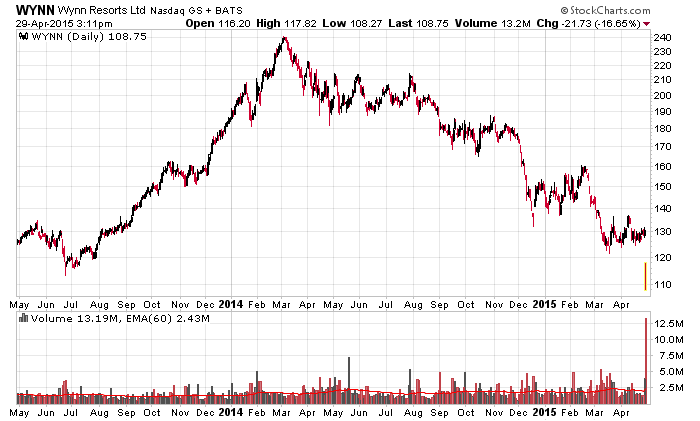
One of the best commentators on conference calls is Steve Wynn (Nasdaq: WYNN) and suffice to say, he has a few zingers in his last conference call. His company’s stock has gotten hammered some 16% today and over half since early 2014.
Some notable quotes from his conference call:
It is impossible for us to predict how long [the downtrend in business conditions] that will last. We’re not in a position to answer those kinds of questions intelligently. We’re only in a position to react intelligently to what we see.
He goes on a speech about how the company will always be able to manage its debts and affairs, and also about how dividends will only be given from cash that has historically been earned:
So as we look backwards for the fourth quarter and especially during the last four months, and understand what’s happening, both in Las Vegas because of the Asian impact on Baccarat, and we look back and then we extrapolate and try predict the future, or at least understand what most likely will be the future, it is foolhardily and immature and unsophisticated to issue dividends on borrowed money. We only distribute money that’s free cash flow based upon our earnings that trail.
…
Dividends are nothing and – we don’t say that because we have a business, that we now have a $0.50 dividends forever. That’s baloney and any company that does that is irresponsible. We distribute the money that we make after we make provisions for capital expenditures and all of our other obligations, to creditors and to our employees. And then we distribute aggressively whatever is free and easy to distribute after that.
The note about issuing dividends from borrowed money should resonate with most oil and gas producers in Canada these days – the only reason why most of them are issuing dividends is simply because they’d get their shares jettisoned from the huge pool of income funds. It would also be an admission of defeat and a negative signal to the market.
On a dialog on the conference call with his own president of the Las Vegas casino (which in my humblest opinion had a dinner buffet that was remarkably worth the US$45-ish that I paid for it):
If you were to ask me, since we’re making forward-looking statements, what will the second quarter look like in Las Vegas? Weak. Do you hear me? Weak. So I’m trying to lower expectations here. This notion of a big recovery is a complete dream. I don’t think Las Vegas is experiencing a great recovery. I think it’s still very patchy and I think that that’s probably our non-casino revenue in the first quarter was flat. I’d be thrilled if it was flat in the second quarter.
It is very rare when you get a CEO making such refreshingly honest statements. There’s a bunch of other commentary here, but I will leave that as an exercise to the reader.
Business notwithstanding, there is a whole bunch of drama going on over at WYNN at the present time, including the divorce of the CEO spilling over onto the business side of things.
Genworth MI (TSX: MIC) reported their 1st quarter earnings results yesterday. The report can be summed up as a relatively boring, “steady as she goes” type quarter, which is somewhat surprising considering the general predictions that the degradation in the Alberta real estate market would cause considerable stress in the sector.
The bottom line earnings took the book value to $36/share.
While the market is signalling there is going to be further losses later this year, the first quarter result had a loss ratio of 22%, which is generally on-level with prior quarters – the company projects 20% to 30% for the year.
Despite the winter quarter being the slowest quarter of the year, year-over-year statistics show a marked increase in unit volume (23,951 in 2014 vs. 32,760 in 2015) and also the net premiums written ($84 million to $130 million). The Q1-2015 net premiums written was also goosed up by the recent CMHC mortgage insurance premium increases. On June 1, 2015, there is another CMHC premium increase on higher ratio mortgages which will also result in a $25-30 million increase in net written premiums.
The company’s insurance in force exposure is 18% in Alberta for “transactional” type mortgages, which are mostly those with 20% or less down-payment. Delinquency rates continue to be very low (0.11% nationally) without any pronounced increases other than a mild rise in Quebec. Ontario has a 0.05% delinquency rate.
On the balance sheet, the company’s investment portfolio yielded 3.4%, but they had some interesting commentary, stating “At this time, the Company believes that the capital adjusted return profile of common shares is less favorable than in the prior year”. As a result of this and also minimum capital test guidelines, they have increased their allocation to preferred shares. Similar to last quarter, they also went out of their way to specify that 75% their energy company investments (in bonds and debentures) were in pipelines and distribution, and the other 25% were in “integrated oil and gas companies with large capitalizations”. The bond portfolio has a mean duration of 3.8 years.
The company has capital that is 233% of the minimum capital test (currently $1.52 billion required) and the internal target with buffer is 220%. This leaves $200 million available for the company to either repurchase shares or distribute in a special dividend. They announced their regular quarterly dividend of CAD$0.39/share with the quarterly release but did not give any indications as to what else they will do with the excess capital.
At a current market price of (roughly) CAD$35/share, I generally believe the company’s valuation is slightly on the low side of my fair value range estimate. I would not start to think of divesting until CAD$40, but an actual sale decision would likely be at higher prices.
I still hold shares from MIC, purchased back in the middle of 2012. Seeing the recent price drop to CAD$28/share would have been a decent opportunity to add more shares and I doubt we will see that again unless if there is a profound economic malaise that hits Canada. If we can survive US$50 oil, our economy is more robust than most think (noting that the rest of the commodity markets have also plummeted). MIC also continues to be a stealthy way to purchase Canadian real estate and also a proxy for a bond fund at a very low management expense ratio. The yield in today’s income starved market is a bonus.
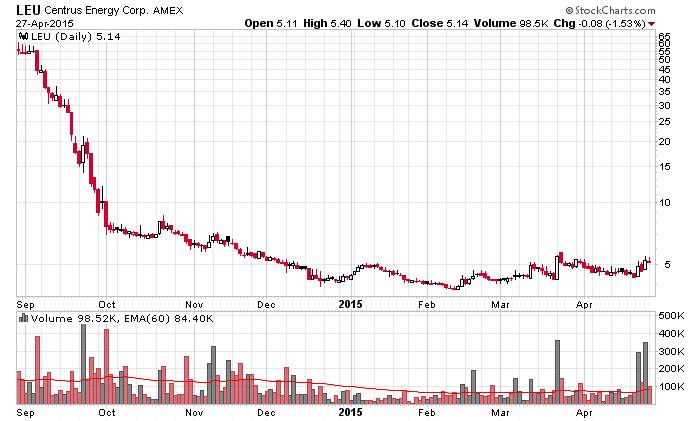
Centrus Energy (Amex: LEU) was formed out of the pre-packaged Chapter 11 bankruptcy proceedings of the entity formerly named USEC Inc.
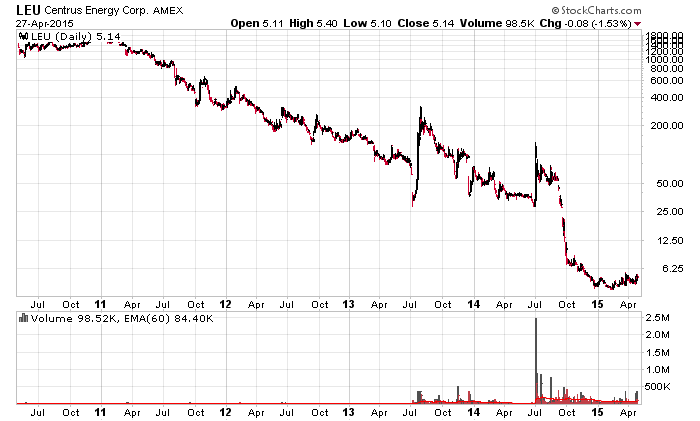
LEU since recapitalization (September 30, 2014)LEU – 5 year chart (adjusted for reverse stock split)
The corporation primarily derived its revenues from reprocessing Uranium from nuclear warheads from Russia and the USA. The reprocessed nuclear fuel was then sold to nuclear power facilities. It was a reasonably profitable activity – for example, in 2006 and 2007, the company earned roughly $100 million in after-tax income.
In addition, the company is working on a centrifuge project that would allow for the cost-effective (compared to gas diffusion) enrichment of low-grade enriched uranium. These enrichment projects, as Iran is discovering (and they are attempting to produce weapons-grade uranium), are not trivial tasks to overcome. Imagine being given a million ping-pong balls, and half of them weigh 1% lighter than the others – how do you separate them?
Things changed with the business. The contract with Russia expired (and diplomatic relations between the countries had soured anyhow). Nuclear energy after the Fukushima reactors blew up took a massive hit. The market for Uranium had essentially peaked in the early 2000’s and pretty much now most producers are on life support if your name is not Cameco or subsidiaries of Uranium One. We fast forward in 2014 and the company cannot pay back its $530 million in convertible notes and is forced to recapitalize.
The recapitalization left the company with $240 million in notes to existing note holders and preferred share holders and 95% of the equity. This also left USEC equity holders with 5% of the company. These shares continued to trade down some 50% post-recapitalization until the remaining entity has a market cap of about $50 million and $240 million in notes.
In terms of the balance sheet, things are very ugly. At the end of 2014, while they do have $220 million in cash, they have significant pension liabilities and also considerable negative tangible equity. On the income side, they have negative gross margins and without a real market for nuclear fuel, which is stocked up for the remainder of this decade.
So what could possibly be an investment case for this company?
It deals with the centrifuge project. One would suspect that this is an item of USA national security and that there would be geopolitical considerations to keeping it alive for future purposes. Accounting-wise, this project does not really appear on the balance sheet except as intangibles. One could argue that the “true” value of the project is worth much more than what appears on the balance sheet.
A very condensed consideration of nuclear energy at this point in time:
One also has to weigh in the factor that world uranium supplies have not been mined as intensively given the relatively low prices seen in the last decade. Nuclear power plant construction has also slowed down due to the 2011 Japan earthquake, but China is building more than 20 reactors, and this is higher than Germany’s 9 (which will be shut down). It is likely China will continue building more nuclear reactors to replace their coal power plants (pollution being one reason).
Japan is a wildcard – they currently have 43 reactors operating and the current government’s intention is to continue producing nuclear power. India is also expanding their nuclear generation portfolio (noting that their nuclear production is going to increase 70% in the next two years – reference Cameco).
Oil and gas does not explicitly compete with nuclear power because of how the power is generated – nuclear power provides base loads, while gas powered plants can be turned on and off relatively quickly and are peak load providers. Nuclear plants are direct competitors to coal powered plants.
The short part of the story is that the stock is trading extremely low simply because there is a culmination of nearly every single bad circumstance for the production and sale nuclear fuel. If these variables were to change, it would appear that a $50 million market cap for this sort of company would be extremely low. While it is not likely that they will ever get back to the days where they will earn $100 million in net income, there is a considerable chance they could generate positive income of some quantity.
Other than pension liabilities, the other primary liability the company has are its US$240 million in notes, which are structured for maturity on 2019 but can be extended to 2024 if the centrifuge project goes ahead. In 2015, the notes accrue 5% cash interest and 3% payment-in-kind (in the form of more notes), while in 2016 and beyond, the notes accrue 2.5% interest and 5.5% payment-in-kind (in the form of more notes). They will not be a huge financial burden until maturity.
Past history would suggest that the company would recapitalize these notes if solvency became an issue again.
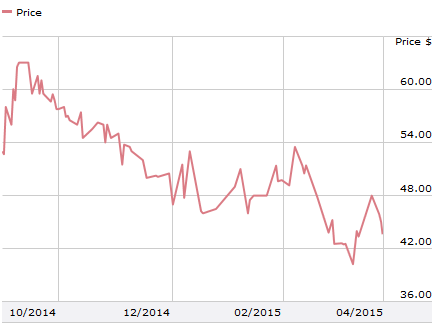
The last reported trades on TRACE of any real size (i.e. par value of $100,000 or greater) was at 45 cents on the dollar, which is hardly a ringing endorsement by the bond market. Assuming a 2019 payout, that would be roughly a 25% yield to maturity.
TRACE prices of LEU 8% notes (maturing September 30, 2019 or 2014)
The risk-reward here on both the equity and debt are high risk and extremely high reward if things work out for the nuclear fuel industry. There are a ton of what-ifs to consider, but one would think the worst-case outcome for Centrus at this point is bleeding cash until another recapitalization in 2019 (I’d guess you’d see a maximum of 50% downside but it should be reasonably obvious that they are going nowhere). In terms of upside, if all the stars lined up correctly, you could see a 10-bagger over a few years. I have no idea what the probability of this would be, but I’d ballpark it at 10-30%.
This is also a rare company that would likely be bidded significantly higher in the event of a nuclear detonation occurring somewhere in the world, although they would likely be sold if there was a civilian nuclear power plant incident (in line with Chernobyl or Fukushima).
The financial statements otherwise are nearly useless in terms of properly trying to value the company.
Final note
There is a lot of analysis work that I have performed here that is not in this post, but the previous 1,000 words roughly summarizes the investment. A whole bunch of commodity risk, political risk, technology risk and financial risk.