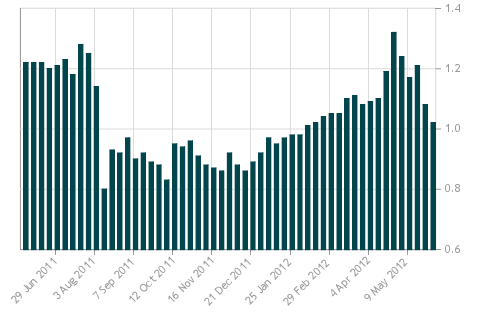
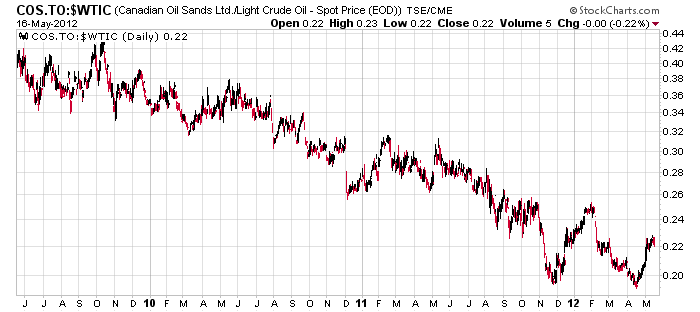
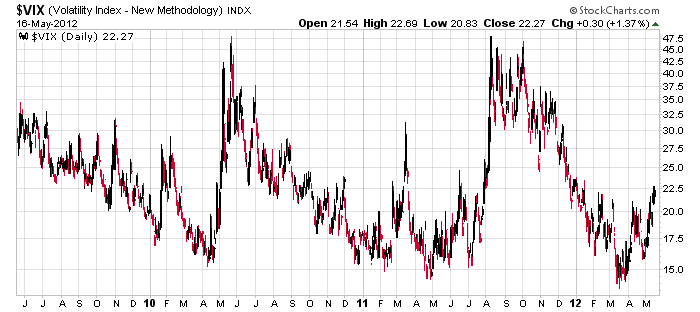
So the Greek debt crisis gets averted for another year or two until they have more problems, and the markets are back to their local highs, per the chart:
Do we go higher? My guess is yes, but not for long. Just have to be patient.
Canadian Finance and Economics
Finance and Economics related articles
The S&P 500 continues to make a local high, and commodities except for natural gas appear to be on the rise again.
My examinations continue to be on zero or low-dividend, non-resource, non-financial companies. I don’t have much to report at present.
The biggest mistake any investor can do is just invest cash for the purpose of investing it in something instead of investing it in something proper.
Hence, I am still twiddling my thumbs.
Curiously I do notice Encana (TSX: ECA) is up about 6% despite the fact that natural gas futures are still depressed. Might be a sign of short covering?
I’ve also been doing some research on R.R. Donnelley & Sons Company (NYSE: RRD) – I have owned their corporate debt in the past so I have not had to do much additional work. They are facing the same issues that Yellow Media had, mainly a good chunk of their business (catalogs and cheque printing) is getting enveloped by the online world. Still, the company is hugely cash flow positive and doesn’t even have the debt albatross that Yellow Media has. If it wasn’t for the fact that they are a well-known case, I might dip my toes in.
There are a couple other smallish-cap companies ($100M-$250M range) that I am reluctant to mention here that seem to have very compelling valuations, plus almost no financial pundits are paying any attention to them.
The great thing about having a large cash position is that it feels like I am working with a blank canvass. Despite earning almost nothing in yield for cash, I also do not feel pressured to make any portfolio decisions. If I have to wait out an entire year without hitting any candidates, so be it.
One other conviction that I have compared to the host of “I don’t know”s I gave in my 2011 year end report is that everybody is chasing yield. In a low interest rate environment, capital is shifting towards securities that can spin off safe income – just imagine if you are a pension fund manager and need a targeted return – formerly you could bank on 30-year treasury bonds giving you a ~6% yield in the first five years of the century, but the zero interest rate policy has pushed down yields to currently 3%. If your mandate is to make 8%, formerly if you had a 50/50 bond/equity allocation you would need to make 6% on the bonds and 10% on the equity. With bond yields presently at 3%, the same allocation forces you to make 13% on equity – a much more difficult task for a fund manager. Suddenly placing bets on that speculative pharmaceutical research firm seems to make financial sense.
How do you make up the yield difference on the fixed income side? By investing in treasury bond-like securities and this means climbing up the risk spectrum – provincial/state debt, municipal debt, corporate debentures, and even preferred shares.
Everybody is chasing yield and prices today reflect this. Just be warned that the markets might face a Europe-type situation where the underlying entity no longer can pay out such cash flows – even when European banks are getting interest-free loans, they are still choosing to put their capital into safer 10-year German bonds at 1.9% compared to Italian debt (7.15% currently). Measuring the ability of corporations and sovereign states to actually pay the income is always a vital calculation. As the cliche goes, it is about return of investment, not return on investment.
This could be an explanation why certain large cap stocks are trading at very low P/E ratios – albeit, it makes no difference (taxation differential between dividends and capital gains notwithstanding) whether a corporation makes a 10% after-tax return and retains it, or gives it out in a dividend. Somebody would look at both companies and likely favour the one actually giving out the dividend. The true answer is whether the company can deploy its retained capital as profitably.
The opportunities presenting themselves currently seem to be very narrow and opportunistic and off the radar. It’s not like buying shares of Starbucks under $10/share back during the economic crisis.
After this post, it is quite likely I will not be posting again on this site until 2012. The reason is simple: I am taking an extended vacation. I will generally not be in front of a computer during most of this time!
I won’t even have access to my portfolio, but at 72% cash, it is unlikely to cause any heartburn in the event that the European Union fiscally has a true blow-up and takes down the whole financial system in the process.
I do have some positions in companies that I have programmed a “trading autopilot”; these transactions will occur automatically given a set of conditions, both time and price. Interactive Brokers in this respect is quite friendly.
Have a Merry Christmas and Happy New Year!