CoronaPanic, Edition 13

As I write this:
S&P 500 -20.4% YTD
TSX Composite -21.7% YTD

Buckle up. After posting 3 monster-sized gains in a row, if you’re into the short-term trading thing it’s probably a good time to harvest a few bucks since the ‘second wave’ will start hitting the headlines. I’ve taken off my S&P 500 exposure, but will add it back on later.

This is where you are going to see supply chains get rationed and there will be further spin-off business disruptions that are second and third-order effects of shutting down half of a country’s economy and shutting in the population.

The numbers will get worse in terms of people confirmed with COVID-19, and the death count will rise. However, the growth of this will flat-line.

This is also the phase where you are going to see significant social unrest in the population. Shutting in a population for a week is one thing, but the second and third week you are going to get a lot of people that are going to be stir-crazy.

The primary thesis is the same, however – the trend between now and half a year later will be up, but there are going to be a lot of dips and drops as this panic continues to resolve itself.

Some other miscellaneous notes.

Tailored Brands (TLRD:US) I’ve mentioned before – they shut down their entire operation in the second half of March. Their stock is somewhat up, but their unsecured debt (July 2022) has cratered to about 25-30 cents on the dollar, and this is a pretty good sign that they’re going to go into Chapter 11. Considering the lease-heavy aspect of their business they are probably going to be using this as a way of breaking the leases, recapitalizing and getting on with it. They’ve got a billion and a half dollars of secured credit, so the unsecured holders are going to get killed (or more precisely, they’ve already been killed).

FTI Consulting (FCN:US) specializes in bankruptcy consulting, and looking at their chart, they’re right up there with toilet paper maker Cascades (TSX: CAS) as having a stock chart you’d never see any huge market dump on.

There is a lot of “liquidity sniping” on the TSX. I don’t know what this is formally called, but I’ll explain. You see a quote at bid 11.50 and ask 12.50, and you think it’s a really good deal at these prices (say you believe it is worth 17), and there is supply coming into the market (i.e. it is a down day in the market). You put in a bid at 11.55, and then some computer puts in a bid at 11.56, and you realize there’s no way you’re going to get any liquidity because the computers are going to beat you. The way you defeat this is to use hidden orders. You put a hidden order in at 11.55, and so when some guy puts in a market order to sell, you get priority at 11.55. The computer then sees the trade and has to adapt to dark liquidity, and it has a much more difficult time to do so – how much of the spread is actually being captured by you? Most brokerages don’t allow hidden orders, but Interactive Brokers does.

CoronaPanic, update 11

Today is the day where the “Oh my God, I sold everything a week ago because I was going to get a better price in the month of May when this Coronavirus thing was going to end” crowd realizes that they are done and now have to get that cash back to work, except it is difficult to do anything other than hit asks.

The supply (forced liquidation selling, panic selling) goes away. This results in prices going up since there is still an avalanche of demand. There will also be volatility – except this time on the upside.

Psychologically there is the anchoring effect – people see things that have traded at 10%, 20% below current prices and think if they just wait it will get back there – after all, more and more people are diagnosed with this Coronavirus thing, more people are going to die of it, more people going to ICUs, and all of the carnage in the media, the shut-downs, the horror stories of people that can’t do this or that, etc., etc.

This is wrong thinking. In the lens of the financial markets, it doesn’t matter. In the lens of the financial markets, they will be asking themselves how much companies will make in 2021 and beyond, even though fiscal 2020 will be a disaster.

If you were lucky enough to buy on March 23rd, today (the S&P 500 is at 2530 as I write this) you probably will have made about a fifth to a quarter of the gains that await you over the next three to six months.

However, you won’t get much size in a massive up day like this (unless if you are talking about extremely small quantities relative to company size). There will be a day or two where the news headline will be sour, pronouncements of things never ending, but those will be the days to get proper liquidity. There will also be liquidity provided by supply from people that have gotten hacked to death and want to lower their risk exposure on the up days to limit their losses.

Also, the true liquidity is in the index futures, so if you lack specific names, it’s better than nothing.

My opinion on the actual matter on the ground is relatively meaningless, but I suspect the ‘inflection point’ of cases is turning, so that future growth percentages will taper from this point forward. I also suspect that the true mortality rate will be under a percentage point.

Gold – short-term trap

I know intuitively it sounds like the US turning its currency into toilet paper will result in gold going up in price, but the process will likely take longer than most people realize.

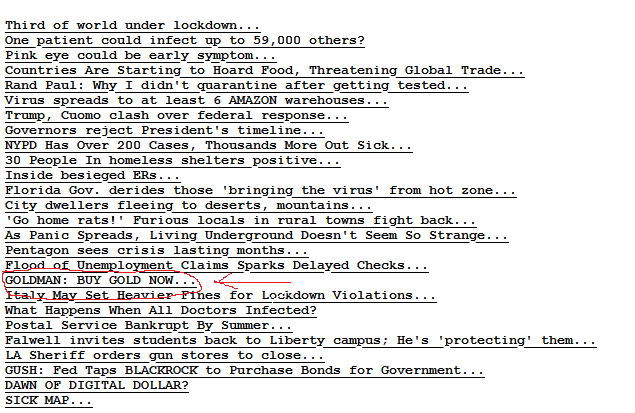
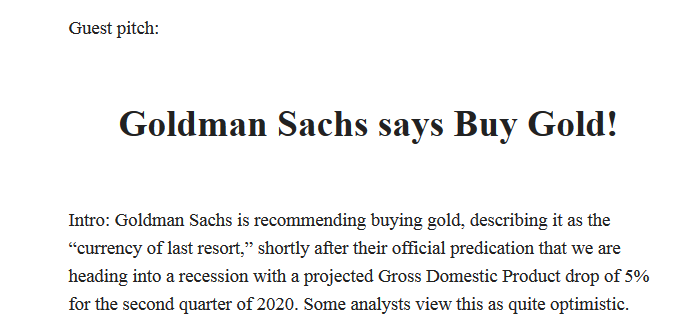
Instead, I’ve gotten a barrage of spam, both from the Drudge Report and some random email that managed to make it past my spam filters with exactly the same message:

This just looks like a trap written all over it, at least in the short term.

Don’t get me wrong, until they start hauling high-grade ore from asteroids from orbit, gold will be a very precious commodity on the planet earth due to having several millenia of cultural value (in addition to having very good industrial value due to its conductivity and ductility). But there appears to be a lot better value elsewhere if you take some basic assumptions on what will be in demand half a year ahead in time.

Things will stabilize, gold will lose its luster (temporarily) and sold to buy yielding assets. But when those yields compress, gold will start looking good again. Not right now, for me, however.

CoronaPanic, Edition 9

More completely random ramblings, and even less marketable commentary:

VIX has been above the global financial crisis 2008-2009 levels:

Are the “short volatility” funds going to re-enter the market at this point?

In particular, the leveraged ETF that I use to examine volatility, TVIX, had a massive spike up before subsiding:

Opened at 892, topped out at 985, closed at 646… my god! Trading or gambling at this point?

Option expiration this Friday – I’d think most of the specialists have already hedged off risk, but there are usually games played on the last day of options trading which cause volatility. Put sellers are going to be assigned.

Although pension funds are the last thing that are on people’s minds right now, companies with large defined benefit pension liabilities are going to be facing a haircut of about 15-20% if they are a typical 60-40 equity-bond split. Guess what? You’re on the hook as well since the government has plenty of people on its pension payrolls! Here in British Columbia the public service pension plan is decently managed, but in other less credible jurisdictions, they’re going to have to face the difficult decision – reduce benefits, or force existing workers to contribute more… a lot more. Companies with defined pension benefit plans will also have to make up the shortfall.

The impact on lease defaults is just going to start. Pretty much most companies with IFRS 16 “right of use assets” are sitting on a big fat zero, while maintaining the liability of lease payments. This is not going to end up well for a lot of REITs. Taking a look at Tailored Brands (TLRD), the operators of Moore’s (Canada) and the Men’s Warehouse, for example, in their last 8-K today stated:

On March 17, 2020, the Company issued a press release announcing that in response to the coronavirus and to protect the health and safety of its customers, employees and the communities in which it serves, the Company will temporarily close its retail locations in the U.S. and Canada starting Tuesday, March 17, 2020 through Saturday, March 28, 2020.

On March 19, 2020, the Company issued a press release announcing that in light of evolving government and citizen response to the coronavirus outbreak, it will, out of an abundance of caution and concern for its employees, close its e-commerce fulfillment centers starting Friday, March 20, 2020 through at least Saturday, March 28, 2020, and will suspend the currently limited operations in its retail stores during this period.

This is a big fat zero for at least 10 days of business. Mind you, buying a suit is the last thing that you’d want to do at this moment (so effectively it doesn’t matter whether you actually keep the lights on or not) but the counterparty, the landlord, is going to start feeling a bit of tension, especially when these companies are so close to the brink of wanting to just Chapter 11 themselves out of these agreements. This also explains why companies max out their revolving credit facilities – it is usually the first step before you do a Chapter 11 filing. You want to have enough cash to actually keep things going, otherwise DIP lending at this time is going to be ridiculously expensive.

Even Obsidian Energy (TSX: OBE) managed to get out of massive lease payments in Penn West Center in Calgary – I guess that’s going to be another abandoned commercial building in Calgary soon. Morguard REIT (TSX: MRT.UN) took the hit on that one. That’s what leverage does – all of these carefully planned cash flows balanced with interest payments from debt, and if you lose just a bit of that cash flow, the ratios all go out of whack, covenants get busted, and next thing you know it is a liquidity disaster.

Insurance companies – those with segregated or guaranteed funds will be paying liabilities, and also they have some of their investment portfolio in risk assets (debt that is no longer safe), although one would suspect they would do better than most. Nobody’s also heard a peep from Warren Buffett yet, back in the 2008-2009 days, you had him making $5, $10 billion preferred share deals with Bank of America, and Goldman Sachs during the bottom of the crisis. Nothing to that scale yet. Or perhaps he’s just buying back stock?

It’s also encouraging to see Costco doing as well as it has been. They should be declared a “too important to fail” national security company. Must say in my last visit, their supply chains are still looking mighty good. The employees are doing real hero’s work. Compared to Loblaw (TSX: L) chains (including Superstore, and Shopper’s Drug Mart), night and day difference. It shows.

What’s India’s secret? Over a billion population, but 194 reported cases to date…

Finally… where’s the climate emergency now? From a social/cultural standpoint, I think this event has given everybody a very healthy dose of perspective as to what happens when things go really dysfunctional, and the fact of how smoothly things have been running to date – do we really want to be throwing sand into the gears in the future once this is all said and done?

There’s still too much to look at out there. Found an interesting small software company that feels Constellation Software-ish but sadly without the management that has a huge ownership stake.

CoronaPanic, Edition 8

Some very random scattered observations. It’s been very difficult keeping your wits together in this environment. I’ve had to limit my “screen time”.

TSX Composite is down 31.3% YTD
S&P 500 is down 25.8% YTD
Canadian dollar is down about 10% YTD
Spot Crude (Western Texas Intermediate) is down 66% YTD

The TSX is down more probably due to the energy-intensive aspects of the Canadian stock market.

Crude, in particular, is trading at a curve that is utterly crazy:
Near month (May) $23.75
December 2020 $30.70
December 2021 $35.55
December 2022 $38.50
December 2023 $40.74

Want to dig a huge hole in your back yard, store 10,000 barrels of oil in there (this is about 1.6 million litres, so not a trivial amount!), and then sell it back to the market in a year and a half? If you can do it for less than about $120k, you’ll make a profit out of it…

I am puzzled how Natural Gas, for the most part, appears to be taking things relatively well – perhaps because they’ve already been beat up so badly? AECO daily pricing has held up quite well.

“The World in Data” guy is doing a huge public service by keeping the COVID-19 statistics accurate.

I don’t trust the data out of China (it’s also easier to treat the flu by sending people into virtual prison!) but South Korea’s ability to track and isolate this is quite impressive.

Hong Kong is also another jurisdiction that has very good capacity to deal with these sorts of things.

A silver lining is that we will soon be able to get more data out of Italy and other European countries to reliably tell us what risk factors are in play – i.e. the Chinese data from the studies of the people that died we can test whether they are reliable or not.

We don’t hear much about the inverted yield curve anymore – the 30-year US bond rate is now 1.9% and rising – inflation?

There has been too much on the radar in terms of what appears attractive if your hurdle rate is a 15% return on investment. If you’re looking for some “safe” investment products, I think the debenture complex of Ag Growth International (TSX: AFN.DB.E, F, G) look pretty attractive – they will give you roughly 17%, 14% and 14% CAGR, respectively over 2.8, 4.3 and 4.8 years, respectively. This has to be weighed against buying the equity (currently at $18) which you can make a pretty good argument that it will trade at its previous historical levels at $45 after everything is said and done. You’ll make 50% on the safer debt investment, but you’ll presumably make 150% on equity in a normalization scenario.

I have taken a position in Chemtrade debentures (TSX: CHE.DB.D, specifically) – this company produces sulfuric acid, water treatment chemicals, and sodium chlorate – these chemicals are really basic for industrial processes in electronics, pulp and paper, and other industries. Their equity (in the form of an income trust) has typically been a yield darling, but I suspect they are going to cut even further as a result of Covid-19. But the company does generate plenty of cash and while they are over-leveraged, they will survive this. They have a senior debt to EBITDA covenant which they may get close to but this is rectified by pulling the plug on the distribution. I’ve been watching Chemtrade for ages now, and while I was never thrilled about the relatively high valuation of their income trust (it traded as a yield vehicle) the underlying business is strong.

A comment on Canadian REITs – For the last five years or so, RioCan (TSX: REI.UN) has been trading at a close level to around CAD$27/unit. Today it is $15.69. While obviously there is going to be some lease impairments on companies that simply can’t afford to pay the bills anymore (restaurants, mom and pop shops, and just retail overall in general even without the assistance of Covid-19), eventually this land will get repurposed and produce income yields again. With interest rates being very low, when this rush for cash is abated, these types of income vessels are going to be very popular again. Don’t even get me started on residential entities like CapREIT (TSX: CAR.UN) that are still trading at levels that astonish me. There aren’t that many REITs to sift through, and while I think they are not going to post extraordinary returns when there is the inevitable bounceback, they are relatively “safe” – you can be sure those mortgages will be renewed on even the worst retail properties.

The markets have been limit-up, limit-down so many times over the past two weeks I have lost count when there have been volatility pauses. But these are also markets where if you want to sell, you should only do so on one of those limit-up days, and if you want to buy, you have to do it on one of those limit-down type days. This volatility has been more insane than I have ever seen it, and this includes the global economic crisis of 2008-2009. This probably also means that if you can keep your sanity you might be able to make some money out of it, but it requires a seriously wild ride to get to and from – if you don’t get cashed out.

Almost everything is trading at elevated yields that we have not seen in ages. Dividends are probably going to get cut across the board from a lot of companies, and P/Es are going to be sky-high after Q1/Q2 results get reported.

GFL’s IPO (TSX: GFL) was done at the cusp of the market meltdown, and they’ve held up surprisingly well. Considering that garbage collection is one core duty of society that can’t be stalled out, I can see why. They might stand a decent chance of recovering quite well (I’d choose them over the REITs for example).

Throughout this process the supply chain has been quite resilient. It has only been a week since the lockdown and as far as I can see, things are still available. Aside from some silliness involving toilet paper and other products, goods are still flowing. This is important. There are two large logistic companies in Canada, Transforce (TSX: TFII) and Mullen (TSX: MTL), and both are very well run, and both are trading at lows. While this sector will obviously take damage during the lock-down, it is a privileged sector that currently has priority.

Finally, quant funds have had their models absolutely destroyed, and just like Long Term Capital Management, are being forced to rapidly unwind. Leveraged funds, especially on fixed income, for example, have likely tried to scramble. As soon as this supply pressure abates, there will be upside volatility. Traders that are keeping cash on the sidelines likely won’t have much time to take action in this event – it will probably be just as violent going up as it was down. I’ve been on the wrong side of a lot of this to date, so take these words with grains of salt!