Microsoft vs. Google

I’m not interested in investing in large cap companies, but they are interesting to look at a superficial level. Sometimes this superficial analysis gets me very close to actually purchasing large cap companies (e.g. I thought Starbucks was a good purchase around $12/share back in late 2008/early 2009 when it was going through its coffee crisis during the economic crisis – I never did purchase them simply because there were so many other alluring securities trading at dirt cheap prices at this time).

Getting back to the original topic, looking at trailing 12 month P/Es (after subtracting net cash balances of both companies), Microsoft is at 12.1 and Google is at 15.9. So Microsoft is about a quarter cheaper than Google, just based on past earnings values.

Intuitively, Google looks like a much cheaper investment than Microsoft when you plug the question into your mind “Which company will be more relevant five years from now?”, or you can also use the more direct variant “Which company will grow its earnings more in five years from now?”. Both companies are in the revenue range ($74 billion for Microsoft and $43 billion for Google) where the law of large numbers is evoked – long gone are the days of 40% growth.

This is a fairly elementary analysis, but a hypothetical decision to invest a dollar in Google vs. a dollar in Microsoft is an easy decision. Google is probably the better medium term play.

However, I wouldn’t discount Microsoft’s chances too heavily – when I look at my own computing habits, I still see myself using a Microsoft operating system most of the time, and also Microsoft Office.

On this note of stickiness, as long as Yahoo doesn’t screw up their finance portal by adding in features which are utterly useless (e.g. how their news services are not filterable by content provider), I still find it to be my main “standby” webpage for just getting quick metrics on companies. I don’t know how they were able to be so sticky, but they way they present public information is a touch better than the others, including Google. If it wasn’t for Yahoo Finance, I’d find them to be completely useless.

Rosetta Stone – posting lacklustre quarter

Rosetta Stone (NYSE: RST) posted their second quarter results today and they were below analyst estimates by a fair chunk.

Investors should keep in mind the company is still in the middle of a turnaround process to get costs down and restore some semblance of profitability while keeping their main product line viable in the world of freely offered software. The current CEO is new to the position, but has been with the company as their CFO prior to being promoted to CEO. They are trying to optimize the revenue stream and milk it for what it is worth, and this is going to be a lumpy process as they figure out what is and what is not working – keep in mind that sales and marketing has crept up from 45.5% of revenues in 2009 to 50.6% in 2010 and 60.2% in 2011; assuming you can ratchet down this ratio without adversely affecting the top line, you will be adding significant incremental profit to the bottom line. It just isn’t going to be done in a quarter.

The stock will probably get hammered about 15% in Thursday’s trading and I will consider adding to my position if it goes to the single digits.

Keep in mind that the company does have $120 million cash on the balance sheet and at Wednesday’s closing price of $13.13/share, this does make an enterprise value of $156 million. This is sure to go lower on Thursday. When you consider this is a software company with a quarter billion in sales a year, this seems to be relatively cheap, albeit in a business that is not going to grow like a weed.

Genworth MI Canada reports second quarter

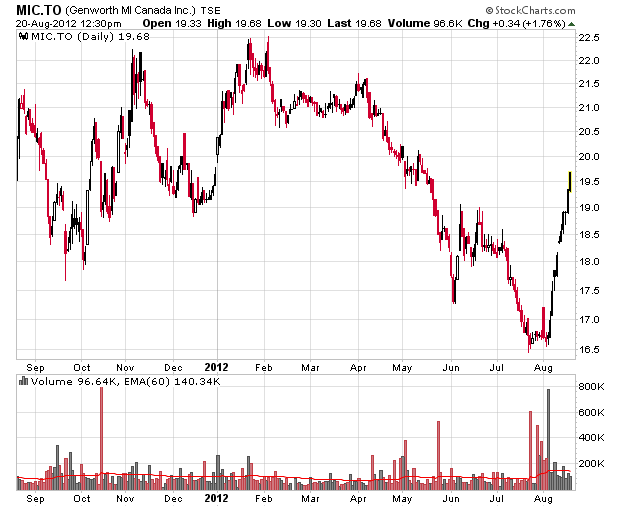
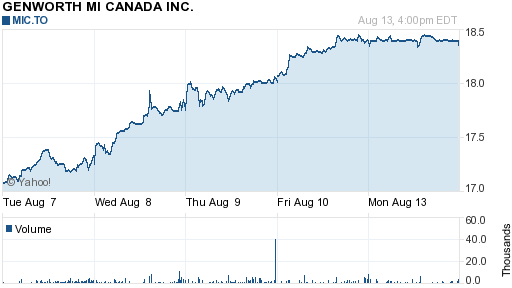
Readers are likely aware of my position in Genworth MI Canada (TSX: MIC) and they reported their second quarter results today. The quarter was relatively boring, with losses on claims slightly lower and investment income slightly lower (due to lower rates). Loss ratio is 32% and expense ratio is 17% (total 49%) for the quarter, which is tracking roughly on-line the previous year. Delinquency rates continue to decline, with total portfolio down to 0.17% (from 0.25% year-previous).

Portfolio is at a 4.2% yield with a 3.5 year duration, approximately 3% in cash, 7% equities and 90% in fixed income (corporate and government).

Nobody said this company will be exciting. It isn’t.

Book value, excluding intangibles, is $26.30/share. With the market value being $16.97 as of today’s closing, even if the company exhibits mediocre performance, it is still likely undervalued. They key risk continues to be some sort of collapse or meltdown in the real estate market. Also, underwriting business will be slowing due to recent changes in the Government of Canada’s policies on mortgage insurance.

Apple running up against the law of large numbers

Apple’s 3rd quarter results: I find it funny when analysts report a company making $8.8 billion in net income from $35 billion in sales to be a “miss”, but indeed that is what they are reporting today. Sales figures on notebooks, desktops, iPods and iPhones appear to be flattening out. The iPad continues to exhibit significant growth and is probably in the midpoint of its growth trajectory before it finally starts to taper out.

Apple has grown so large that it will become more and more difficult to post high percentage growth figures. Before this release, the market is saying that the entity is worth about $560 billion (noting that at the end of June the company now has $117 billion in cash on its balance sheet). In after-hours trading, the stock is down 5%, so that shaves off about $30 billion off of its capitalization, to about $530 billion.

Extrapolating the last quarter’s results into a full year gives a P/E of 15, or if you subtract the cash stack, a P/E of 12. When you factor in that growth will not quite come as easily for the company, one can get a semblance of how this $530 billion capitalization is not going to become a trillion dollars anytime soon. Still, when you ask yourself if Apple is going to go the way of the dodo like Nokia and Research in Motion, the answer is instinctively no, but nobody thought those other companies would be surpassed so quickly either. Apple has one huge asset in its advantage that its competitors currently do not: it is a fashion icon.

Kevin Graham on Microsoft

Kevin Graham writes about why he is long on Microsoft (Nasdaq: MSFT) despite quoting reviewers’ ominous warnings about the usability of the new Windows 8 interface.

Certainly from historical financial measures, Microsoft is a cash machine and he does illustrate this.

Does anybody remember the release of Office 2007, with its new ribbon interface? Here is a reminder:

Almost everybody that I talk to said that this new interface required many, many painful hours of re-learning to find out where the functional equivalents were in the older pull-down menus from Office XP and before. It is one reason why I still run Office XP today – I find that the ribbon makes it about three times as difficult to remember where the function is that you are looking for and memory retention is significantly worse.

Windows 8 is going to be a similar analogy to the difference between Office 2003 to 2007. It is throwing away a lot of the “intuition” people have built up using the Windows interface, which will result in increased training time to acclimatize to the new operating system.

While the “Windows and Windows Live” division of Microsoft is responsible for about 40% of its profits, the office (business) division is just over 50%. Businesses have very little choice but to keep with office because of the fact that most staff you can hire will already know it (including the ribbon interface). Microsoft did not lose relevant business for the interface change, albeit, I do not think they were doing themselves any favours.

Windows 8 is probably going to be another incarnation of Windows Vista. With the “appletization” of computing being the new wave of software, the operating system is continuing to be less and less relevant. It is why you still have about a quarter of the population still using Windows XP, while Windows Vista users have gone below 1%. Basically people that had Vista went and upgraded to Windows 7 as soon as it was available, while those that have Windows XP machines are keeping them until they purchase new hardware with the newer version of Windows (and I am of that type – using my old and trusty Windows XP notebook that I purchased over 3 years ago).

This is the primary reason why Microsoft-centric hardware vendors like Dell (Nasdaq: DELL) are taking it in the chin.

This upgrade cycle – upgrading your software when you purchase a new computer system – is likely extending from an upgrade every two years to an upgrade every three, four, five or even more. The new features of the upgraded systems are becoming less and less relevant to actually getting work done and as a result, Microsoft’s business metrics should also slow down, albeit still gushing cash.

At a glance, if Microsoft gave out a $6 dividend tomorrow and promised not to blow money on stupid acquisitions (including their own stock, or buying out Yahoo), you still have a company that is generating roughly 15% of its value in cash a year, which is a fairly decent return when compared against the bond market. The remaining risk is how long companies and consumers will put up purchasing licenses of Windows and Office. Even if Windows 8 is a user interface disaster, I still don’t see people migrating from Office for a long time.

I do not see the stock itself, however, becoming a quick “double” or anything radical like that. If anything you will see some P/EV compression as the cash continues rolling into the bank account.