Divested Rosetta Stone

My quarterly report will come out sometime after the end of March, but I have divested myself out of my position in Rosetta Stone (NYSE: RST). My average in was around 8.50, while my average out was around 13.40. I had written about them in the past on this site, albeit not in any comprehensive detail. I’ll give a little bit of my research here.

The reason for this sale is because although at current valuations the company appears to be cheap (2012 revenues at $273 million, cash at $148 million, no real debt, decent free-cash flow, diluted market cap of $316 million), and operationally they seem to be successfully executing their original plan which was to reduce the sales and marketing “bite” per dollar of revenue, my perception is that their revenue generation ability in absolute dollars-and-cents has flat-lined and that their initial attempts to get costs down are successful, they will be running up against incrementally more difficult decisions with respect to getting the expense side of their ledger under control.

For example, examine this chart (S&M = Sales and Marketing, R&D = Research and Development, G&A = General and Administrative):

  Total Revs Bookings S&M S&M / Revs R&D G&A
31-Mar-09  $ 50,284  $        –  $   23,612 47.0%  $     4,843  $      9,887
30-Jun-09  $ 56,460  $        –  $   27,147 48.1%  $   10,101  $     23,167
30-Sep-09  $ 67,216  $        –  $   32,263 48.0%  $     6,125  $     11,914
31-Dec-09  $ 78,311  $        –  $   31,876 40.7%  $     5,170  $     12,207
 2009:  $252,271  $ 114,898 45.5%  $   26,239  $     57,175
31-Mar-10  $ 63,014  $ 60,768  $   28,361 45.0%  $     5,470  $     13,643
30-Jun-10  $ 60,648  $ 64,033  $   29,441 48.5%  $     6,100  $     12,416
30-Sep-10  $ 60,926  $ 73,305  $   34,093 56.0%  $     6,030  $     12,048
31-Dec-10  $ 74,280  $ 81,814  $   38,984 52.5%  $     5,837  $     14,548
 2010:  $258,868  $279,920  $ 130,879 50.6%  $   23,437  $     52,655
31-Mar-11  $ 56,978  $ 55,580  $   37,820 66.4%  $     6,484  $     14,808
30-Jun-11  $ 66,743  $ 66,711  $   40,535 60.7%  $     6,354  $     13,809
30-Sep-11  $ 64,202  $ 66,062  $   39,821 62.0%  $     4,991  $     14,115
31-Dec-11  $ 80,526  $ 84,834  $   43,316 53.8%  $     6,389  $     19,300
 2011:  $268,449  $273,187  $ 161,492 60.2%  $   24,218  $     62,032
31-Mar-12  $ 69,449  $ 65,267  $   38,404 55.3%  $     6,273  $     13,657
30-Jun-12  $ 60,812  $ 63,043  $   35,125 57.8%  $     6,493  $     12,919
30-Sep-12  $ 64,279  $ 72,125  $   37,113 57.7%  $     5,177  $     14,474
31-Dec-12  $ 78,701  $ 84,327  $   41,005 52.1%  $     5,510  $     14,211
 2012:  $273,241  $284,762  $ 151,647 55.5%  $   23,453  $     55,261

Management has expressed its intentions of having revenues grow to about $400 million in the year 2015 and “low double digit EBITDA margin”. If they can actually achieve this (which would represent about 14% revenue growth compounded over the three years) then yes, they are grossly undervalued.

I just don’t think they will realize this. In particular, they have already trimmed a good portion of the “empty calorie revenues”, as they like to call it, and indeed they have: in 2011 they spent 60.2% of revenues in sales and marketing, while in 2012 they spent 55.5%, so they have made fairly good progress in this. They should be able to get this down to somewhere close to 50% before they run into real difficulty. In their seasonally-low (with respect to their sales and marketing to revenue ratio) 4th quarter, this went to 52.1%.

Assuming no revenue growth and roughly equivalent profitability, if they did manage to find another 5% in cost savings, leaves the company with an extra $13.66 million pre-tax and applying a 30% tax rate, a $9.56 million post-tax increase to the bottom line in relation to their 2012 results. Pro-forma, applied to their 2012 results (which you have to adjust to account for their tax accounting decisions) would leave a $7.8 million pre-tax profit, or about $5.5 million after-tax, or about 25 cents per share.

Management has done a good job to this point getting the company in a position where they can actually make profits again. I just don’t think they will be able to get to the point where they can generate huge profits because they are locked into a very discretionary part of the software market and other factors.

Another positive is because they are shifting from traditional to subscription-based software, they have the benefit of racking up plenty of deferred revenues on the balance sheet, which translates into cash on the asset side (and the deferred revenues get converted into revenues as subscriptions continue). In this respect, they have done a masterful job of piling on cash from 2011 to 2012, with about $32 million extra packed onto the balance sheet.

Management does scare me when it openly talks about wanting to make strategic acquisitions and anybody in the software industry will tell you that integration of software is a pain in the rear end operationally. It takes a lot longer than top level executives usually appreciate.

This is a type of company that really should be private, but because they have already gone through the private-then-public route, I doubt there is much appetite within their insiders to go through the whole transformation again. Any strategic acquirer would be a consumer-oriented software provider.

Management has performed well under the circumstances. Valuations (especially the $168 million enterprise value) still look relatively cheap. I have just unsubscribed from my original investment reason that the company will be able to generate excessive profits through further cost cutting. It looks like the market has already priced most of this in with the 2014 analyst estimates of 28 cents per share.

I could be wrong with my rather flat revenue projections for RST, but whoever bought the shares from me will be their risk and reward if they believe in the growth story.

Canada Airlines – Westjet, Air Canada, Transat

The words from Warren Buffett resonate within my mind when I recall him saying that the cumulative retained earnings out of the airline sector is negative.

This brings us to Westjet’s (WJA.TO) and Air Canada’s (AC.B.TO)’s relative good performance over the past year – shareholders are up 150% and life is good:

wja

acb

I won’t examine Air Canada because there are a whole bunch of other messy variables to take into consideration (pension liabilities, special government regulatory business, the fact that it is Air Canada, etc.) but we will take a very superficial look at Westjet.

Looking at their year-end results, the corporation has an existing market capitalization of $3 billion, $1.46 billion in cash, $739 million in debt (thus enterprise value of about $2.3 billion) and delivering about $452 million in free cash flow to its investors – a multiple of about 5 times free cash flow. What is not to like about this?

The profits were generated through high seat loading factors (Westjet did 82.8% of seats filled in 2012) and fare rates being sufficiently high, in addition to fuel costs being moderate through the year.

In other words, everything is going quite well for Westjet and they had a banner year. It looks like this is continuing in 2013 – in February they announced a load factor of 86.1%.

An investor will ask – what is the upside from here? The only upside I see is through sheer trading momentum – this is why I would not want to short the stock at present. The higher the stock price goes, the more tempting the short case may seem under the inevitable basis that eventually competition will eventually catch up to the airline and there will once be some overcapacity in the industry. Until then, there is no reason for the stock to not go higher – they could reach $30 or even $40 a share and you could make a “numbers” case for the company’s valuation just based off of free cash flow. The lack of solvency risk (i.e. cash higher than debt at present) is also another bullish case.

Interestingly enough, Air Transat (TRZ.B.TO) has not exhibited the same trajectory, so some inferences can be made on the vacation destination market vs. regular North American travel.

Genworth MI Canada Q4-2012

Genworth MI Canada (TSX: MIC) reported their 4th quarter and annual results today. Because they never bothered to post the full financials on their investors website, sadly I had to dredge it out of the parent company SEC filing.

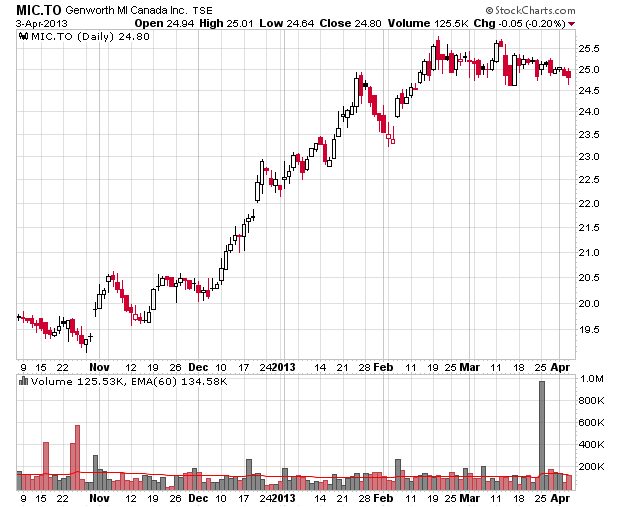
The chart has suggested there is an improvement of sentiment and there was also a scurry of investors in the past few days lightening up their risk in the company in the leadup to the quarterly announcement:

mic

The results have to be translated to exclude the positive impact of the December 20th announcement concerning how they were accounting for the government guarantee fund (which caused a non-trivial reversal in expenses). After doing all the adjustments, the magic number is 90 cents per share earned in the quarter.

The CMHC hitting its insured portfolio ceiling is also visibly helping the business on the private side, despite changes to amortization and down payment rules.

Delinquency rates continue to remain exceptionally low at 0.14% for the quarter (0.2% in the previous year’s quarter).

I haven’t been able to see the consolidated balance sheet as of yet, but book value is $30.62/share, while intangibles and goodwill is approximately 20 cents a share.

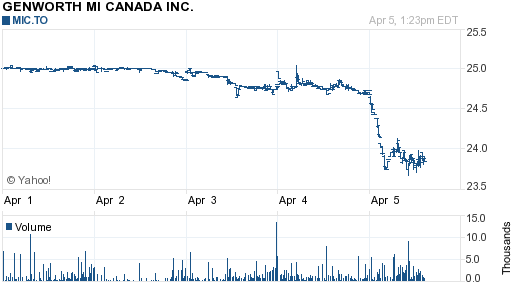
With a market value of $23.68/share, they are still deeply betting that the Canadian housing market is going into the gutter. While this might be true price-wise, what is important is the ability for people to pay off their mortgages, and this means employment. Nothing has changed in Canada at present with respect to this and although I believe housing prices will exhibit long-term depreciation (especially when interest rates decide to rise again), this will not adversely affect the mortgage insurance business unless if such price drops are precipitous.

The effective loan-to-value of the insurance portfolio is a good metric of how buffered the company is in the event of a mortgage default. Most of the embedded risk are on new purchases and as payments continue amortization of mortgages continue to result in risk reduction for the company. At the end of the year, the loan-to-value (essentially an inverse measurement of equity) on such insurance is as follows:

2006 and prior – 40%
2007 – 68%
2008 – 73%
2009 – 75%
2010 – 82%
2011 – 88%
2012 – 92%

It should be pointed out that on a typical 5-year fixed rate mortgage at current rates, if there was a 5/10% downpayment made, that the homeowner at the end of the 5-year period will have 18.7/23.0% equity in the property. This is the buffer room that insurance companies have with respect to price deprecation and also are compensated with the 2.75% premium paid on such mortgages.

Needless to say my original thesis is still in effect – Genworth MI is an inexpensive cash machine, even at current prices. Not as good as when it was in the teens when I bought my shares, but still is a very good value. All things being equal, at existing market values, investors should be realizing about a 14% annual return and this does not include any accretion that comes out of a realization of the negative differential between book value and market value. Compared to putting money in bonds, this is a pretty good return given the risk taken (which is low, but certainly not zero – this is what you are being compensated 11% over bonds with!).

The company also gives out a 32 cent/quarter dividend, but this is utterly irrelevant to the investment thesis, which is that there is incredibly deep value in the company. I am quite frankly surprised that the company already hasn’t been hived off to Sunlife (TSX: SLF) or Manulife (TSX: MFC), both of which desperately need diversification from the tragic errors they made with variable life annuities a few years back.

There’s excellent potential for this company to get back to book value and it is just a matter of being patient and not watching the Canadian real estate market implode. As long as that market does not implode, the shareholders should profit immensely.

Dell buys itself out at $13.65/share

Dell is buying itself out at $13.65/share. My quick summary is that for existing shareholders this is probably as good as it is going to get. Cash flows are going to decrease as the PC business continues to be eroded by tablets and mobile devices, and the company is going to be forced to face a very Hewlett-Packard type of situation where they’re going to have to get into serious competition against the likes of IBM – not inconsiderable amounts of risk involved.

Investors that really feel like a glutton for punishment in the PC space should consider an investment in Intel which would have correlation to the same marketplace. At a market cap of $105 billion there is zero chance of it going private but they are trading at a reasonable valuation and are not having their margins pressured nearly as badly as anybody in the PC space is.

Beginning the volatile ascent upwards

There is always something to remember regarding the tops and bottoms of markets – they are the most gut-wrenching volatile periods where there are fortunes to be made buying and selling.

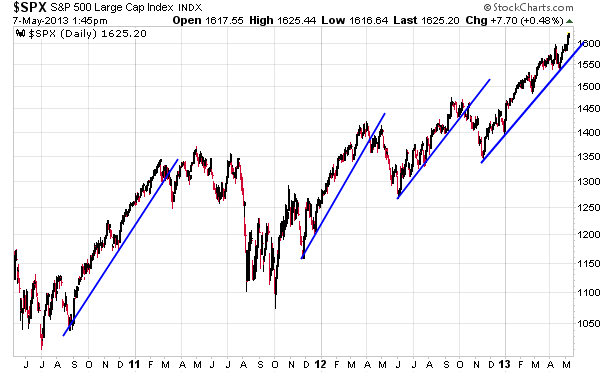
The markets over the past three months have mostly been a slow ascent upwards, but lately the sentiment has changed where “cash is trash” and you are starting to get retail into the woodwork – typically a huge yellow flag.

What the natural progression in these market cycles are is that retail will get involved to the point where every Joe and his/her neighbour will have to get into the equity side of the market because so many people around them are making too much money in the stock market. This is like shades of what happened in 1999 and early 2000 before the whole market collapsed during the Internet bubble collapse.

I’m not saying the market is bubbly – in fact, valuations are relatively reasonable (e.g. the two largest components, Apple and Exxon are trading at surprisingly reasonable valuations) but in order for there to be a top, expectations need to be at a maximum. I simply do not see the expectations to be at a maximum quite yet, and thus we will likely have more volatile trading that has an upward ascent.

Things are likely to get a little more exciting in the next few months.