Patience and cashing up

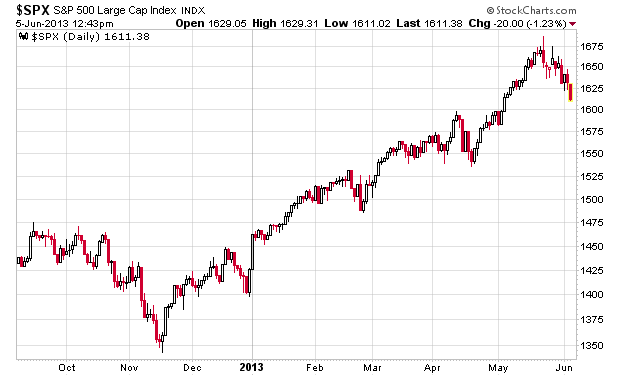
There hasn’t been a heck of a lot to report in the markets lately other than the S&P 500 continuing its rise up as the perception of the recovery continues.

That said, I believe it is unstable and historical norms would suggest that if one applies a bit of regression to the mean that we’re probably closer to the inevitable local high than the local low.

This is exactly why I have been slowly unloading some positions as they have gone higher. I’m no longer in a net negative cash position, and the cash percentage will continue to increase as the market continues to increase.

A few other observations.

One is that the Canadian dollar is testing lows. They have traded very narrowly since the 2008-2009 economic crisis and they are at the low end of the range. With the perception of Canada being a commodity market and the perception that our interest rates are not going to be rising anytime soon, this may signal a continued decline of Canadian currency relative to the USA.

cdw

The other observation are about long-term bond yields creeping up:

tnx

I am not sure what to make of this. Certainly bond traders are adding supply to the market and dumping it into equities, but this is the classic “risk-on” type formula where you have anticorrelation between bond prices and equity prices. Right now equity and any non-fixed income assets are winning.

I look at the year-to-date performance which is still significantly positive and my gut is telling me to cash out and call it a day until rainier days hit the markets. This will continue to happen as markets continue to rise.

Trends in REIT spin-offs

Loblaws (TSX: L) a few months ago announced they were bundling their real estate assets and spinning them off into a REIT. They will retain control of the REIT.

Now, Canadian Tire (TSX: CTC.A) is doing the same thing.

I detect quite a bit of froth in this space.

Financial-engineering wise, this makes sense because the real estate assets are currently overvalued with very low cap rates for such assets, more so than the underlying valuation of the businesses in question (in Loblaw’s case, groceries, and in Canadian Tire’s case, retail junk).

It makes me wonder if an entity such as McDonalds will consider the same – the amount of real estate assets they have is not inconsiderable.

Markets are partying on – when will it stop?

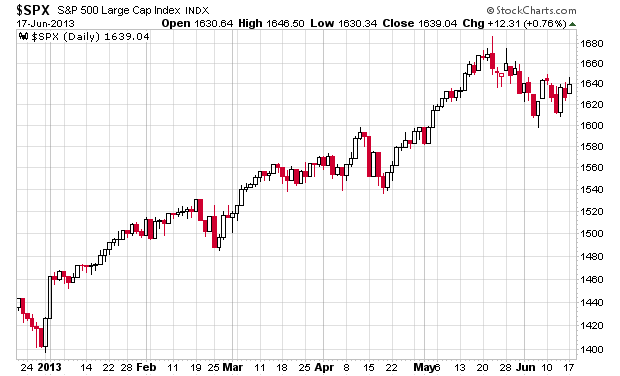
Stock markets are reaching all-time highs. The S&P 500 is well beyond the peak it reached in 2007. Sentiment is positive, what can go wrong?

spx

Please realize I am a horrible chartist and the trendlines drawn are merely approximations. However, over the past three years, the S&P 500 has seen three major periods of rallying and note the dates/values are approximate:

08/2010 to 02/2011 (6 months): 1,040 to 1,340 (+29%)
11/2011 to 03/2012 (5 months): 1,160 to 1,420 (+22%)
06/2012 to 09/2012 (3 months): 1,270 to 1,470 (+16%)
11/2012 to ??/???? (6 months and ongoing): 1,350 to 1,620 (currently) (+20%)

Given historical trends, this rally is about to run out of gas. The party will likely stop sooner than later, so be careful and raise cash.

Genworth MI’s sensitivity to unemployment rates

Genworth MI took a dive today because of the rise of unemployment in the Statistics Canada March release of the labour profile. Employment of full-time workers went down 54,000 workers.

mic

A rise in unemployment will increase the frequency of claims on mortgage insurance, while a decrease in property value will result in an increase in the severity of claims.

I believe the market is over-reacting to this news, but it is true that the default and delinquency rates for Canadian mortgages at present is quite low compared to historical norms.

On the brighter side, a lower share price makes the share buyback option more attractive.

Genworth MI upcoming quarterly report

There is a strong possibility that Genworth MI (TSX: MIC) will make some sort of announcement this month, specifically with respect to what they are going to be doing with their excess capital.

A chart of MIC shows that it has gone nowhere over the past month, but this has been since quite a run-up since last August when it traded all the way down to about $16/share.

mic

At the beginning of January 2013, MIC had about 210% of the minimum capital test that is required and the company has an internal target of 190%, which means that they had about $287 million in excess capital available. This does not include the additional capital that has accumulated in the first quarter of 2013.

Having this extra capital (noting that $337.87 million was in very low-yielding cash and short-term equivalents at the end of 2012) is lowering the return on equity, reducing portfolio yield and is producing a drag on performance. The cash can be safely returned into the hands of investors.

There are four options available, noting that it is unlikely that acquisition is a possibility given the very narrowly-defined scope of the industry the company is in:

1. Buy back shares: Likely through a dutch auction tender and at a higher level than existing market value. They have done this two times in the past.

On July 15, 2010, they announced a $325 million buyback between $24 to $28/share and on August 24, 2010 they announced that $26.40 would be the tender price. The stock closed on July 15, 2010 at $23.07/share and the day after it opened trading at $24.25. The market price on August 24, 2010 was $25.79/share. Genworth Financial proportionately tendered its shares to keep its 57.5% ownership stake in MIC.

On May 5, 2011, they announced a $160 million buyback between $26 to $29/share. The market value was $25.25 on the day of the announcement, and the stock opened at $25.55 the day after. On June 27, 2011, they announced that $26 was the price and the closing market value that day was at $25.77/share. Notably after this buyback, the market value fell in the subsequent months.

Given the current market value of the company, if they were to proceed with a similar tender, it would be almost on similar terms as the previous one, with perhaps a tender range between $26 to $29/share. This would be close to book value and this would achieve about a 10% reduction in share count and subsequent 11% increase in earnings per share.

2. Give a special dividend: A special dividend of $287 million would be equivalent to a $2.90/share dividend. The only special dividend declared to date was announced on November 3, 2011 of a $0.50 dividend, payable on December 1, 2011.

3. Some combination of the two;

4. No decision, keep the cash, and wait for less stormy days later.

Influential in this decision will be the needs of the parent company, Genworth (NYSE: GNW), whom is looking much more financially stable than it was back in 2010 and has no pressing need for an infusion of capital either way.

My guess at present is that Genworth MI will launch a tender for its own shares this month. They are still trading under my own estimate of its fair value.

As readers are aware, I have been long on Genworth MI since last July.