Talisman gets bailed out by Spanish firm

Everybody by now has heard that Talisman is getting bought out for US$8/share by Respol. Talisman was in the middle of some fairly serious difficulties and this is probably a very welcome takeover which should easily glide through a shareholder vote.

The focus of this post is not on the actual takeover, but rather whether the Canadian government will clear the acquisition or not – if it was a Chinese national entity doing the takeover, the primary headlines would be about whether the government would allow it or not. Presumably Talisman management would be smart enough to pre-consult with the appropriate federal officials to see if the acquisition would proceed.

This is very likely a welcome injection of about US$13 billion (when one factors in debt) and most institutions this very minute are likely dumping shares and bonds of the company – these assets will get redeployed elsewhere. Despite crude oil and gas being down a tiny bit today, most Canadian oil and gas equities have increased a moderate single-digit percentage.

The question is – are there more acquisitions to come in the Canadian oil and gas space?

Genworth MI valuation follow-up

Genworth MI is up about 4% following their quarterly report.

Book value (including intangibles) is $34.76/share diluted, while excluding intangibles is about $34.57/share diluted (there is not a lot of baggage on the balance sheet other than deferred policy acquisition costs that gets expensed off when revenue is recognized).

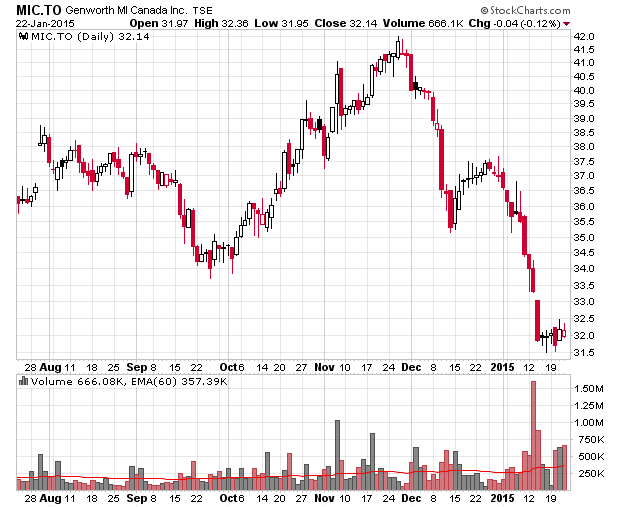
Taking the tangible book value and giving a standard 20% premium over book yields about $41.48/share, which is slightly below what it is trading at present ($41.70 as I write this). There is nothing exceptional in the portfolio that would warrant an extraordinary value beyond a percentage multiple over book (unlike companies like Berkshire and Fairfax which require some careful consideration with their own portfolios).

From a perspective of price-to-book for typical insurance companies, MIC has reached its full valuation and any gains to be made from here are likely to result from minting cash through operations rather than any huge expansion of the price-to-book multiple. This statement could be incorrect as market psychology usually likes to take things to excess and also the market is still yield-hungry. MIC does deliver 3.74% at current price with a historically rising dividend which would appeal to fund managers.

Income-wise, they are still at around the P/E 10 level which also has some valuation appeal for those that invest on that basis.

I would not feel too badly about lightening up my holdings at current prices, which I might do depending on other available options.

It is unfortunate that I would only get interested once again in this company if there was a true housing crisis in Canada. Otherwise it is unlikely the market would offer a huge discount to book that was initially given back in 2012 – where the equity was trading at over a 1/3rd discount to book along with many other insurers. These inefficiencies have been mostly corrected by the marketplace and the companies that are left with discounts to book have genuine issues that result in such valuations.

Looking over my previous work on MIC, I have done a relatively good job of analyzing the firm and it has been an amazing gainer for me over the past couple years. I wish I had candidates on my list that have nearly the risk/reward ratio that this one did.

Genworth MI Q3-2014 results

My previous projection on Genworth MI’s (TSX: MIC) Q3-2014 was mostly in-line.

Specifically, I projected a dividend increase (which was done – from 35 cents to 39 cents), and a likely chance for a special dividend (which will be 43 cents this quarter). Operating EPS was slightly less than I expected (95 cents diluted vs. “around $1” expected) and this was primarily due to the larger loss ratio.

A few notables:

1. They wrote $217 million in premiums this quarter, which indicated a very high volume market for mortgage insurable Canadian real estate. Year-to-year, about $20 million of the $56 million increase was due to the premium increase announced by CMHC earlier in the year. The rest of it is sheer volume, mostly in the high loan-to-value business (i.e. highly leveraged loans).

2. Loss ratio was 21%, slightly higher than I was expecting but still quite low by historical standards. The MD&A projects “35-40% over an economic cycle” and for those of you that are mathematically astute, this implies that there will likely be times where the loss ratio will be at the 60-70% range (and the common stock would be quite battered at this rate was it would show the entity as barely making any money and shelling out huge amounts for mortgage claims).

3. Delinquency rates are still quite low although they went ever so slightly up from quarter to quarter, interestingly enough in the low loan to value category. I believe this is just white noise.

4. OSFI regulations regarding minimum capital for mortgage insurers has more or less been finalized and using 2015 standards, has the company at a 223% position in terms of minimum capital required – the company’s internal target to survive a prolonged recession is 220%. This excess capital is presumably given off in a special dividend.

All-in-all, the company is continuing to mint cash and shareholders should be extremely happy. The downside to this is that I can’t really see how things can get any better for the company. Maybe if CMHC pulled out of the mortgage insurance market, but there is no way the federal government will allow this cash cow to stop generating money for the federal coffers.

At current valuations (CAD$40/share) I cannot recommend a purchase. It is on the upper end, but not quite exceeding, my fair value range for the company. This has been a big winner for me over the past couple years and it will be sad to see it leaving the portfolio, but superior gains are only to be made when there is blood on the street. A couple years ago, the blood was projected to be in Canadian real estate. Right now it is elsewhere.

Genworth MI Q3-2014 preview

Genworth MI (TSX: MIC) is going to report their 3rd quarter earnings on November 6, 2014. I do not expect anything too different than the previous quarter other than the seasonal factor of higher insurance underwriting as the Canadian housing market is more active in the summer.

Specifically, loss ratios are likely to be at significant lows. Q2-2014 reported 12%, which can only be classified as insanely low – Q3-2014 will be low, but probably not as low as that.

Earnings-wise, given their revenue recognition model, they will likely report revenues around the $141 million range and if their typical rate of realization on investment gains continue, should report around a $1.00 EPS level of operating income. Treasury bond yields were down quarter-to-quarter which should result in unrealized gains.

In terms of solvency, the company’s internal target is 220% of minimum capital required (which they state is sufficient for them to survive a severe recession). They reported 230% in Q2-2014, and this will be higher in Q3-2014. It is quite probable they will increase their dividend rate from 35 cents a quarter to a higher number (their track record has consistently lifted dividends in the Q3 of each year), but there is also a possibility of them declaring a special dividend to eliminate the excess capital.

I do not anticipate a share repurchase – management has been relatively diligent at only buying shares at or below book value.

Other than the usual cries of a pending Canadian real estate market crash, the only pending storm clouds for the company appear to be the fact that they might attract public scrutiny for simply being too profitable. While CMHC takes the lion’s share of the mortgage insurance market (and indeed this is a very lucrative industry for the crown corporation), Genworth MI takes the other slice of the market and earns duopoly-type returns for doing so. The party continues until it doesn’t.

Pinetree Capital Re-visited: Another debt opportunity

Please read my prior article, Pinetree Capital: Possibly the worst closed end fund ever, for a good backgrounder on what I am writing about here.

How would you like it if you bought an equity interest in 70 cents per share for the market price of 20 cents?

Normally most people would snap up on the opportunity. Every dollar you invested is backed by over 3 dollars of real net financial assets! What could be the catch?

The catch, of course, is that the assets you are purchasing are illiquid, of dubious value beyond a thin market quotation, and is managed by somebody that has an impressive track record of losing money.

Otherwise the market would not be giving such a steep discount to the whole consolidated operation.

What is interesting is that the capital fund continues to be hampered by debentures that have a 33% ceiling on the debt-to-asset ratio. Last year the fund breached this and had to pay handsomely for the privilege of obtaining more time.

Management has a huge incentive to not let the debtholders take over – surely the big players in the debenture space would liquidate the fund piece by piece and would not be hamstrung by pesky management or their insanely huge salaries.

The debentures, by virtue of the debt-to-asset covenant, are functionally secured, first-in-line debt, next in line to the margin loans the fund has been taking to fund its incredibly speculative investment portfolio.

They also mature in 1 year and 7 months time.

Now that the whole world stock market has tanked over the past month, speculative issues get hammered the most. Pinetree has been suffering, and its equity has thus gone down to the huge discount over stated asset value that you see today.

There is probably some value in the equity, but it will take time to realize the value due to liquidity issues.

However, the real value is in the debentures mainly because they have the noose over management at the moment, who have shown every indication they will dilute and use every trick in the book to maintain control of their lucrative salaries.

Who wants to invest in this train wreck? I don’t know, but if you have a very thick stomach wall for scraping the bottom of the investment barrel, consider purchasing some Pinetree Capital Debentures (TSX: PNP.DB) if you feel brave. There is a reasonable chance that you will be made whole.

Disclosure: I own the debentures.