Mortgage changes and Genworth MI valuation

By now the whole nation has heard of the proposed changes to mortgage financing and insurance requirements for Canadian mortgages.

Genworth MI (TSX: MIC) evaluated the impact of these changes and the payload of this was in the following paragraphs in their press release issued 4 minutes after the market opened yesterday:

Based on year-to-date 2016 data, we estimate that a little over one third of transactionally insured mortgages, predominantly for first time homebuyers, would have difficulty meeting the required debt service ratios and homebuyers would need to consider buying a lower priced property or increase the size of their down payment.

Furthermore, approximately 50% to 55% of our total portfolio new insurance written would no longer be eligible for mortgage insurance under the new Low Ratio mortgage insurance requirements.

The market proceeded to take MIC down from about $34 to $30 in short order, presumably on the basis that a third of their mortgage insurance market is going to get knee-capped due to customer income requirements.

mic

It is important for the reader to understand the difference between transaction insurance (which the typical retail investor is familiar with) and portfolio insurance (which is where a financial institution purchases insurance on its own behalf for the purpose of assembling mortgages and securitizing them for selling in the secondary marketplace).

I am generally of the belief that despite these regulatory changes, Genworth MI is very much undervalued at present pricing. There are quite a few variables at play in this space, which I will go over as follows:

1. On the basis of premiums written, portfolio insurance was 13% of Genworth MI’s business in 2015. There was a regulatory change (dealing with mortgage substitutions and time limitations for portfolio insurance) that is effective July 1, 2016 which caused a one-time spike in portfolio insurance demand in Q2-2016. The portfolio insurance market was already effectively squelched by regulatory change and this further change will dampen it further.

Because portfolio insurance is written on low-leverage mortgages, they are akin to selling significantly out of the money put options on mortgages. In Q2-2016, Genworth MI insured $26 billion in mortgages via portfolio insurance, but this only generated $78 million (0.3%) in premiums (the median loan-to-value was 65-70%).

I would anticipate that portfolio insurance will be a very small part of the future mortgage insurance market – I’d be surprised to see more than $10 million in premiums each quarter going forward.

2. Transactional insurance is the bread and butter of the business. The question is how much of consumer demand for insurance will be eliminated because consumers failed to pass the affordability test (due to using the Bank of Canada posted rates) versus these consumers simply choosing to downsize their financing requirements to fit with the new mortgage insurance parameters.

My initial estimate would be that transaction insurance would slow down by about 1/6th of ambient levels instead of the 1/3rd backward-looking estimate given in the release. The past four quarters had $686 million in transactional premiums written. Going forward, I’d expect this to decline to around $570-ish.

3. Clearly these changes are going to result in less premiums written for Genworth MI (and also CMHC). However, this will not impact the existing mortgage insurance portfolio. If Genworth MI decided to stop underwriting all business and decided to run off its mortgage book, shareholders would still be looking at north of their Q2-2016 book value of $38.23/share as the company recognizes revenues. In a relatively normal environment, the company’s projected combined ratio should be around 45-50% (which is above what it has typically been) and the unearned premiums (currently of $2.08 billion) would likely amortize to another billion in pre-tax income if the book were to be run off.

The terminal value of the operation, with the assumption they decide to shut everything down, would be very well north of the existing book value, and most of this capital would be freed up completely after 5 years (customers would have their mortgages amortized to a point where mortgage losses would virtually be impossible).

There are various ways to value companies, but they all generally depend on a function of income expectation and how much cash can be liquidated from the balance sheet if operations were to cease. In Genworth’s case, there is a huge margin of error between current market value, current book value, and a reasonable expectation of performance in future years.

Simply put, the market is valuing Genworth MI as if it is going to lose money in the future. I do not believe this is a reasonable assumption even though this Canadian government appears hell-bent on pushing us into a tax-induced recession.

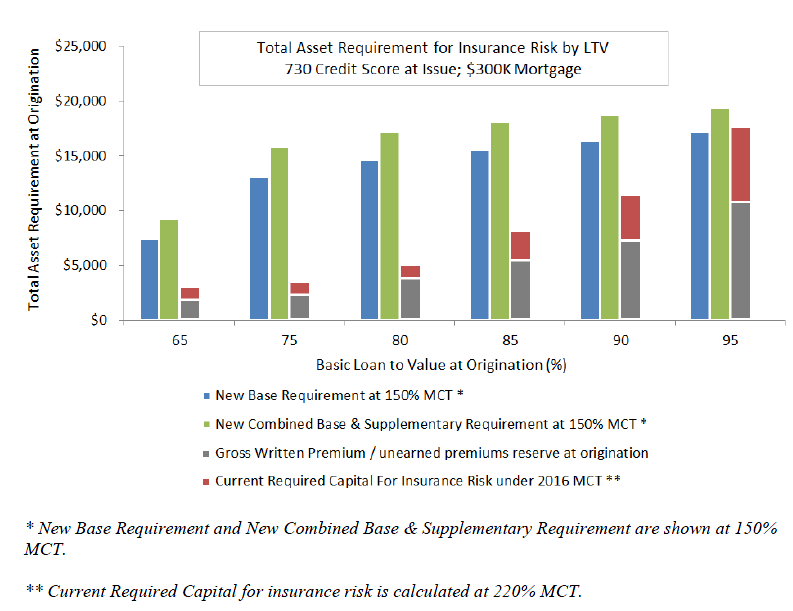
4. OFSI has released a draft proposal concerning the capital requirements of mortgage insurance companies, and in general this will require Genworth MI to retain more capital for its existing mortgage insurance portfolio. The reason is that the new capital requirements introduce a supplemental capital requirement for housing markets that are “hot”, which is determined by a price to income ratio. It is likely that mortgage insurers are going to raise premiums in 2017.

Genworth MI’s policy has been to keep its capital base above a certain level above its internal minimum (in the new proposal, the fraction will be above 150% of the revised minimum capital test) and distribute the rest of it in buybacks and dividends. Although the future rate of premium collection will be less, the company will be in a position to repurchase shares at a considerable discount to book value.

5. These changes in capital requirements force mortgage insurance companies to heavily err on the side of conservatism, both in terms of balance sheet strength and insuring customers that are quite strong (via the posted rate interest test).

6. The parent company (Genworth Financial) has stabilized considerably since last year and I still believe a low probability scenario is for them to exit the Canadian mortgage insurance market through a sale of the entity. They could certainly fetch more than CAD$30/share, but the question would be who the buyer would be – there are not a lot of obvious well-capitalized candidates, but I would think of Fairfax or even the CPPIB or a Canadian pension fund doing so.

7. It didn’t take a rocket scientist to realize that the government announcement of October 3, 2016 would be negative for transactional and portfolio insurance volumes, yet the market only reacted when Genworth announced the retrospective impact of the changes. Yes, I should have been there on the morning of October 4th and pounded the bid, but I was asleep at the switch and I would have expected the negative market reaction to be on October 3 and not a day after!

8. In relation to the rest of the financial entities trading on the TSX, Genworth MI is very much undervalued and the market has over-applied the negative effects of the regulatory change on the company by weighting its impact on future premiums written too heavily. Genworth MI could easily give its shareholders a boost by announcing a wind-down of operation and a release of capital as mortgage insurance policies amortize, but they will not do this simply because Canadian mortgage insurance is still too profitable. In the first half of 2016, they make approximately a 60% profit of every dollar of premium they recognize. Why give this up?

Where should Genworth MI be trading? Higher than what the market is currently valuing it. This is a fairly strong buy on my radar, despite the fact that it has been a long-term core holding since 2012 when I first invested.

Difference Capital

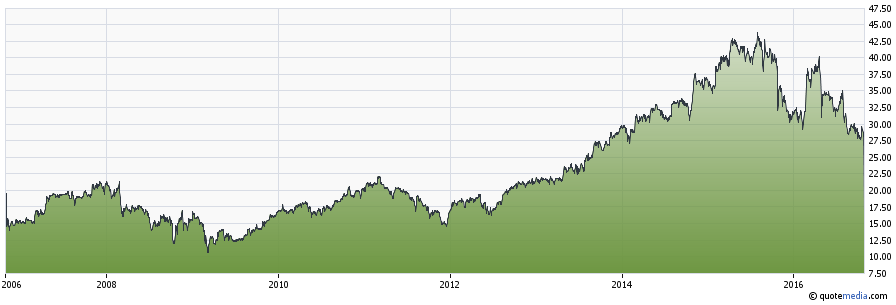
Difference Capital (TSX: DCF) was the venture capital corporation created by Michael Wekerle in 2012 (done via reverse merger of an existing corporate entity). It invested in a whole bunch of private entities in the hopes of making superior returns. While the going was initially good, it has steadily eroded in value as demonstrated by the five year chart.

dcf

In its modern incarnation, it has about $79 million invested (mostly in equity, and the rest of it in debentures and real estate) along a smattering of mostly private entities. They did employ some leverage in the form of a convertible debt offering and they did get in a bit of financing trouble as a result of the debt issuance, but for the most part they cleaned this up in 2015-2016 through buying back the debt at a discount, from $47 million outstanding at the beginning of 2015 to $32 million on June 30, 2016. The debt has an 8% coupon.

They also have $16 million in cash, and an extra $3 million in receivables if some of their prior asset sales do not incur claims by the end of 2017.

The math is simple – can they cover the $32 million in debt over the next couple years? Assuming there are no material claims, they have $37 million to pay off in interest and principal (interest expense assuming no buybacks), which leaves them about $18 million short if you completely dedicate their existing cash and receivables against their debt. Their burn rate is also about $3 million a year, excluding interest, offset by about $1 million in investment income.

The equation then becomes a matter of raising $22 million over the next couple years to service their debt, or to obtain an extension of their debentures (with some sort of sweetener). I view the latter to be the more likely scenario, but it is quite conceivable that they could cash out an investment or two and partially chip away at the $22 million figure. The other option is to equitize the debt at maturity, but this would be done at a significant discount to their proclaimed NAV.

The debt is trading at 97 cents on the dollar and given everything I have seen, I would view it as over-valued at present. The market is weighing the probability of a clean maturity to be too high.

No positions.

Petrobakken / Lightstream Resources bites the dust

Lightstream Resources (TSX: LTS), formerly known as Petrobakken (TSX: PBN), was formerly a subject of analysis on this website. Despite the company having excessively high yields and posting (and boasting) about huge cash flows through operations, I remained very skeptical of them. Then the oil price cratered at the end of 2014, and then all the excess leverage the company held came to bite it.

The senior unsecured creditors failed to reach an agreement with the company, and as a result they will be going into CCAA proceedings.

I have never held shares of this company. The entity, once restructured, should be mildly profitable in the current oil price environment, but they need to shed a healthy quantity of their debt. It is a classic case of using too much leverage when the times are good.

Turning down a very likely 12% annualized return

There is a catch to the title – the 12% annualized return is in the form of a 6.6% return over six and a half months.

I have mentioned this before (at much higher yields) but Pengrowth Energy debentures (TSX: PGF.DB.B) is probably the best low-risk/medium-reward opportunity in the entire Canadian debt market today. At the current price of 97 cents (plus 5.5 months of accrued interest payments), you are nearly guaranteed to receive 100 cents plus two interest payments of 3.125% each. The math is simple – for every 97 cents invested today (plus 5.5 months coupon which you’d get 6 months back at the end of September), you will get 103.4 cents on March 31, 2017, the maturity date. This is a 6.6% return or about 12% annualized.

By virtue of Pengrowth’s debt term structure, this one gets the first crack at being paid by their billion-dollar credit facility which was untapped at the last quarterly report.

The only risk of any relevance is that the company will opt to exchange the debt for shares of PGF at 95% of the 20-day volume-weighted average price, but considering that the debenture face value is $126 million vs. the current market cap of $1.1 billion, the equity would not incur too much toxicity if management decided to do a virtual secondary offering at current share prices.

The company did give plenty of warning that at June 30, 2016, current oil/gas price levels and a 75 cent Canadian dollar would result in them potentially blowing their covenants in mid-2017. But this is of little concern to the March 31, 2017 debenture holder. They will get cashed out at par, either in cash or shares.

I own some of these debentures, which I purchased earlier this year when things were murkier and much more attractively priced. Given some recent liquidations in my portfolio, I could have reinvested cash proceeds into this apparently very low risk proposition. But I did not.

So why would I want to decline such a no-brainer opportunity and instead funnel it into a short-term bond ETF (specifically the very-low yielding Vanguard Short-Term Canadian Bond Index ETF at TSX:VSB)?

The reason is liquidity.

In any sort of financial stress situation, debt of entities that are “near guarantees” are traded for cash, and you will suddenly see that 97 cent bid moved down as entities are pressured to liquidate. For securities that are precious and safe, such as government AAA bonds, there is an anti-correlation to market pricing that occurs and ETFs holding these securities will be bidded up in response.

VSB is not something that you are going to see move up or down 5% overnight in a real panic situation, but it will retain its liquidity in stressful financial moments. The selection of VSB is different than the longer-term cousin, which has more rate sensitivity, but something has changed in the marketplace where equity and longer term debt asset classes have decided to trade in lock-step: as demonstrated in last week’s trading in Japan and the Euro-zone. When equities and long-term government debt (nearly zero-yielding, if not negative) trade in the same direction, it gets me to notice and contemplate what is going on.

The tea leaves I have been reading in the market suggest something strange is going on with respect to bond yields, the negative-interest rate policies and their correlation to equities. I’m not intelligent enough to figure it out completely, but what I do know is that putting it into so-called “low risk” opportunities like Pengrowth debentures come at future liquidity costs in cash if I needed to liquidate them before maturity. Six and a half months can be a long time in a crisis situation, and we all see what is going on in the US President Election – markets are once again seriously considering Donald Trump’s election now that Hillary clearly isn’t healthy enough to be Commander-in-Chief of the US Military. The public will ask themselves: If she can’t stand up to attend a 15-year memorial of 9/11, what makes you think she will be able to stand up when the terrorists strike the homeland again?

The markets have vastly evolved since last February where things were awash in opportunities. Today, I am seeing very little that can be safely invested in, which is getting me to change what I am looking for, but also telling me that I should relax on the accelerator, raise cash, and keep it in a safe and liquid form until the seas start getting stormy again. And my gut instinct says exactly that: winter is coming.

Genworth MI – Despite housing slowdown, still undervalued

mic

Genworth MI (TSX: MIC) has gone nowhere in the past three months, despite the corporation lowering losses from insurance claims and the housing market being relatively stable to date. The company trades at a 10% discount to book value, and also at a P/E of 9 (realizing that these two metrics are not the only ones that insurance companies should be valued by, but suffice to say, unless if the insurance written is completely bad, it is difficult to lose money when buying something under book and under a P/E of 10).

There are a few cautionary flags – the reduction of their portfolio insurance business (which allows third-party financing firms to securitize and sell their lower loan-to-value mortgages with portfolio insurance) and also the slowdown in housing sale volumes, combined with the attempts by the BC Government to quell foreign ownership with a 15% transfer tax for non-permanent residents or citizens.

In particular, the transfer tax has caused quite a quenching of the roaring housing fire that was occurring in the southwestern BC housing market. This in turn has spooked the various markets linked to residential real estate. However, it is my assessment that as it relates to mortgage insurance, the market has continually over-estimated the impact of the short-term gyrations in Canadian real estate.

What would cause issues is mortgage serviceability and this is a function of employment, not housing prices. Although there is correlation between housing prices and construction-related employment, if there is not mass unemployment it is difficult to see how somewhat lower housing prices would cause difficulties in the mortgage insurance space. Indeed, the $300 billion ceiling for private insurance in Canada seems to be more of a daunting barrier than the state of the actual insurance market.

It is worthy to note that during the depths of the 2008-2009 financial crisis that the loss ratio peaked out at 46% (June 30, 2009) and this still resulted in a profitable book for the firm. The subsequent combined ratio peaked at 62%, which means that for every dollar of revenue booked that the firm recorded a gross profit of 38 cents.

Also, the corporate has increased its quarterly dividend every year for the past 5 years – it is currently 42 cents and if prior patterns continue they will likely raise it to 45 cents per share. Although the yield is not important (cash generation is), there are various market participants out there that only care about yield and this would serve to boost the stock price.