BP cuts dividend

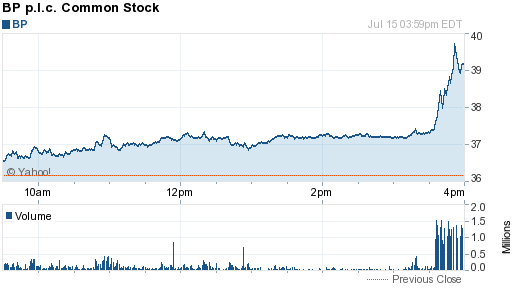
BP has now cut its dividend:

As a consequence of this agreement, the BP Board has reviewed its dividend policy. Notwithstanding BP’s strong financial and asset position, the current circumstances require the Board to be prudent and it has therefore decided to cancel the previously declared first quarter dividend scheduled for payment on 21st June, and that no interim dividends will be declared in respect of the second and third quarters of 2010.

The Board remains strongly committed to the payment of future dividends and delivering long term value to shareholders. The Board will consider resumption of dividend payments in 2011 at the time of issuance of the fourth quarter 2010 results, by which time it expects to have a clearer picture of the longer term impact of the Deepwater Horizon incident.

The Board believes that it is right and prudent to take a conservative financial position given the current uncertainty over the extent and timing of costs and liabilities relating to the spill. BP’s businesses continue to perform well, with cash flows from operations expected to exceed $30bn in 2010 at current prices and margins before taking into consideration costs related to the Deepwater Horizon spill. BP’s gearing level remains at the bottom of its targeted band of 20-30 per cent. In addition, the Company has over $10bn of committed banking facilities. To further increase the Company’s available cash resources, the Board intends to implement a significant reduction in organic capital spending and to increase planned divestments to approximately $10bn over the next twelve months.

This decision has a double benefit to BP – first, it will provide them some mild political cover for not dishing out money to shareholders. In theory, this is a value-neutral decision since the company is effectively investing that capital into its liabilities (either related or not to the Gulf of Mexico oil spill). However, value funds and income funds will likely jettison BP shares for mechanical reasons.

The second benefit is that each quarterly dividend costs BP about $2.63 billion dollars – this money will shore up their balance sheet. Since they have some maturing debt that needs to be paid off, BP needs to conserve cash to avoid a short raid on their stocks and bonds – already their short-term maturities are trading around 7-8% yields to maturity when they should really be trading around 2-3% (i.e. nearly a “sure thing”).

For people that insist on getting into BP, the next couple weeks should be a good time. The exact timing in terms of price is an unknown variable, but I would estimate layering in 25-30 dollars a share (e.g. if it goes down to 28, you will get a 40% allocation).

There is also an off-chance that the US government will introduce some other hidden risk into the equation that would end up tanking the stock price. You would think, however, that most of the risk has already been introduced into the stock price.

Option fans should also consider that the implied volatility for BP is well into the 90’s (very high when compared to its price history).

Prediction: BP vs. Drillers

I have now been asked by many different people about the valuation of BP.

My response to them is the same as before: “I would not bother thinking about this [buying shares] until BP has cut their dividend.”

However, I will offer up a prediction:

Over the course of the next 2 years, $10,000 invested in BP (NYSE: BP) at the closing price of June 16, 2010 will under-perform $10,000 evenly invested in Transocean (NYSE: RIG) and Noble (NYSE: NE). Assume dividends are not reinvested and remains as zero-yield cash.

The analysis of BP has converted from a financial/resource calculation to purely a political risk calculation. The current US administration is very adverse towards their non-donor constituents and while BP has donated scalds of money to the Democratic party in 2008, it is very likely they will still be made into a scapegoat for the Gulf of Mexico oil spill.

I am very interested in the drillers, and I am waiting for one more “shoe” to drop before likely placing some bids. Implied volatility on Transocean would suggest that selling near-the-money put options is a viable strategy for entry, but I am waiting for a price drop before executing on that. This also goes outside of my “don’t invest in companies outside an English-speaking jurisdiction” rule, but there are times to make exceptions and it seems to be close to one.

I also notice that Canadian oil sands companies are getting quite a bid – I am guessing capital is flowing into the politically safe Alberta oil sands. Suncor and Cenovus are the big players here, although there are a couple interesting bitumen plays that have a smaller capitalization worth looking into.

All of these oil investments assumes an implicit risk that the price of oil will at least be stable or preferably increase.

When will the Lulu bubble burst?

People in and around the Vancouver area are probably quite aware of Lululemon, a marketing firm that sells retail apparel. Most people would consider them to be a retail apparel firm, but I would dispute this classification.

I have been watching this company since it went public, not because I ever intend to buy shares in the firm (or their clothing), but rather because it is a Vancouver-based business that has been insanely profitable and has done an incredible job permeating amongst my own age demographic.

Although I have very little intuition about fashion, I have studied the industry extensively and currently have some money where my mouth is in the form of a stake in corporate debt of Limited Brands (one major holding they own is the branding to Victoria’s Secret).

This morning, Lululemon reported their first fiscal quarter results. While I am less concerned about them beating or missing analyst estimates (they exceeded them) my focus is on their gross margins – 54% for this year’s quarterly result. This is a high gross margin for an ordinary clothing manufacturer, so they are adding much value on the marketing side and thus having their customers pay more for products that otherwise would cost the same to make.

Gildan Activewear, for example, has a gross profit of around 28% in their last quarter.

If you look at other firms to benchmark Lulu with (of which I will use Limited Brands, Abercrombie & Fitch and Nike) – Limited’s after-Christmas quarter reported gross margin of 36% (which includes “buying and occupancy” costs), while Abercrombie’s gross margin was 63% (strictly on “cost of goods sold”, not including store and distribution expenses), and Nike’s is 47% (albeit for the Christmas quarter, but their yearly results are comparable to this). If you were able to drill into the numbers and make them on an equivalent basis (which is not very easy to do when mining the details of the company’s detailed quarterly reports that they externally report), the profitability of Lululemon is not that much higher than equivalent (i.e. “high-end”) and established US corporations.

So looking at a relative valuation basis, you now have the following (not factoring in Lulu’s recent quarter):

LULU – Market cap $2.8 billion, TTM revenues $453M, net income $58M; (cash: $160M, debt: $0)
LTD – Market cap $8.0 billion, TTM revenues $8.84B, net income $558M; (cash: $1.7B, debt: $2.8B)
ANF – Market cap $3.1 billion, TTM revenues $3.01B, net income $90M; (cash: $633M, debt: $71M)
NKE – Market cap $34.8 billion, TTM revenues $18.65B, net income $1.73B; (cash: $4.0B, debt: $0.6B)

This very brief comparison gives me the belief that Lululemon is being valued as a marketing company (like Nike) rather than an “high-end retail” apparel company (like Limited and Abercrombie). It is also much, much differently valued than a “commodity clothing” firm like Gildan (which does not have a direct retail presence).

The most cursory glance at the financials would lead one to believe that if you were to believe that LULU was a “buy” at the moment, they would have to grow, considerably, into their valuation even to make it comparable to Nike’s valuation level. Assuming a “steady state” valuation of 20 times earnings and/or 2 times sales, you would have to extrapolate Lulu growing their top line at 30% a year for roughly 5 years with the share value being roughly the same as it is now.

Even though in the last quarterly result they grew their top line 70% over the previous year, it is very difficult to swallow a company’s shares thinking that they have an implicit requirement to grow their sales from $450M/year into $1.4 billion just to cut even. Will they do it? Who knows. But the level of baked growth makes the stock look very risky for the reward offered – if they have one misstep, they will see a 2008-style haircut. It won’t be nearly as bad as the 90% cut from the 2007 highs, but it will be considerable.

British Petroleum and the drilling companies

I have done nothing other than look at the summary financial statements of BP, but on paper they look undervalued. The mess in the Gulf of Mexico, however, will be costing them considerable amounts of money. I’ve projected a couple years of earnings ($40 billion) that will likely go down the tubes as a result of this environmental incident.

The market will take BP down to the point where nobody will expect, and when everybody has written off the stock, that is usually the time to buy. In essence, this is a psychological play, so it involves more game theory than financial analysis since it is likely that BP will remain a continuing entity in the future. Their balance sheet is fine – about $40 billion in debt and $7 billion in free cash flow ($20B income) in 2009, so they won’t be facing any solvency issues.

The better question is whether one should invest in the drilling companies. It is likely lease rates will drop since offshore drilling will have significant demand drops and the market has already been pricing this in. As an example, Transocean has also been slaughtered.

I generally do not look into companies that are not trading in Canada or the USA, and BP is a British company, so I will not be considering them seriously. However, the other companies (e.g. the aforementioned drillers) I will be investigating. Since there are so many eyeballs on this sector, there must be other circumstances (e.g. panic) that would be required to ensure that you are getting good value for your investment. It is also exceedingly difficult to predict when to catch the falling knife and the investment to invest in BP is essentially that – you need to place your purchase orders when everybody has gotten their hands so bloodied up trying to catch the knife that they have given up trying.

I would not bother thinking about this until BP has cut their dividend.

Apple vs. Microsoft

It was only a couple months ago that I wrote about how Apple and Microsoft’s market capitalizations are closing in on each other.

Today, Apple for the first time has a market cap higher than Microsoft, at $222 billion for Apple and Microsoft at $219 billion.

The real issue with the two companies is that Microsoft is really living off of its legacy product lines (Windows and Office) while Apple has come out with a huge stream of technological innovations, mainly the iPod and iPhone product lines (which secretly get the users to lock into their business model, similar to how software in the 90’s was “for Windows” only).

At this time, I don’t see how Microsoft can demand a market premium for its position – on the retail end, Windows has not fundamentally changed in 15 years (Windows NT 4 was the quantum leap product, and Windows XP was a great retail refinement of the Windows NT core). Microsoft Office has not fundamentally changed since the release of Office 97; everything else subsequent has been cosmetic in nature. With competitors chipping away at the cost premium that Microsoft charges (typically to large-volume corporate licensees), their ability to extract margin out of the marketplace with upgrades and obsolescence upgrades is limited. Microsoft will continue to produce cash like no tomorrow, but it is tapped out in terms of growth. Microsoft shares, as a result, trades like it – analysts expect $2.31/share in FY2011, while the stock price is $25.01/share – a yield of 9.24%.

Apple, on the other hand, has plenty of room to invade the computer marketplace, and combined with their mobile device market seemingly can command a high premium and has room to grow. As a result, they are given a premium in the stock market – analysts estimate $15.42/share in FY2011, on a stock price of $244.11/share – a yield of 6.32%.

Although Apple has competitive issues (i.e. Google is trying to invade the territory), it remains to be seen whether it can keep Google and other competitors at bay. Certainly its marketing arm continues to create users that have an almost religious-like adherence to its products.

I don’t have a position in either company and don’t plan on establishing one.