Petrobank / Petrobakken – How to play Petrobank
I noticed that one of the most bullish people on Petrobank (TSX: PBG) / Petrobakken (TSX: PBN) that I know of on the internet has stated they have “Caved to a moment of weakness” and increased the concentration of their PBG holdings to 40% of their equity portfolio. This is as close as you can get in finance to an “all-in” bet without actually going all-in.
I wrote about portfolio concentration in a previous post, and if your portfolio size is a sufficiently small fraction of your annual income, then making concentrated bets is not only acceptable, but ideal.
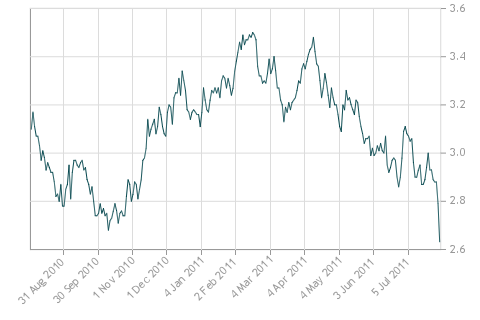
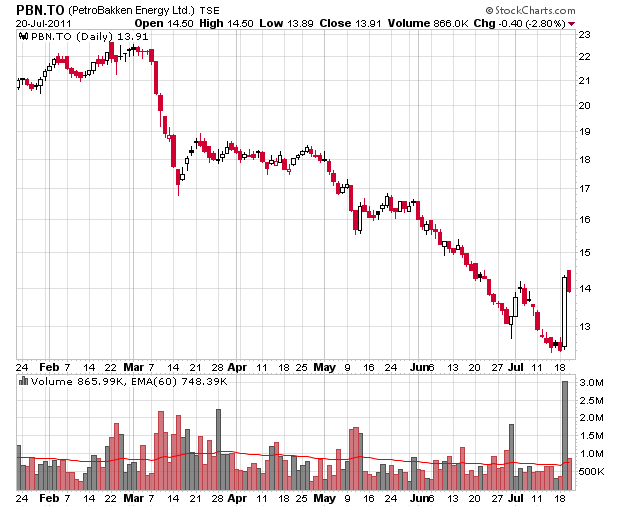
PBG owns 59% of PBN, so PBG is joined at the hip with PBN’s performance. Indeed, looking at the consolidated financial statements of PBG is quite challenging since one has to mentally sort out what PBN is doing away from the main figures and this takes a bit of work. They do some segmenting in the management discussion and analysis, but the relevant component is that PBG’s business unit does not make any revenues and spent about $54M in Q1 for capital expenditures. Also, when subtracting the market capitalization of PBG’s ownership in PBN, PBG’s price is around $40M. If you believe PBG’s operations have any value at all, it would make PBG the better bet between the two companies.
A very relevant issue for PBG is that they depend on PBN’s dividend stream to provide approximately $100M/year of cash. PBN’s dividend level is at a point where I would expect it to be dropped at some point in the future. PBG also has a mostly untapped $200M line of credit at its disposal and it has the option to selling more of its PBN stake, although I am sure management would not want to press down PBN further from current levels.
A believer in PBG’s operations (but not PBN) would likely be better served by going long PBG and shorting PBN. Calculating the ratio is an exercise in arithmetic: an investor purchasing 100 shares of PBG can offset the PBN ownership by shorting 104 shares of PBN.
Monetary Policy in a POW camp
Reading the article “Economics of a POW Camp” should reinforce the notion that when you have less currency, you get deflation.
Encana – PetroChina deal fallout not that bad
I notice natural gas titan Encana (TSX: ECA) traded a bit lower after they announced that their previously announced joint venture with PetroChina for a shale gas field fell through.
I do not view this as being too adverse an event – Encana’s management has typically been quite long-range viewing and they are dealing with a very difficult situation in the natural gas market, with spot prices currently CAD$4.30ish and typical marginal costs of extraction higher than this. They have frequently stated that they believe the natural gas marketplace is artificially low and the best thing for resource companies with plenty of reserves on the ground is to wait for higher commodity prices before drilling. My guess is that PetroChina’s management had more of a short term focus.
Back in fiscal 2008, spot natural gas went well above $10 and Encana had a banner year on earnings, reporting over $8/share (note the 2008 number is not a direct comparison with the present company because the company split off Cenovus in 2009 which also benefited from $150 crude oil). If we ever see higher natural gas prices, Encana should be well positioned to capitalize. Currently with shale gas drilling there is a huge supply glut in the marketplace.
In 2010 the company earned $2/share on an average spot natural gas price of about $4.25 per mmBtu. Encana at present values appears to be a fairly good “grandmother” type stock that should retain its value even in adverse market conditions. Even in the depths of the 2009 economic crisis (which is generally what I use to gauge maximum downside) the stock did not trade lower than 20% below existing market values.
It is an interesting comparison to look at a company like Microsoft and ask oneself whether it is likely in the medium range future whether licenses for Windows and Office will be more or less valuable a commodity than natural gas.
Connacher – Short term yield
Connacher Oil and Gas (TSX: CLL) is a small oil sands producer. Like OPTI (TSX: OPC), it is heavily in debt. Unlike OPTI, there is a valid business case to be made that would suggest that it could actually pay its debt without bankrupting its shareholders. The forecast does depend on the price of oil (and specifically bitumen) continuing to be high. The bulk of the capital expenditures on its two primary oil sands projects (Pod One and Algar) has been completed and so the cash requirements have been primarily maintenance and additional exploration.
The company is capitalized with roughly $500 million in equity and $1 billion in debt. The company was able to perform a term extension on its first lien and second lien notes, pushing the maturity away from 2014/2015 to 2018/2019 and incurring less of an interest rate bite (in exchange for some capital – the loan went up from roughly $800M to $900M).
There is also a $100M senior unsecured debenture (TSX: CLL.DB.A) which is due to mature on June 30, 2012. Given the company’s cash flow situation and available credit (having extended a credit facility for $100M for three years, a facility currently not used) it is quite probable that the debentures will be redeemed at maturity.
At a 98 cent price that would imply a yield to maturity of about 6.8%. The primary risk to the successful maturity of this issue would be if the price of bitumen dropped significantly beyond existing levels. Closer to the maturity date, it is likely the company will float another convertible debt offering to refinance.
My assessment is that there are probably worse places to put short term investment money than the debenture issue.
Disclaimer: I own some of these debentures from the economic crisis (early 2009) when they were trading under 40 cents.