Genworth MI – 4th quarter 2015 report

Genworth MI (TSX: MIC) reported their 4th quarter and year-end earnings yesterday.

I have been covering Genworth MI since 2012. While I liquidated a significant portion of the company in 2014, as a result of the price depreciation exhibited over the past three months I have taken the liberty to once again make MIC the largest position in my portfolio (at prices from 22 to 25 a share) as I believe it is trading well below my estimate of their fair value. Companies trading at a discount of over 1/3rd of their tangible book value and at a P/E of 6 either are fraudulent (which is clearly not the case with Genworth MI) or have external sources of perceived stress causing such an intense discount.

Financial Statement Review

I will pick off some salient details of their report.

1. From year-to-year the balance sheet saw an increase of about CAD$450 million of real assets (cash, bonds, preferred shares, common stock) relative to the end of 2014. Roughly half of this was through an increase in deferred premiums (money collected for mortgage insurance that is held on the liability column of the balance sheet until it is recognized as actual revenue in accordance to a model for historical loss experience) and a good chunk through retained earnings.

2. Premiums written were up to $809 million for the year, compared to $640 million the year before (a 26% growth). You can thank the CMHC for this. Alberta went down from 26% in 2014 to 22% in 2015.

3. They continued to add to their preferred share portfolio; they sold their common shares and moved to preferred shares, which is still sitting on an unrealized loss position of $33 million on a $281 million cost base; this is better than Q3-2015 which was $42 million unrealized loss and $236 million, respectively. Given the existing valuation state of the Canadian preferred share market, shifting to preferred shares is a value-added decision especially when considering the positive tax consequences of inter-corporate dividend income for insurance companies. 92% of their portfolio is rated “P2” and the remainder is “P3”.

4. The company repurchased $50 million of shares and outstanding shares is down from 93.1 million at the end of 2014 to 91.8 million on December 2015.

5. The company’s debt maturing in 4.5 years has a yield to maturity of roughly 3.5% (traded at 109 cents on the dollar at year end). Their maturity at 8.25 years out was trading at a very slight premium and is YTM 4.2%. Back on November 6, the company was exploring a debenture offering. Their cost of raising debt capital seems to be relatively low, so it is curious why they never proceeded with it.

6. Delinquencies have not materially picked up in Q4-2015 (rate still is 0.1%).

7. Minimum capital test ratio goes from 227% to 233%. Management has pledged repeatedly that their target is “modestly above 220%” in terms of capital management. It is getting to the point where they will likely execute on another share buyback, and considering the huge discount to book value, they should consider a dutch auction at around CAD$25 to get those shares very cheaply off the books instead of dealing with a thin marketplace (recognizing that Genworth Financial owns 57% of the shares outstanding). As they have 13% in excess of 220%, this translates into about $203 million in excess capital.

If they managed to buy back 8 million shares for $200 million, they’d be able to increase book value by over a dollar a share! At existing valuations it would make complete sense for them to go private, but since Genworth Financial is facing huge financial challenges, they’re not the entity that is going to do it. This is a contributor to the depressed share price of Genworth MI (the market knows that Genworth Financial is facing pressure to sell the entire asset for a pittance).

8. The company expects lower amounts of mortgage originations in 2016. This will negatively impact premiums written in 2016. They did take 4% market share from CMHC in 2015, however, which may offset the decrease in originations.

9. Loss ratio is expected to be between 25-40%, which is more than the 20-30% guidance given for the 2015 year. Loss ratio guidance has always typically been conservative in nature. Considering the combined ratio for 2015 has been around 40%, an extra 10% on the loss side would put it at 50% and thus not anywhere close to endangering the profitability of the company.

Extra thoughts concerning valuation

Stated book value per diluted share is $36.82 – this is 35% less than the current market value of $23.91/share. If the company continues to book premiums written at $800 million in 2016 and maintain a combined ratio of 50% (30% loss, 20% expense), this would still be quite an undervalued entity.

I see two issues of market price stress:

1. The perception that the Canadian housing market will collapse and cause a huge wave of defaults which would bring mortgage insurers down like what happened in the USA in 2008;

2. Parent Genworth Financial’s issues spilling over onto Genworth MI – Genworth Financial needs money out of their subsidiaries and the trickle-down effect of dividends will not cut it for them. They can consider capital transactions (share buybacks) and keep their proportionate stake which enables them to bleed money out of the company at an accelerated pace, but this would still not be adequate for their situation. The market is likely taking the MIC subsidiary down in value on the implied assumption of a fire-sale of the 57% stake in the company. Of course, Genworth Financial would have to be completely desperate to do it at a 35% discount to book value (not to mention a P/E of 6), but the question here would be: Would they be willing to sell the whole thing at book?

Dundee Corporation – DC.PR.C – Series 4 Preferred Shares – Amended Exchange Offer

You can read my previous analysis piece on the original exchange offer here.

Dundee Corporation has announced a revision to the exchange offer. This offer would have never been made if there were sufficient votes to accept the original exchange offer (2/3rds of votes required).

The management information circular has not been posted yet, but James Hymas beat me to the punch to providing some of his always excellent analysis on anything relating to preferred shares.

My own quick summary is: the deal stinks less compared to the original offer, but it still stinks.

The revised terms of the amended offer compared to the original exchange offer include:

– The removal of the $0.223/share consent payment for shareholders voting yes to the proposal before a specified date.
– The ability to redeem 15% of the issue on June 30, 2016 and a further 17% of the then-issue (i.e. another 14.45% of original issue size) on June 30, 2018January 31, 2018;
– An increase of the dividend rate from 6% to 7.5%;
– Granting of 0.25 warrants to buy DC.A stock with a strike price of CAD$6.00 with an exercise price of June 30, 2019 (which will be listed on the TSX).

Closing Market Prices for Reference

DC.A: $5.95/share (no dividend)
DC.PR.B: $12.00/share (11.9% yield)
DC.PR.C: $14.43/share (6.2% yield)
DC.PR.D: $9.50/share (11.8% yield)

Analysis

The meeting date has been postponed to January 28, 2016, but shareholders of record on December 3, 2015 (per the original exchange offer) will have a vote on the matter. They chose to keep the original record date – a revised record date would include shareholders that were more willing to buy into the terms of a sweetened exchange offer.

By far and away the most important provision is the removal of the $0.223/share consent payment. This consent payment introduced the concept of a prisoner’s dilemma where if you believe the deal was going to pass, you would be incentivized to vote in favour of the deal despite how bad it was.

Without a prisoner’s dilemma, there is no incentive to voting yes for a marginal or mildly adverse offering (which was the only way the previous offering had any chance of passing).

This deal still stinks, but the removal of the $0.223/share carrot will remove votes in favour because (and this is my personal speculation) most of the shareholders are angling for the June 30, 2016 redemption.

So now, shareholders can vote against the proposal and face no “punishment” of having missed out on a consent payment.

Notably the consent payment for the intermediaries is still in effect – brokers will receive $0.1784/share for each vote in favour received by January 21, 2016 and $0.0892 by January 26; so if you are indeed in favour of this bad deal, it would be in your best interest to vote your shares at the actual meeting so the company doesn’t have to pay out consent payments to third parties!

The ability to redeem 15% of the shares on the original June 30, 2016 redemption date is “nice”, but not of material economic consequence. The subsequent tranche (14.45% of the original offering size) on June 30, 2018January 31, 2018 is long-dated enough that credit risk considerations come into play (for instance, the company’s credit facility would have to be renegotiated at this point and you would expect their subsidiaries would actually start making money at this point).

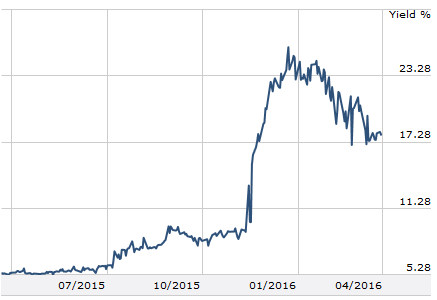
The increase of the dividend rate to 7.5% reflects the very weak trading performances of the other two preferred share issues (yielding nearly 12% at current prices). James Hymas has done a much better job than I could explaining the quantitative details of this component. Credit risk, especially by redemption time, becomes a huge factor in properly determining the course of action for this exchange offer. Dundee is good for a June 30, 2016 redemption through the unused portion of their credit facility. After this, who knows?

I will attempt to ballpark a valuation of the warrants. The company stated the warrants would be listed on the TSX if the exchange offer is accepted and this would give preferred shareholders a venue to liquidate for immediate cash proceeds. While the historical volatility of Dundee common shares as of the past 30 days has been around 80%, their at-the-money options currently trade at an implied volatility of 42%. Using Black-Scholes valuation (which is not the best way to value long-dated options, but is good enough for paper napkin purposes such as this post) we get an option value of $1.84/share, or about 46 cents per preferred share (as each share would receive a quarter warrant).

Using some more formal methods involves different results – if you are that bullish on Dundee’s common stock, why bother playing around with the preferred shares when you can simply buy the common shares or even the other preferred shares?

Doing some simple sensitivity analysis, if Dundee traded to $8 (25% higher) between now and the January 28, 2016 special meeting, the implied value of the warrants per preferred share would be approximately 83 cents (50 cents intrinsic value and 33 cents time value), assuming implied volatility doesn’t drop (in reality – it would slightly). 83 cents does not come close to mitigating the capital losses that have occurred between the initial offering (when shares were trading at CAD$17) and when the exchange offer was proposed. Right now preferred shareholders are sitting on a $2.60 drop in market value and this exchange offer will come nowhere close to compensating them even with the increased coupon and partial early redemption rights.

I also find this statement to be amusing:

The determination of the Board of Directors is based on various factors, including a fairness opinion prepared by GMP.

Apparently the original exchange offer was fair, but the amended one is as well! Is there any offer that wouldn’t be considered fair by GMP?

Conclusion

Preferred shareholders have an even easier decision this time around – vote against the offer. It is still terrible compared to the existing Series 4 preferred shares.

As I have disclosed in my prior post, I sold out my DC.PR.C position between $17.20-$17.44/share in late November/early December. I’m a spectator at this point.

Update January 9, 2016: The initial part of this post had the second redemption date as June 30, 2018 when it should be January 31, 2018. The above has been corrected and the 5 month difference does not materially change the above analysis.

End of Canadian tax season

The last chance to dispose of stocks on the TSX will be at 12:59pm EST on December 24, 2015. These trades will settle in the 2015 calendar year. The exchange is closed on December 25, 2015 and also December 28, 2015 (in lieu of the December 26 Boxing Day holiday). Trades conducted on December 29, 2015 will settle in 2016.

Our American cousins journal their trades for taxation purposes on the transaction date and not settlement date, so they have up until December 31 to make their last-nanosecond trading decisions for tax purposes.

I have been insanely busy lately dredging the recent trainwrecks (mainly relating to oil and gas) and have been finding material of value, hence I haven’t been writing much here.

The biggest gainer on December 22 market trading

I will predict the company with a market capitalization of at least $1 billion that will exhibit the largest percentage increase in market valuation on December 22. I am pretty certain of my conviction.

Unfortunately, the company is not publicly traded. It is very likely to be publicly traded one day.

The company is called SpaceX, run by the same genius that runs Tesla Motors (Elon Musk).

Yesterday, they launched a rocket into space. They have done this before and being a private firm, this was no small feat as it was only done before by government-funded/operated space agencies.

The next step in their cost-optimization is being able to get the first stage rocket back to earth in one piece. Since the first stage probably costs around a low 3-digit million amount to construct, you would save a lot of money recovering this piece instead of having it dumped in the ocean.

They managed to do this less than 24 hours ago. Watching this video (the re-entry of the first stage rocket starts around 32 minutes in) is amazing. You can read about their initial attempts here.

My university degree was majoring in physics. I do not believe most people can appreciate how truly difficult this is to get correct.

They still have to figure out some other non-trivial matters, such as how much metal fatigue becomes a factor when reusing rockets, and how to deal with various atmospheric and variable factors that inevitably will come into play when it concerns rocketry, but for the most part, they are very well on their way to total domination of the low-cost space launch market.

After this successful re-entry, if SpaceX was publicly traded, I would guess their market capitalization would be up by 50% in a single day, which will likely top the charts on an ordinarily boring Christmas-time trading day.