Bank of Canada keeping rates steady

The Bank of Canada has kept the target overnight interest rate steady at 1%. This surprised nearly nobody. Their statement is relatively unchanged from the prior one.

The chart to keep looking at is not the BAX futures, but rather the 10-year benchmark government bond yield:

With the yield spread from short-term rates to the 10-year at about 205 basis points, the bank is unlikely to lift rates anytime soon.

BAX futures are as follows:

Month / Strike Bid Price Ask Price Settl. Price Net Change Vol.
+ 11 JN 98.695 98.705 98.695 0.005 12727
+ 11 JL 0.000 0.000 98.630 0.000 0
+ 11 AU 0.000 0.000 98.615 0.000 0
+ 11 SE 98.630 98.640 98.630 0.000 31347
+ 11 DE 98.500 98.510 98.480 0.020 37387
+ 12 MR 98.350 98.360 98.310 0.040 24564
+ 12 JN 98.200 98.210 98.140 0.060 13081
+ 12 SE 98.040 98.050 97.970 0.070 3855
+ 12 DE 97.870 97.890 97.790 0.090 809

The market has priced in a rate hike by year’s end, but I do not think this projection will come to fruition – come December, the 98.5 price will be likely around 98.7 – a thin value bet could be placed here.

Here we go again – Market volatility

The main US indicies are down under the reports that more European countries are facing debt downgrades – Italy today is the prevalent one.

However, since I think it is safe to say the whole world knew that other European countries other than Greece are going to face similar meltdowns in their finances, investors should be aware that there are other possibilities – such as a slowdown in demand.

Such a slowdown in demand will not be in favour of commodity markets, but will be in favour of anything defensive – consumer staples, utilities and bonds. The insurance sector should also look good, but these companies are difficult to research.

It is also very difficult to make money in these sorts of marketplaces (at least long-only) since indexers will be selling their equity and thus it becomes a game of timing when the supply stops – this could be months down the road. It is a good time to prime that research list and take advantage if we are going to be seeing a significant drop in equity prices.

Soft Drinks and Pseudovariety

Philip H. Howard, a professor at a university in the state of Michigan, wrote a paper dealing with the structure of the soft drink industry. He determined that when you link the variety of brands back to their parent companies, three companies controlled 89% of the scene given a retail sample in Lansing, Michigan (the state capital, metropolitan area population of approximately half a million people).

When reading the paper, strictly from an economics standpoint, leads me to ask two questions:

1. If you are invested in the industry (e.g. in Coke or Pepsi), how likely is it that the industry will continue to be entrenched as-is for the indefinite future? Warren Buffett made a large bet that it will be. How can a company such as Coca Cola destroy its own brand?

2. If you are a potential competitor to the industry, how do you break into the field and still make money? The industry is quite self-protective and will purchase or destroy competitors, as appropriate – they have plenty of tools to doing so, such as purchasing optimal shelf space at grocery chains, etc. Witness Jones Soda (Nasdaq: JSDA) for an example when you get on the radar of the majors.

Note that there are similar industries in nature – in particular, tobacco and liquor distribution come to mind. Tobacco is an industry that is almost impossible for a newcomer to break into the field because of government protection. Liquor is somewhat less restrictive, but the only real breakthroughs have been with beer and wine as opposed to hard liquor.

The US will not default

I was very curious why the markets tanked when S&P put out a notice that their credit outlook on the USA is negative. It is not like the world knew that they were incurring massive deficits and will find it mathematically impossible to bridge the gap without a political stimulus of the world turning off the capital spigot.

The USA also has the advantage of being able to print its own money, and borrow in its own money. This advantage is compared to the Eurozone countries, which cannot print Euros willy-nilly.

Instead of defaulting, it is quite apparent that the USA is choosing to inflate and dilute the value of its currency. This is not a permanent solution – they still must address the fundamental issue, mainly pouring more money out the window than taking in.

Although there will not be a default, holding US cash is a very difficult decision because its purchasing power will continue to whittle away. People have found diversification avenues in commodities, but you have to weigh in a whole bunch of other dynamics that you wouldn’t have to with plain cash – just ask investors in Uranium. Diversification is also available in real estate, but that has not been very good for US investors for the past few years – and indeed, real estate implicitly bets on the ability of the various states to enforce and respect land titles and property rights. This generally leaves the stock markets – where you can take a risk that companies will be able to maintain their cash flows, assuming the US government doesn’t tax it away to pay off their debts.

An interesting starting point is to look at your own personal consumption habits and invest to simply hedge your lifestyle consumption – for example, if you consume gasoline, purchase an oil company that has sufficient reserves. If you use a mobile phone, purchase shares in that telecom company. Assuming you are paying fair value, you will be able to offset cost increases in your consumption with equity valuation rises.

Onset of food price inflation

The best measure for food price inflation is usually through Loblaws’ quarterly releases.

In their year-end release, they have the following comment on food prices:

– the Company’s average quarterly internal retail food price index
was flat. This compared to average quarterly internal retail food
price deflation in the fourth quarter of 2009.

Anecdotal evidence by my food shopping trips to Superstore would suggest that food prices are increasing somewhat. For example, a 4 litre jug of milk is about CAD$4.40 presently, while a couple years ago it used to be around $3.90. The BC Dairy Board might have to do with this price increase. I also notice prices for bread products creeping up to around CAD$3 for a 1.5 pound loaf of good quality bread, although they do have a freshly baked 99 cent French Bread which is a very good value if you can use a knife to slice it. It has been this price for the past five years.

Staple commodities such as grains and sugar have been rising significantly over the past couple years since the economic crisis, and combining this with energy price increases, there doesn’t seem to be a way that costs can be kept down other than with removing labour costs from products. This does not bode well for employment.

Federal Reserve and the long-term bond yield

The US federal reserve today released a “business as usual” statement, leaving their short term rates between 0 to 0.25%. Most relevantly:

To promote a stronger pace of economic recovery and to help ensure that inflation, over time, is at levels consistent with its mandate, the Committee decided today to continue expanding its holdings of securities as announced in November. In particular, the Committee is maintaining its existing policy of reinvesting principal payments from its securities holdings and intends to purchase $600 billion of longer-term Treasury securities by the end of the second quarter of 2011. The Committee will regularly review the pace of its securities purchases and the overall size of the asset-purchase program in light of incoming information and will adjust the program as needed to best foster maximum employment and price stability.

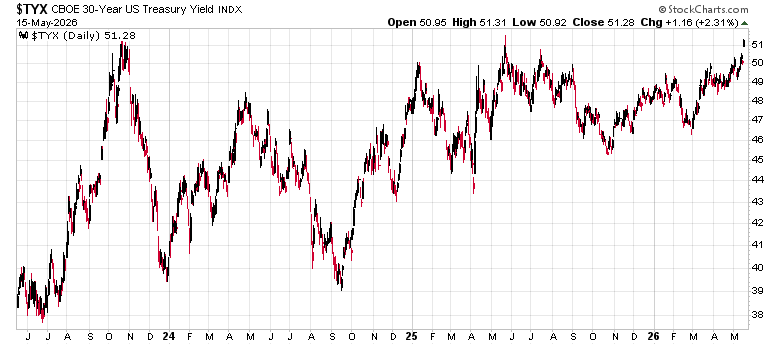
This QE2 (Quantitative Easing #2) capital will fund the US government’s fiscal deficit. Normally when the federal reserve purchases long-dated treasury securities, you would expect the yields of such bonds to decrease, but ever since the last imminent threat of QE2 last October, long-term bond yields have done nothing but rise. The following are 1-year charts of the 30-year and 10-year US treasury bond yields:

If these yields rise further, it affects valuations of other yield-bearing securities since these bonds are considered to be “risk-free”. In addition, the value of companies with long bonds in their portfolios will decline, and companies will be taking comprehensive losses to account for the market value decline in treasury prices.

Will interest rates rise further? Time will tell. Just be prepared for volatility.

It should also be noted that Canadian equivalents are trading at less yield than US counterparts – e.g. the Canadian 10-year note is trading at 3.27%, while the US 10-year treasury note is at 3.43%.

Speech worth reading

Take a moment to read Bank of Canada chief Mark Carney’s speech, Living with Low for Long. It gives some interesting perspective in terms of the macroeconomic and monetary policy side of the economy.

Export-related economies are “unsustainable” – this is a kick at China for sure:

This is an increasingly uneasy emergence. Growth strategies reliant on exports and excess national savings are unsustainable in the long term. In the near term, for many emerging economies, the limits to non-inflationary growth are approaching and the challenges of shadowing U.S. monetary policy are increasing.

US householders are still suffering:

Unfortunately, the best contemporary analogue to the Japanese zombie firms is probably the U.S. household sector. Problems with the foreclosure process, government programs and forbearance by lenders are all delaying the adjustments. Absent more aggressive restructuring, the impact of negative equity on one-quarter of U.S. homeowners will weigh on consumption for the foreseeable future.

Sensitivity of householders to rising unemployment is significant:

The Bank has conducted a partial stress-testing simulation to estimate the impact on household balance sheets of a hypothetical labour market shock. The results suggest that the rise in financial stress from a 3-percentage-point increase in the unemployment rate would double the proportion of loans that are in arrears three months or more. Owing to the declining affordability of housing and the increasingly stretched financial positions of households, the probability of a negative shock to property prices has risen as well.

Apparently if more people adhered to the following quotation, we might not have the 2008 financial crisis:

Similarly, financial institutions are responsible for ensuring that their clients can service their debts.

Makes you really wonder about who’s buying sovereign debt in countries clearly unable to pay it back.

And finally, when rates rise, they may rise very quickly, leading to:

More broadly, market participants should resist complacency and constantly reassess risks. Low rates today do not necessarily mean low rates tomorrow. Risk reversals when they happen can be fierce: the greater the complacency, the more brutal the reckoning.

An interesting speech. Nothing concrete, but you can infer what the Bank of Canada is guessing their tea leaves indicate.

US Thanksgiving Shopping – Amazon vs. Walmart

The USA celebrated their Thanksgiving weekend last Friday, and one tradition they have is buying new stuff. Reading all the stories about the crowds and such always makes for media amusement in what is otherwise a very slow news day.

Some more sober statistics is that retail sales apparently were up 0.3%, while online sales were up a whopping 16% by comparison with respect to last year’s thanksgiving to this one.

One can easily see why people buy stuff online – it is so much easier to compare prices, shipping costs are now baked into the retail price, and you avoid crowds. I think shopping in crowds is a cultural event for a lot of people, in the quest for finding that elusive “great deal” that you can brag to all your friends about after.

This brings me to the subject of the valuation of Amazon (Nasdaq: AMZN), the largest online retailer. They are trading at $177/share, which gives them a market cap of about $80 billion. Amazon’s sales for the past 12 months were $31 billion, and income was $1.12 billion. So on a past 12 months basis, Amazon is trading at a P/E of 71x, or a yield of 1.4%.

Quite obviously, the market expects Amazon to grow a lot to fit into its present valuation. If the analysts are correct, Amazon priced in 2011 projected earnings will have an earnings yield of 1.96%, or 51 times earnings. You have to assume that Amazon will be able to grow their income considerably within a short period of time to begin to match some other firms with comparative valuations. For example, Walmart (NYSE: WMT)’s 2011 valuation has it at 12.1 times earnings, or an 8.3% earnings yield.

For Amazon to fit into this valuation, they will need to increase their bottom line profits by a factor of 5.9 times from what they have currently made over the past 12 months. This is a huge leap and there is obviously growth in the marketplace that can be better purchased elsewhere.

However, in terms of providing retail customers with a venue to shop in, they do an absolutely fantastic job. This is another classic case of a great company having a stock that you would not want to invest in at current valuations.

Food price inflation

It is visibly evident, especially going through the supermarkets, that food prices have been heading up. In light of the fact that commodity prices (e.g. grain, sugar, etc.) have been rising, there is no way that producers can sell the same products and maintain margins without increasing prices.

Reducing the size of packaging has been one approach some companies have been taking – seen with such products such as breakfast cereals, to name one.

This is a function of loose monetary policy and demand for goods – the net result is that everybody is going to have more money, but the purchasing power of that money will be less. It will be nearly impossible for the average member of the public to maintain their purchasing power – you are forced to make a financial decision of some form to maintain it.

The big macroeconomic picture

Sometimes when you step back, get away from the computer for a couple days, and then step forward again, you take a different perspective on things. Such as what to sort through first in an inbox that has 60 unread emails.

I have typically experienced that a hands-off approach works better than a hands-on approach to portfolio – every time you touch your portfolio, you have to be making a correct decision compared to the person on the other end of the trade.

This time when I returned, I noticed that practically all resource and commodity-based equities, in addition to the broad indexes were up. My portfolio received a minor increase, so it is always emotionally difficult to look at everything else go up, but I am buffering that against the fact that I have a risk-adverse portfolio with a significant amount of cash.

The two obvious factors that went on this week was:

1. US Congressional Elections – Republicans take the House, Democrats keep the Senate. My projection here is that the state of the fiscal situation in the US government will not change to a significant degree – there will be massive fiscal deficits for years to come. It will be unlikely that this new congress will be able to restore some sort of fiscal balance. In fact, the decision might be whether to bail out certain states or not, which have accrued liabilities that is far beyond their ability to pay. What is interesting is that the market predicted this result in advance, but there was no significant market reaction.

2. Federal Reserve engaging in potential quantitative easing – they announced a number less than what the market was expecting, but announced it nonetheless.

The big macro issue is that in order to stimulate exports, countries are reducing the value of their currency by pumping more of it into the economy, which you see in the form of government deficits. Since every country that has an export base is doing the same thing, you do not see much of a shift in relative valuation, but you do see a shift in valuations with hard assets, such as commodities and to a lesser degree, equity and debt. This creates a rather volatile situation in the marketplace.

I don’t know how this will resolve itself – my instinct has always been to purchase commodity-linked equities, but it feels like a crowded trade. Cash feels like it is depreciating by the day. Fixed income has valuation and risk/reward issues, especially if/when long term rates increase. Shorting long-term bonds is something to be considered, but doesn’t alleviate the problem of what to do with cash. Income-related securities have also been bidded to the roof, and barring any price corrections between now and year end, one of my 2011 predictions will be that income-related securities will underperform.

The least of what seems to be all ugly options is cash, specifically Canadian currency cash. There are a few reasons for this:

a. You can get a 2% yield on it (retail) or slightly less in institutional amounts (1-year treasuries are about 1.2% right now in Canada).
b. The Bank of Canada is not engaging in quantitative easing. In fact, by smartly increasing short term rates to 1%, they have probably done the whole country a favour.
c. Being a Canadian resident, I am intimately familiar with the country and the Bank of Canada, although I should point out there are three provinces that I have yet to visit.
d. Cash is very liquid and can be deployed at a button click’s notice into something better that appears on the radar.

Ultimately, investing in what you know will be in demand, at a good price is the generic fallback, macroeconomics be damned. But the macro situation is becoming something an investor has to pay very close attention to even with their microeconomic investments. A couple weeks ago I mentioned that some of my research lead me to place orders in two (US-denominated) securities. One of them went above my order price and has not gone back down. The other has been hovering in a range, and I have established a 6% position in.

Besides for this, I continue to watch, although I know my US cash holdings feel vulnerable to depreciation of purchasing power.