Tim Hortons, McDonalds, Wendy’s and branding

Tim Hortons (TSX: THI) dodged a lawsuit concerning the methods that it uses to bake goods and cost allocation between franchisees and the parent company.

The key quotation is the following:

Under what’s known as the “Always Fresh Conversion” several years ago, the company stopped making baked goods from scratch in each location every day, and instead started shipping partially baked items that had been flash frozen before final baking in ovens at all Tims locations every morning.

This “several years ago”, to my own experience was nearly a decade ago. While I was not a huge consumer of doughnuts to begin with, they were good for parties and the like. After they did this conversion I no longer purchased them and notably did not find any substitute products that were baked of sufficient quality that I could go to.

I’m somewhat surprised that Tim Hortons is able to retain such a high amount of customer share despite the perception of product quality being somewhat worse than McDonalds (NYSE: MCD). Financially, Tim Hortons is quite well managed, with them reporting a 2011 fiscal year earnings that was about 11% better in operating income than in 2010 (adjusting from a one-time gain from the sale of their bakery). Their balance sheet is relatively clean, with a year’s worth of income of long term debt.

They do appear a tad expensive, with a valuation of 22.5 times 2011 earnings.

The lesson for investors is that product branding is a very strong intangible asset of a business. It takes more than flash-frozen not-so-fresh doughnuts to turn off consumers and their fast food habits.

I guess my sour grapes is still remembering staring at my computer screen in 2003 and seeing McDonalds trading at $15 a share and thinking that despite its operational woes at the time, the company was worth purchasing. The original parent of Tim Horton’s, Wendy’s (NYSE: WEN) just doesn’t have the allure at current valuations either – their branding is much, much less valuable. Everybody around the planet knows about McDonalds and this is what makes their brand so powerful.

30-year treasury bonds

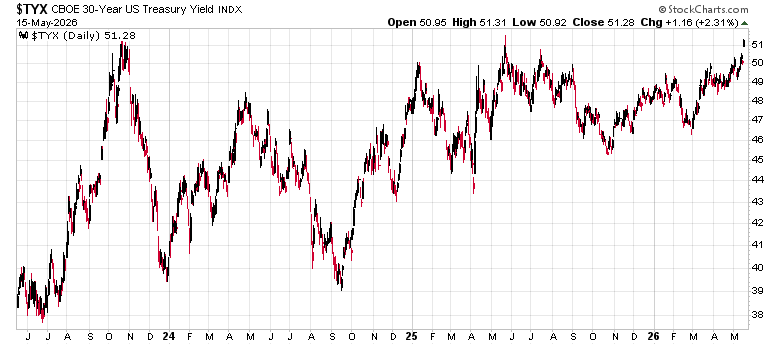
I am so tempted to short 30-year bonds right now. I might soon.

There are a few ways to represent this position:

1. Short bond futures (CME) – this is the world’s most liquid proxy to treasury bonds (other than dealing with the underlying product directly!). It has the advantages of liquidity and dealing strictly with the capital and not income component of the bond.

2. Purchase/short a liquid ETF that deals with long-term treasuries. There are a few to choose from:

- iShares 20-year+ government bond fund (TLT) – MER is 0.15%; average term of bond is 27.8 years – fund is highly liquid and shortable;
- Proshares Ultra/short (2x) 20-year+ (UBT/TBT) – MER is 0.95%; linked to TLT performance above as basis index. UBT is not very liquid, while TBT is very liquid.

ETFs have the advantage of being tradable in smaller amounts than futures (Future contracts are for $100,000 face value of product, which currently trade around 142% of par for the June contract). Futures typically have a spread advantage ($31.25 per $142,000 notional value), but liquid ETFs such as TLT have typically had penny spreads, resulting in comparable slippage. As previously mentioned the futures have an advantage with stripping the income-related aspects of the bond, and also tax advantages (both in the USA and Canada).

Still watching

The S&P 500 continues to make a local high, and commodities except for natural gas appear to be on the rise again.

My examinations continue to be on zero or low-dividend, non-resource, non-financial companies. I don’t have much to report at present.

Playing with numbers – What you can buy with $469 billion

Apple’s market capitalization is $469 billion. Let’s see what you can buy with $469 billion?

Microsoft’s market cap is $257 billion, and Intel is $136 billion. Throw in Dell for some chump change ($32 billion) and you still have $44 billion left to blow on beer and popcorn.

Alternatively if you wanted to go for a more “online model”, you could pick up Google for $199 billion, and throw in Ebay for $43 billion, Yahoo for $20 billion, LinkedIn ($8.5 billion), Amazon for $87 billion and still have $112 billion left to pick up things like Facebook (presently the IPO is not priced yet).

I’m not saying that Apple is a buy or a sell at existing prices, just that its market gigantic market capitalization means it will be facing the law of large numbers, mainly it becomes more and more difficult to increase your size on a constant percentage basis when you get bigger.

Another investment candidate

There are some interesting companies available that do not give out dividends.

I’ve started to build a position in a company that is another leader in its niche, in the $500-$1B market cap range, enterprise value roughly equivalent to its revenues. It is seemingly a bit expensive, trading at about 25 times projected 2012 earnings, but it is in a sector where it will obviously be a growth industry and likely they will be able to increase such earnings over the long run.

The most dangerous investment right now appears to be locking your money up at 2% for 10 years in government bonds. Even cash seems to be better than this.

Yellow Media Q4 projections

I made a pretty good estimation of Yellow Media’s Q3 projections, my range was EBITDA of $160.4M to $175.8M with them achieving an actual of $166.0M.

Modelling Q4, there are two significant factors worth considering. One has to adjust an amount due to the impact of the LesPAC disposition. There may be an impairment expense dealing with the CanPages fallout that will take effect in Q1-2012. A parenthetical note that has to do with the “I” in EBITDA; one has to make a subtle adjustment to the amount of cash interest the corporation is paying – it will be about $7M less due to debt repayments.

In Q3-2011, the corporation did $166.0M EBITDA; in Q4-2010, the corporation did $192.7M, but Trader Corporation needs to be removed from the equation, thus this is adjusted down to $161.3M. This number itself is artificially low because the company expensed the majority of its income trust to corporation expenses in this quarter. With Trader Corporation, the number is $225.2M, and adjusting Trader out of this was $193.8M as a baseline.

Leaving out my distillation which can compete with alchemy, leaves the following projection, which uses a 14% decay and plus or minus 4% for error bounds:

Higher than expectations: $174.4M or above;
Lower than expectations: $158.9M or below.

I also anticipate the company will announce it will convert the Preferred Shares Series 1 into equity, but this should not surprise the market. A potential surprise, and one I cannot predict, is whether the company will suspend preferred share dividends completely – my model shows that in 2013 the company will face a cash crunch if it cannot renew its credit facility as the Medium Term Notes become due. This does not assume any further asset sales.

There becomes a bit of psychology involved. Payment of preferred share dividends will cost about $29M for 2012, and this is assuming Series 1 and 2 convert into equity at the earliest date. If dividends are suspended, the company will save cash flow but this will not be sufficient to pay off the 2013 Medium Term Notes with existing operational cash flow. If the dividends are not suspended then the company will still not make the 2013 MTN payments unless if they can raise cash through an extension of their credit facility or an asset sale.

However, the market perception might be better later in 2012 than it is currently. It is also more likely that it is more likely there would be some sort of recovery if the company paid preferred share dividends than if it did not.

My guess is that the company will continue paying preferred share dividends for this quarter, but I am not completely sure. I do believe the preferred shareholders will become more vulnerable later in the year when Yellow Media tries to renegotiate the credit facility – if their operations are not to snuff, the bank(s) that are willing to lend to Yellow will likely have as a covenant that preferred shareholders cannot be paid unless if Yellow Media is below certain debt coverage ratios.

I also believe management will bring up the idea of doing a reverse stock split, as the dilution after the conversion of Preferred series 1 and 2 will likely keep the stock price below the psychological barrier of one dollar for some time.

This continues to be a high risk, very high potential reward situation if the company gets it right and stems the decay in revenues. However, it will be a long and drawn out battle as it struggles to raise cash to slay its debt albatross. If you assume the company will not go into creditor protection, the unsecured convertible debentures (TSX: YLO.DB.A) has great value, but again, they are trading at 21 cents to the dollar for a reason – you never know if/when they are going to do a pre-packaged CCAA deal, at least if you are not an insider. Since the unsecured convertible debentures are subordinated to the other components of the debt structure, they will likely be offered a pittance compared to the Medium Term Note holders in such a deal, which explains why they are trading at about half of the Medium Term Notes of comparable coupon and duration.