A mental break from the markets

I have been taking a mental break from the markets and will likely continue doing so this week.

The only comment I have is that because of the US fiscal situation (which I will consider to be a crisis), companies that are highly reliant on US government revenues are getting hammered. Some of these may make viable investment candidates and would likely warrant some research attention.

Zarlink hostile takeover

Zarlink Semiconductor (TSX: ZL) is facing a hostile takeover bid. I have no idea whether investors should sell the equity or wait for something sweeter, but the relevance of this for me was that when I was looking at companies to invest in during the peak of the economic crisis, Zarlink debentures came on my radar screen. The debentures were trading at about 40 cents on the dollar back then, while the underlying company was not terribly profitable and seemed to be going along the wrong trajectory.

I was also concerned back then that you had a company which had a market capitalization that was a low fraction of the debt outstanding which would have made capitalizing the debt more difficult if the company went down that route (like Arctic Glacier, which will be condemning its unitholders to dilution purgatory at the end of July).

In retrospect, the decision to not invest was bad compared to some entities I did put my money in, but back in the middle of the economic crisis, capital was scarce and I made other investment decisions. Zarlink was a close candidate but barely did not make the cut.

Now when you look at various investments, the potential returns for risk is depressingly low. Back then you didn’t need to take much risk to get a very handsome potential reward. Today those risks are much, much higher.

Petrobakken short squeeze

For other articles I have written about Petrobakken, you can click here.

A lot of people are asking “Why did Petrobakken go up 14% in a day?”.

The quick answer is because this is a classic short squeeze, fuelled by a cascade of stop orders taking the stock up higher.

We have the following 6-month graph:

Nearly everybody that has invested money in the company is sitting on a losing position. Conversely, those that were short Petrobakken are sitting on money. In order for short sellers to maintain their fraction of PBN, they must be able to add to their short positions. Short interest in PBN has been about 3 million shares since October and about 4.8 million shares in June. Short interest in Petrobank (which owns 59% of PBN) has also been proportionately higher, so one can’t automatically assume that the short position in PBN is hedging off ownership in PBG.

Eventually there has to be a spike as marginal short players have to cover their tracks – it is nearly impossible to tell when this happen, but when they do, the liquidation is swift and sharp:

PBN continues to trade above my fair value estimate and I will continue spectating as I have no position in this or PBG. My guess, from a trader’s perspective is that there is a good probability that we will see one other sharp spike up and then the shares will continue their steady descent down to fair value. The valuation mismatch between today and what it was a year ago, however, is much less than when the shares were trading at $25. The company also still has the material financial issue of figuring out how to spend more money and issuing dividends beyond the cash flow coming in.

Bank of Canada sending out a warning signal

The Bank of Canada kept their target interest rate steady at 1%, but ominously sent out a signal as follows:

Reflecting all of these factors, the Bank has decided to maintain the target for the overnight rate at 1 per cent. To the extent that the expansion continues and the current material excess supply in the economy is gradually absorbed, some of the considerable monetary policy stimulus currently in place will be withdrawn, consistent with achieving the 2 per cent inflation target. Such reduction would need to be carefully considered.

The Greenspan-esque interpretation of the tea leaves will point out that prior wording stated “eventually will be withdrawn” while this press release states that it is approaching if the rest of the financial world does not implode.

When reading the more detailed Monetary Policy Report, two charts came to mind:

Total CPI is increasing significantly – it is no surprise to hear this as commodity prices continue to shoot up like a rocket and prices are passed along the supply chain.

Finally, BAX futures shot down for the year-end interest rate – at 98.46 (1.54%) compared to 98.61 a week ago. This is projecting a near-certainty of a 0.25% rate increase by years’ end.

If short term interest rates rise and the yield curve continues to flatten (10-year rates are still at 2.89% even after the bank rate announcement), this will start to have interesting effects on “yieldy” equities as the leveraged bet starts to become less profitable. There are also implications for the real estate market that I won’t be getting into at this time.

Shaw and Netflix – Bandwidth vs. Content

This is probably old news to a lot of people, but I’m awfully curious how the competition dynamics between Netflix vs. the bandwidth providers (e.g. Shaw/Rogers/TELUS) will play out. Shaw announced a streaming movie service recently.

I look at a company like Netflix (Nasdaq: NFLX) and ask myself how many more legs the company has before it starts to hit a competitive wall like TiVo (Nasdaq: TIVO) did.

I’m not going to call winners here, although I am quite aware that it is necessary for bandwidth providers to exist in order for companies like Netflix to exist; the question is where is the most profit to be obtained in the value chain? Is it about the bandwidth, or the content?

The biggest pure play on bandwidth has to be Level 3 (Nasdaq: LVLT), which has successfully been losing money since its history and is a darling of Southeastern Asset Management and the Canadian Berkshire-equivalent, Fairfax (TSX: FFH).

Time will tell, but I’m sticking to the sidelines.

Microcap fishing – Audiotech Healthcare, Spot Coffee

I have spent the better part of the day doing some screening and research on microcap companies (generally those with market capitalizations of under CAD$50 million). I discarded most of the energy and mineral-type firms as these firms are generally impossible for third-parties to get any sort of edge on.

Finding good microcap companies reminds me of the process of mining for bitcoins – you can spend hours (and days) doing it, but still end up with nothing. That was pretty close to what the last half day of my life feels like.

When doing some intermediate analysis on 9 companies, one managed to clear the necessary thresholds for “interestingness” on my watchlist, although this was not a case that screamed at me as a company that will see 5-fold increases in its equity prices. It would be considered a value play. I set a price target that was roughly 20% under what it was currently trading as this would be a valuation that I would be interested in doing some more extensive due diligence for a potential purchase (although it would be a small allocation if it ever got to that point). I will receive an email if it reaches this price threshold.

However, there were two interesting “discards” that I will share.

The first company is Audiotech Healthcare (TSX: AUD), which operates a few hearing clinics in more remote areas of BC, Alberta and the USA. They are family run and family-controlled and stable and profitable. Their balance sheet is in OK shape, with sufficient cash on hand to cover upcoming debt maturities and otherwise not polluted with massive goodwill (indeed, none). Management is relatively respectful of shareholder value (likely due to its significant economic interest in the company) and related party transactions are at an acceptable level (the worst of it is a dead real estate lease in Calgary which will likely be off the books soon). Valuation is relatively cheap, with recent business performance in the last fiscal year producing $347,000 in free cash flow on a (undiluted) market capitalization of $2.38 million. They are ripe to go private or to be consolidated by a larger player.

Unfortunately, their shares are completely illiquid. With $10,000 in volume traded over the past 30 days, a single trader can probably take the stock price up 50% in a day. Hence, this company is in the “interesting but not practical” list of investment candidates.

The next company that I had to do a double-take on is a little more strange. Spot Coffee (Canada) (TSX: SPP) operates coffee franchises, not too dissimilar from Blenz, Waves, Second Cup and Starbucks, in locations in Western New York state, Toronto and one location in Florida. The only difference is that they appear to be larger scale than the typical Starbucks chains and they also serve slightly more complex food offerings.

What is particularly strange is that when you read the management/director biographies, you ask yourself “What the heck are these people getting into this business for?”. I will post the following from their most recent management information circular and let you come to your own conclusions:

The company itself seems to be financed mostly with equity, with the company raising equity capital through private offerings as the need arises. The last private placement was at 10 cents per share for $500,000 and warrants to purchase shares at 15 cents a piece expiring in 3 years. The current market value is $8.6 million and 13.5 cents per share. Operationally they are losing money, but this is due to the lack of economies of scale associated with having such a geographically dispersed operation and relatively low numbers of operating coffee shops.

Gross profit margins have been improving – the most recent quarter being 73%, which is a good improvement over the previous year. Presumably if they manage to scale up their sales in other locations they can actually start to make money, but I haven’t bothered doing the breakeven calculations. This is investing in an industry that is already well established.

Although I won’t be touching the equity on this company, something makes me suspect that this company might be the recipient of some “hype valuation” if they continue opening more stores, sort of akin to Caribou Coffee (Nasdaq: CBOU).

That concludes my investment research for the day – little to show for it.

Interest rates show nothing exciting

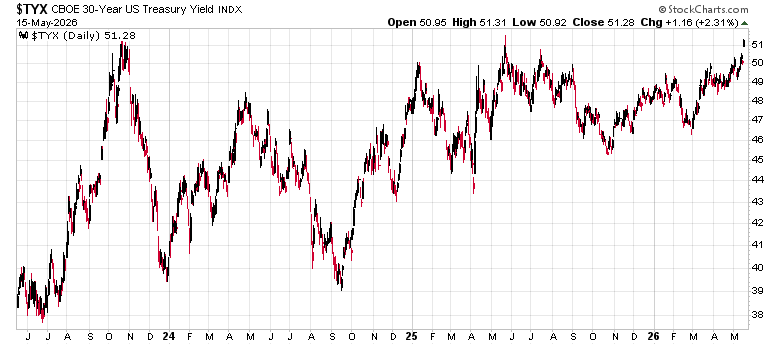
Government 10-year bond yields are sitting at 2.95%:

December BAX Futures are at 98.61; with the current 3-month banker acceptances at 1.20% (98.80), there is a moderate expectation of a 0.25% rate increase. However, I do not believe this will come to fruition and it is highly likely the Bank of Canada will continue to keep the short term target rate at 1% until such time that 10-year yields rise above 3.5%.

Since the markets are awash in liquidity and credit is very cheap, investors will continue to chase yield. When will this party stop? If I gave you a million dollars for 10 years at 2.95%, do you think you can do better? I’d take all the money I could at that rate and fixed term.

Keeping currency conversions factored

It should be on the back of an investor’s mind that the appreciation or depreciation of US currency is a significant factor in commodity pricing – as the US currency as depreciated significantly over the past 10 years, this has lead to disproportionate increases in commodity prices when you scale the charts for Canadian currency. Over the past year, the Canadian dollar has scaled up 10% against the US dollar:

When looking at increases in gold and oil pricing, the change is less dramatic when priced in Canadian dollars:

Spot WTIC Crude in Canadan Dollars

Spot gold in Canadian Dollars

I have been looking at my US dollar exposure and have generally asked myself why I have kept any exposure at all and simply not hedged myself. One reason is that I don’t have a clue how to predict currency movements. There always seems to be more variables at play than one would typically think (interest rate, economic, stability, geopolitical factors to name a few). The other reason is that Canada does 75-80% of its trade with the USA. As long as we have this much economic exposure to the USA, the US currency will always be a relevant factor in a Canadian’s life.

Finally, one might actually think there will be a faint hope and that the USA will get its own domestic economic act together. I know such thoughts are stunning and frightening to even assigning an above-zero probability.

Arctic Glacier – Melting down

A couple weeks after Arctic Glacier (TSX: AG.UN) announced it was diluting existing shareholders roughly 90% by converting $90M of convertible debentures into equity on a company with a (then) $14M market capitalization, they now announced that because of cold weather, sales in the second quarter were low enough to breach their loan covenants for their credit facility.

The company is laden with debt – $90M of convertible debentures outstanding (and will be cashed to equity at the end of July), and approximately $194M in term loans that are first and second-ranking.

I will anecdotally state that to my vantage point in southwestern British Columbia, that this spring has been the coldest I have felt in a long time. While I do not need to purchase ice by virtue of my ownership of a freezer, I have not had the urge to do so for outdoor recreation either, and suspect that many other people are in the same boat. Fortunately for the company, it does business outside of southwestern British Columbia.

Even when you wipe out the convertible debentures and convert them into equity, the term loan leaves a crushing amount of debt for the company given their operations. Their highly seasonal nature makes cash flows lumpy so you have to look at the annual statements to get a good comparison. Operationally the company has seen its cash flows decline significantly over the past few years and it is no surprise that the common shares are trading very unfavourably – 28 cents currently.

This is clearly a distressed situation and the term loan lenders can choose to be very unfriendly to the company. What is likely to happen is that the term lenders will receive some equity stake in the company in exchange for an extension or easement of the loan covenants, coupled with a higher interest bite. Equity investors should be cautious in doing the appropriate calculations to see if there what margin of error they have.

The lesson to be learned here is that when you invest in companies that are heavily capitalized with debt rather than equity, you will run into these sorts of problems eventually if there is any variability in the company’s operations year to year. Investing in the equity of such entities is a high risk proposition and such investment should be compensated appropriately with a high potential reward if things go right.

I have no position in Arctic Glacier, nor do I intend to start any.

FLIR Systems – cooling down

FLIR Systems (Nasdaq: FLIR) is a company that specializes in infrared imaging. Normally I do not examine Nasdaq 100 firms, but given that I have been doing a lot of research on military-related investments this one struck up on my radar some time ago and I did some research on it before putting it on a watchlist.

Yesterday, they announced that their expected revenues and earnings would be under what they had previously guided ($390M revenues for the quarter vs. $410M expected; $0.35 EPS compared to $0.38 EPS expected) due to a slowdown in their government product/services division. They are trading down about 11% from the previous day although you can reasonably infer that well-informed investors caught wind of this between May and June this year.

FLIR’s technology is widely utilized. The company made its breakthrough when it got into the civilian infrared imaging market (opposed to strictly military) and this has opened up new markets. The company is now bound by the law of large numbers with respect to its revenues, so it should generally be considered to be a leading player in a maturing industry. It is still trading a valuation which projects ample growth in the future, but a sign of the maturity of the industry was perhaps when the company decided it was going to declare quarterly dividends earlier this year – currently they are at 24 cents per share per year.

Most good companies have periods of time where their stock prices go through significant corrections before they lead their way up again – purchasing such companies when they go through corrections and temporary operational setbacks is how one outperforms the marketplace. Markets love to extrapolate growth way out into the future, and they also like smoothness of earnings and revenue growth curves – any hiccups along the way and the market loves to punish these companies.

On the flip side, investors in companies that have most of their revenues derived from US government entities should be somewhat worried about the US fiscal situation.

The usual disclosure is that I have no position in FLIR, nor am I interested in it even at existing valuations.