Effect of Egyptian civil disruption

The first geopolitical detonation has happened in the month of January, primarily the overthrowing of the Tunisian government, and the ongoing attempted ousting of the Egyptian government.

My knowledge of that part of the world is very limited, but I do know that part of Northern Africa should affect Europe much more than it would affect Canada or the USA. However, one has to ask themselves what the secondary or tertiary effects of what we are seeing – and right now, I have no idea other than to watch and wait.

I have sufficient idle cash in the portfolio that if the markets decided to crash, I would be relatively well-positioned to start looking for pricing inefficiencies.

Learning to read statements faster than others

First Uranium posted a production report for their last quarter. In the Thursday morning very long release contained the words that all equity investors dread:

The Company’s current cash resources may be insufficient to address its medium-term working capital needs. Accordingly, the Company has retained RBC Capital Markets as its financial advisor to review all funding alternatives.

Nobody appeared to read this paragraph until the opening of trading on Friday when presumably all the analysts released negative reports on the company.

The company’s common stock declined significantly Friday – from about $1.17/share to about $1.05/share presently. What is interesting is that this is purely from the news contained in the Thursday release – so institutional investors and analysts could not interpret the statement until given an evening to doing so.

I sold all the debentures (TSX: FIU.DB) out of my TFSA on Thursday for 80 cents on the dollar, but this was strongly instigated by the report. Most people on Thursday mis-interpreted the report as “steady as she goes” for the company operationally when they likely missed the critical part concerning the future capital requirements.

I also had some debentures in my non-registered account that I jettisoned, but still have some position.

First Uranium will likely have to raise further equity or debt capital to bridge their capital expenditure requirements. After that, presumably their existing Ezulwini mining operation could be cash flow positive. The equity is a high risk, high reward situation that I have not invested in. Depending on how such financing is structured it could be positive for debenture holders (e.g. a straight equity raise), but the company is otherwise restricted in terms of raising secured debt because of an existing agreement with noteholders (of which I own some as well).

Federal Reserve and the long-term bond yield

The US federal reserve today released a “business as usual” statement, leaving their short term rates between 0 to 0.25%. Most relevantly:

To promote a stronger pace of economic recovery and to help ensure that inflation, over time, is at levels consistent with its mandate, the Committee decided today to continue expanding its holdings of securities as announced in November. In particular, the Committee is maintaining its existing policy of reinvesting principal payments from its securities holdings and intends to purchase $600 billion of longer-term Treasury securities by the end of the second quarter of 2011. The Committee will regularly review the pace of its securities purchases and the overall size of the asset-purchase program in light of incoming information and will adjust the program as needed to best foster maximum employment and price stability.

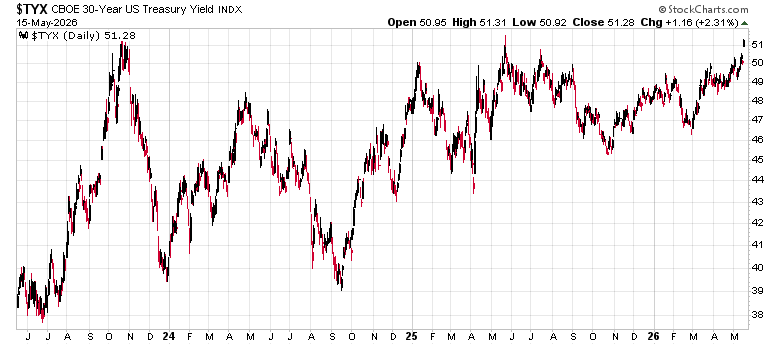
This QE2 (Quantitative Easing #2) capital will fund the US government’s fiscal deficit. Normally when the federal reserve purchases long-dated treasury securities, you would expect the yields of such bonds to decrease, but ever since the last imminent threat of QE2 last October, long-term bond yields have done nothing but rise. The following are 1-year charts of the 30-year and 10-year US treasury bond yields:

If these yields rise further, it affects valuations of other yield-bearing securities since these bonds are considered to be “risk-free”. In addition, the value of companies with long bonds in their portfolios will decline, and companies will be taking comprehensive losses to account for the market value decline in treasury prices.

Will interest rates rise further? Time will tell. Just be prepared for volatility.

It should also be noted that Canadian equivalents are trading at less yield than US counterparts – e.g. the Canadian 10-year note is trading at 3.27%, while the US 10-year treasury note is at 3.43%.

Priszm Income Fund – Specified Defaults

Priszm (TSX: QSR.UN) filed in the documentation pertaining to their bridge loan, and when going through it, came up with the following summary as to what conditions the business defaulted on their senior loan obligation:

I notice that the senior noteholders are three related companies – The Prudential Insurance Company of America, Pruco Life Insurance Company and the Prudential Retirement Insurance and Annuity company. Whoever was the investment manager that picked Priszm for investment isn’t feeling too good right now – and presumably forced to sinking in $4M more into this train wreck in order to salvage the remainder of their investment.

The subordinated debentures (TSX: QSR.DB) traded down today to about 20 cents on the dollar as investors question their sanity for putting money into this venture. To figure out if there is any value left, one has to figure out whether management’s motivation is to eventually resurrect the company, or to generate a tax-loss write-off that works in their own favour (and not necessarily investors). One thing that I believe is virtually guaranteed is that the units are nearly worthless.

Disclosure: I own $200 market value of debentures, which I still believe offers a better payoff ratio than the upcoming Lotto MAX.

Equal Energy debentures – a lock at par

When a company rolls over its debt and extends the maturity, a call on the previous debt is not too far away. Equal Energy (TSX: EQU.TO) announced a bought deal for $45 million in face value of debentures, with a 6.75% coupon, maturing in just over five years (March 31, 2016) and a conversion premium of approximately 40% over common share price ($9/share).

They have two debenture issues on the marketplace, $80M maturing December 31, 2011 (TSX: EQU.DB) and $40M maturing June 30, 2012 (TSX: EQU.DB.A). Both of these have a conversion price well over the price of the common shares.

Most importantly for existing holders is the current phrase in the press release:

Proceeds from the offering will be used to retire a portion of the 8.00% convertible unsecured subordinated debentures due December 31, 2011 (the “8.00% Debentures”). Equal intends to call the 8.00% Debentures for redemption as soon as practical. The Company intends to fund the balance of the redemption cost of the 8.00% Debentures from its operating bank line.

Closing of the offering is expected to occur on or about February 9, 2011. The offering is subject to receipt of normal regulatory approvals, including approval of the TSX.

The company has been clearing away its debt at a fairly rapid pace over the past couple years and has sufficient room in its line of credit to pay off the debentures (currently $115M of room at a relatively low rate of interest). It is likely to assume that December 2011 debenture holders can expect a call by around mid February of the year. They will receive 102.5 for the debt. Investors paying this amount would receive interest at a minimum or about a 5% YTM, while investors paying less than 102.5 will receive a higher short term reward assuming a call. There would be a minimum of 30 days notice for a call and a maximum of 60 days.

The June 2012 debentures are a little more complicated – on July 1, 2011 they can be redeemed for 102.5 cents on the dollar, and 105 cents on the dollar before. So management will likely redeem these on July 1, 2011.

I own the December 2011 debentures, purchased during the economic crisis in 2009 at a price that made me wish I bought more of them compared to alternatives at the time. I am also finding it difficult to reinvest this capital in other ventures with similar risk-reward profiles.

The Priszm Income Trust soap opera continues

I have been writing a lot about Priszm Income Fund – a horribly broken trust going through massive financial restructuring.

Today, they announced:

TORONTO, Jan. 19 /CNW/ – Priszm Income Fund (TSX: QSR.UN) (“Priszm” or the “Company”) reported today that the Company has executed a forbearance agreement to extend the maturity date of its senior debt facility, including the payment of all interest accrued but unpaid to January 31, 2011. In addition the senior debt lender will temporarily suspend action to exercise its remedies for the Company’s defaults in respect of the existing terms of its senior debt facility. As part of the agreement, the Company is not permitted to make payments in respect of obligations that are subordinated to the senior debt facility, other than those relating to the direct operation of the business in ordinary course.

The senior debt lender and the Company also executed a separate short-term financing agreement that provides the Company a supplemental facility of up to $4 million to ensure the business has sufficient liquidity to continue operations while a longer-term plan is developed. The facility bears interest of 10% per annum with a maximum one draw per week and matures January 31, 2011.

Translating this into English, the company received a $4M bridge loan in exchange for the creditors not pushing the company into bankruptcy. As part of this loan, the company cannot make payments to subordinated obligations, which would also include the subordinated convertible debentures, amongst other things.

After my January 8, 2011 post regarding the convertible debentures (TSX: QSR.DB), I entered into the market on January 10 and bought $20k face of the debentures at 19 cents on the dollar. My expectations were that the debentures would settle at a value of around 30-35 cents on the dollar. I was aiming for a bit more size on the position, but QSR.DB is illiquid and I did not catch many liquidators on the bid. Today, I sold $19k face for an average of 21.95 cents on the dollar, approximately a 9% gain over my January 10th purchase. After commissions, this will pay for a few sushi dinners. I still hold $1k face value (approximately $230 market value) for entertainment and educational purposes – I want to see how this drama resolves itself. There is also a very slight (and I emphasize very slight, as in less than 5%) chance that the debentures will be redeemed at par by June 2012.

My theory about the valuation of the company changed significantly after some subsequent research and deeper analysis – when the company announced it was exploring a “sale of all assets”, any cash flow generation would have been likely gutted out of the company, leaving purely administrative expenses associated with running a publicly traded company. The company does not have a massive amount of future tax assets which ordinarily gives such unprofitable operations some market value. Assuming the $200k/franchise level that was achieved in the previous sale applied across the 200 remaining franchises would have rendered the company with approximately $40 million further cash, which would have not been enough to pay liabilities, let alone the debentures.

When you bake in costs of restructuring and/or bankruptcy, there is not much value in the debentures – they will likely be given some sort of settlement offer at a deep discount to face value to get them out of the way. This is when I will get rid of the other $1k face value I own.

Minimum needed to invest in stocks

I do note with amusement that a former Member of Parilament’s “real estate bubble” website is advocating some strangely risky financial strategies. Apparently he has forgotten that ETFs derive their value from their underlying holdings, which contain precisely the amount of risk that he declares that people with only a million dollars and above should be engaging in. Here’s my phrase of the day: Diversification is for investors that don’t know where to find value. Diversification also does not mitigate against systemic risk, as most investors in the second half of 2008 discovered.

If your portfolio size is a modest fraction of annual after-tax income, putting all your eggs in a single basket (i.e. putting it all on a very well-researched company) is an acceptable strategy if one believes in maximizing both their risk and reward. As the portfolio size appreciates above annual income, maximum position sizes need to be trimmed down to avoid what I call “blowup” risk, but financial academics call unsystematic risk. With commissions as low as they are, people can invest reasonably with as little as $5k – with $10 commissions, you can diversify into five positions with a 1% expense ratio, or better yet, choose two and keep your expense at that of a typical index fund.

Especially for young people, it is vitally important to learn how to lose money in the public marketplace before making money – making mistakes that cost you 20% of your portfolio means a lot less when you have $5k in the account than $500k. You learn exactly the same lessons, but with a lot less money.

The worst thing that can happen to a beginning investor is that their first three trades are wildly successful.

Continuing to divest

One of the tricks that you learn in the marketplace over a decade of experience is that you make money by buying when things go lower, and sell when things go higher. It sounds awfully cliche, but doing this correctly is an art and will never be a science – sometimes the markets do something “crazy”, and taking advantage of craziness is how you make a substantial sum of outsized gains – whether it is buying at a crazy low, or selling at a crazy high.

While I would not call present conditions crazy, I do consider them frothy and have been lightening up positions since the beginning of September. Having a high fraction of the portfolio in cash is always boring, but I am fairly firm in my belief that cash will be outperforming most asset classes after the winter is done. There is just not enough reward out there for the risk. I still have enough in the market to participate in further gains and to profit in case if things do become “crazy”.

Until then, I wait. Boring, boring, boring.

Canadian Tax Expenditures and Evaluations Report

The Ministry of Finance released their Tax Expenditures and Evaluations Report for 2010. Although this reading is quite technical for most people, there are a few takeaways in terms of the changes of government tax policy.

For large corporations:

Due to corporate tax reductions, retained earnings and equity will be the most efficient way (with respect to total tax burden) to raise capital, although it is very close with raising debt capital. In the USA, equity is much more expensive than debt, mainly due to deductibility of interest (while dividends are punished by relatively high rates of taxation).

On small business corporations:

Equity and retained earnings remain cheaper than debt financing, once again due to low tax rates. When factoring in the lifetime capital gains exemption for the sale of eligible small business shares, the total tax burden decreases even further.

Further in the report is an interesting analysis on the elasticity of tax rates and actual reported tax collections.

Bank of Canada holds steady

The Bank of Canada holds the overnight target interest rate steady which resulted in a very mild decrease in the Canadian dollar as traders positioned themselves when reading the language in the statement.

Specifically:

Underlying pressures affecting prices remain subdued, reflecting the considerable slack in the Canadian economy. Core inflation is projected to edge gradually up to 2 per cent by the end of 2012, as excess supply in the economy is slowly absorbed. Inflation expectations remain well-anchored. Total CPI inflation is being boosted temporarily by the effects of provincial indirect taxes, but is expected to converge to the 2 per cent target by the end of 2012.

This is “fed speak” that is likely “We’re not going to do anything on our next meeting as we see how things unfold.”

BAX Futures have nudged slightly up in reaction to the statement:

Month / Strike Bid Price Ask Price Settl. Price Net Change Vol.
+ 11 FE 0.000 0.000 98.590 0.000 0
+ 11 MR 98.620 98.625 98.575 0.050 23240
+ 11 AL 0.000 0.000 98.520 0.000 0
+ 11 JN 98.380 98.390 98.350 0.040 29808
+ 11 SE 98.150 98.160 98.140 0.020 14591
+ 11 DE 97.940 97.950 97.940 0.000 13813
+ 12 MR 97.770 97.780 97.780 -0.010 6012
+ 12 JN 97.630 97.640 97.640 -0.010 1493
+ 12 SE 97.250 97.580 97.520 -0.010 814
+ 12 DE 97.350 97.410 97.370 -0.010 36

I still maintain that long-term rates maintain much more relevancy – 10 year benchmark bond rates are at 3.25%, and it is likely that in order for the Bank of Canada to raise short term rates that the long-bond will need to go higher. It is my guess that the BOC has a silent objective to keep a 2-2.5% yield spread between short term and 10-year rates.